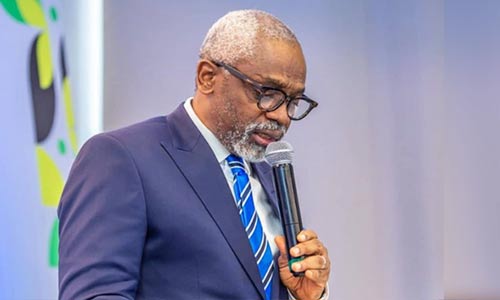
The Chief of Staff to President Bola Tinubu, Femi Gbajabiamila, has said Nigeria can no longer rely solely on a single centrally controlled police institution to address the country’s increasingly complex security challenges, insisting that the existing policing structure has been stretched beyond reasonable capacity.

Gbajabiamila spoke on Monday in Port Harcourt, Rivers State, during a special session at the 66th Annual General Conference of the Nigerian Bar Association, titled “NBA Takes The Mic: Who Polices Nigeria?”
Delivering President Tinubu’s message to the legal community, Gbajabiamila said the administration was determined to address what it considers a structural weakness in Nigeria’s security architecture.
“A country of our size and diversity cannot continue to depend on a single centrally commanded police institution for all its policing needs,” he said.
According to him, the current arrangement has been “stretched beyond what any institution can reasonably carry,” particularly given Nigeria’s population, geographical size and varying local security challenges.
Gbajabiamila noted that Nigeria’s policing structure differs from that of other federal systems such as the United States and Canada, where responsibilities are shared between federal and subnational policing institutions.
He said the constitutional prohibition against state police had left Nigeria attempting to respond to widely differing local security realities through one national command structure.
The President’s Chief of Staff argued that delaying reform was no longer sustainable.
“Further postponement is itself a choice. It is the wrong choice, and citizens have carried its consequences for long enough,” he said.
Gbajabiamila, however, stressed that the push for decentralised policing should not be interpreted as an indictment of officers of the Nigeria Police Force, many of whom he said continue to serve under difficult conditions.
He maintained that their commitment and sacrifice were, in fact, reasons why structural reform had become more urgent.
“Their sacrifice makes reform more urgent, because courage should not have to compensate indefinitely for structural weakness,” he stated.
According to him, a dual policing structure would allow states that possess the willingness and capacity to establish their own police services while retaining a strong federal police institution responsible for national, interstate and other constitutionally assigned security responsibilities.
Gbajabiamila disclosed that Nigeria currently has approximately one police officer to every 650 citizens, compared with what he described as the widely accepted international benchmark of about one officer to every 450 people.
He said the manpower deficit further illustrated the difficulty of asking a single national police organisation to respond effectively to every security challenge across the federation.
Addressing concerns that state police could become instruments of political intimidation in the hands of governors, Gbajabiamila said the proposed framework would contain strong constitutional, institutional and accountability safeguards.
“No governor should possess the personal power to order the arrest of an opponent, stop an investigation, disperse a lawful meeting or direct how officers act in an election,” he said.
He maintained that decentralisation must therefore go together with professional standards, independent oversight, accountability mechanisms and constitutional protections designed to prevent abuse.
Gbajabiamila also disclosed that both chambers of the National Assembly had approved constitutional amendments intended to create a framework for federal and state police services.
He explained that because the proposal requires constitutional amendment, it must also secure the approval of at least 24 State Houses of Assembly before it can proceed to the President for assent.
The reform, if ultimately adopted, would fundamentally alter Nigeria’s policing architecture by allowing subnational governments to establish police services while preserving federal policing responsibilities.
Gbajabiamila urged members of the legal profession to play an active role in developing the framework, stressing that the success of decentralised policing would depend significantly on the quality of the laws and safeguards establishing it.
He noted that the Nigerian Bar Association is represented on both the Presidential Working Group and its Policy Advisory Committee, giving lawyers a direct opportunity to contribute to the design of the proposed system.
The Chief of Staff said the objective was not merely to multiply police institutions but to develop a structure capable of responding more effectively to local security challenges without compromising citizens’ rights or creating avenues for political abuse.
His remarks come amid an intensifying national debate over the establishment of state police, with supporters arguing that localised policing would improve intelligence gathering and response times, while critics have repeatedly raised concerns about possible abuse by state political authorities.
Gbajabiamila maintained that such concerns should be addressed through carefully designed constitutional safeguards rather than used as a reason to indefinitely preserve a policing structure that, in his view, no longer adequately reflects Nigeria’s size, diversity and security needs.
[A MUST HAVE] Evidence Act Demystified With Recent And Contemporary Cases And Materials

Available now for NGN 40,000 at ASC Publications, 10, Boyle Street, Onikan, Lagos. Beside High Court, TBS. Email publications@ayindesanni.com or WhatsApp +2347056667384. Purchase Link: https://paystack.com/buy/evidence-act-complete-annotation
______________________________________________________________________ “Enhance Legal Practice With Authoritative Reports” — Alexander Payne Offers Comprehensive Law Reports, Spanning Over A Century Of Nigerian Jurisprudence Interested buyers are encouraged to place their orders and enquiries via:
0704 444 4777, 0704 444 4999, 0818 199 9888
Website: www.alexandernigeria.com
Interested buyers are encouraged to place their orders and enquiries via:
0704 444 4777, 0704 444 4999, 0818 199 9888
Website: www.alexandernigeria.com