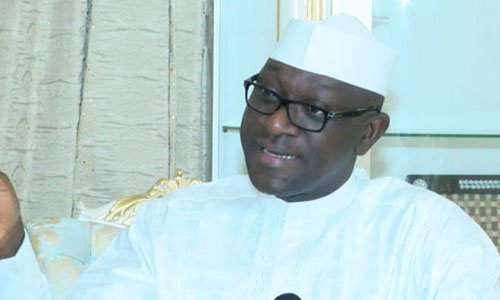
A member of the House of Representatives from Kano State Hon. Abdulmumin Jibrin has defended the public burning of red caps associated with the Kwankwasiyya movement, describing it as political self-defence, and declined repeated invitations on live television to condemn the act.

The lawmaker, a former chairman of the House Committee on Finance and of the Committee on Appropriations, and presently chairman of a housing subcommittee, spoke on Channels Television’s Politics Today, days after presidential candidates and party chairmen signed the National Peace Accord committing themselves to reject inflammatory and provocative conduct.
Asked about the incident, in which he acknowledged being present, the lawmaker said his side had responded rather than initiated.
“We didn’t start this, and it has always been a strategy of intimidation,” he said. “More often than not, if you do not retaliate in a situation like this, the next thing again they will take it to another level.”
He said the person seen in the video that triggered the sequence was not an ordinary member. “He is a leader of the Kwankwasiyya movement, a very known personality, a respected personality in the community, that went to supervise that. And it is not only about supervising it. They actually said they are launching. So he’s directing their supporters to now go ahead and do the same act in every corner of the zone.”
He described the response as unavoidable. “As politicians, sometimes we do tit for tat, and we got to know late in the night, and by morning our supporters… the only way you could calm down the APC supporters, the supporters of the president in Kano, the supporters of the governor in Kano, was to… in fact, that is the minimal of what can be done. If we hadn’t even done that, only God knows what would have happened.”
Pressed on whether his side had purchased the caps in order to burn them, the lawmaker said they belonged to defectors.
“No. A lot of members were being lined up that were supposed to be received into the APC from the Kwankwasiyya movement. They are supposed to be received into the APC next Monday. So what we did was to invite all of them to come. They came there. They are the supporters that you are seeing there. They came en masse from the Kwankwasiyya NDC movement to the APC. And so it is their caps that you are seeing there that were all put, and they willingly allowed it to be burnt.”
Asked what the act signified, he redirected the question. “I think it is better you ask those who started it. Ours was that we just retaliated,” he said, naming the individual he said had begun the sequence and asking what that person had been trying to achieve “by burning the cap with the symbol of the president and the governor.”
He continued: “Then secondly, burning the broom, the symbol of the APC. It’s provocative. But we didn’t even burn the symbol of the NDC. We were cautious. We didn’t burn the symbol of the NDC. All we did was that of the Kwankwasiyya. So we tried to manage.”
Asked whether his side would continue burning caps if the other side did, the lawmaker answered directly.
“Absolutely, without any iota of doubt,” he said.
Put to him that politicians had just signed an accord committing themselves to reject inflammatory and provocative conduct, and asked how public burning of a rival movement’s symbol fits the politics Nigeria says it wants in 2027, he replied with an analogy he returned to repeatedly.
“When somebody comes with a knife and he’s trying to cut off my neck, what do you want me to do? To hold it and push it back?” he said. “So we are not the ones creating problem. We don’t make problem. We don’t create trouble. We don’t look for trouble. All we do is that we just campaign. We’re minding our business. We don’t throw abuses at them.”
He added: “We will retaliate, because we will not allow anybody to ridicule our president or our governor or our party. We will never allow that.”
Asked to condemn the burning of the caps for the sake of peace, the lawmaker declined.
“Well, for now I will have to go and consult with our supporters,” he said. “We have a large, large number of supporters who are very angry until this moment. Extremely upset, very upset. And we’ve been going around trying to calm them down. You have no idea what we had to do between the day before yesterday and this morning to ensure that peace reigns.”
Asked again whether the conduct was bad political behaviour, he answered with a question. “So what do you think we should do? We should allow them to continue to burn our caps?”
Pressed a third time, he said: “I’m answering you with a question. What will you do when someone comes to your house trying to stab you with a knife? Will you just say, oh, I condemn that action? You protect yourself. You defend yourself.”
Told that his response amounted to answering violence with violence, he rejected the characterisation. “No. Self-defence is that. That is self-defence. In politics, that is self-defence. Show me one place where we looked for trouble. But you want us to sit down and fold our hands and you ridicule the president?”
Asked whether the original act was bad conduct, he drew a distinction. “When somebody comes to attack you and you defend yourself by attacking him, what he was trying to do is wrong, but what you did is right.”
Put to him that wrong plus wrong does not make right, he replied: “You’ve taken it to mathematics. I know we are not going into econometrics here. It’s simple and straightforward. In politics, we were provoked. And it was something symbolic and it could have a huge psychological effect. And by now, if there wasn’t retaliation, everybody in the country would have been saying, oh, the president has no supporters in Kano.”
The lawmaker said he had told the gathering at which the caps were burnt that the other side expects defeat.
“They know they are going to lose the election,” he said, adding that this is particularly so in Kano South, which he described as a key swing zone. “There is no how, there’s nothing they can do on earth to win Kano South.”
He said the timing was deliberate. “I think it is a deliberate thing they did just a day before the commencement of campaign, to start up a crisis and to create confusion. But we’re not going to give room for that.”
The burning of the red cap, the signature symbol of the Kwankwasiyya movement founded by the former Governor Rabiu Musa Kwankwaso, is a recurring form of political protest in the state, and it carries particular weight because wearing the cap signifies loyalty to that political philosophy. Setting it alight in public is an intentional signal of rejection of the movement’s leadership and of the end of an alliance.
The practice was first prominently recorded in April 2014, when political youths loyal to the former Governor Ibrahim Shekarau gathered in the Tudun Wada area of Kano for an event tagged “Bukin kona jan hula,” the party to burn red caps, in protest at the Kwankwaso administration and his defection to the All Progressives Congress.
In September 2018, members of a tricycle riders’ association converged at the Sani Abacha Stadium to burn the caps amid localised political shifts.
The most recent incident, in August 2026, saw youths in the Kiru local government area burn the caps in a protest that circulated widely online, following political friction over Kwankwaso’s decision to support Peter Obi for the 2027 presidential race.
Beyond the caps, the lawmaker defended the administration’s record in the state, citing road construction, classrooms, health centres and what he said were more than forty federal appointments given to Kano, and arguing that a communication gap rather than absence of performance had shaped public perception.
Challenged on figures placing 63 per cent of Nigerians below the national poverty line and 27 million facing food insecurity, he questioned the framing. “Can you give me the statistics of the number of people that have been put out of poverty?” he asked, describing the line of questioning as a critique rather than an appraisal.
On the controversy over the President’s academic records, he said the matter “has been a subject of litigation for decades and over time the president has won severally in court,” adding that “the best persons to make comment about this matter are the lawyers that are involved in the matter.”
He closed with a prediction. “Go and write it. President Tinubu will be sworn in for a second term.”
[A MUST HAVE] Evidence Act Demystified With Recent And Contemporary Cases And Materials

Available now for NGN 40,000 at ASC Publications, 10, Boyle Street, Onikan, Lagos. Beside High Court, TBS. Email publications@ayindesanni.com or WhatsApp +2347056667384. Purchase Link: https://paystack.com/buy/evidence-act-complete-annotation
______________________________________________________________________ “Enhance Legal Practice With Authoritative Reports” — Alexander Payne Offers Comprehensive Law Reports, Spanning Over A Century Of Nigerian Jurisprudence Interested buyers are encouraged to place their orders and enquiries via:
0704 444 4777, 0704 444 4999, 0818 199 9888
Website: www.alexandernigeria.com
Interested buyers are encouraged to place their orders and enquiries via:
0704 444 4777, 0704 444 4999, 0818 199 9888
Website: www.alexandernigeria.com