The Academic Staff Union of Universities has expressed serious concern over Nigeria’s electoral system, alleging that elections in the country are routinely manipulated and warning that political violence, thuggery and killings could worsen ahead of the 2027 general elections.

ASUU President, Prof. Christopher G. Piwuna, made the remarks on Friday during a press conference at the University of Jos titled, “Nigeria Universities and Nigeria Today: Our Worries, Our Propositions.”
Piwuna argued that elections ought to provide citizens with a peaceful and democratic means of rejecting poor governance and choosing leaders of their preference, but alleged that the Nigerian electoral process had become so compromised that citizens could no longer confidently rely on it.
“There is no election in Nigeria. How Nigerians would resist these obnoxious policies? The most democratic way to resist obnoxious policy is through election to get the right people,” he said.
“You and I know that we don’t have election in Nigeria. We all know. In Nigeria, if you want to win election, you must have the court. That is what we are seeing and it is so flagrant.”
The ASUU President said Nigerians must continue to speak against what they consider bad governance and should not allow fear to prevent them from demanding accountability.
“We will continue to have conferences and when there is need to street, elections will not change in this country at the rate we are going. It is resistance that will change it,” Piwuna said.
“We must continue to call them out. We must say what they are doing is not right. Nigerians must continue to speak about bad governance. We must not be afraid. We are already dying.”
The union also described the political class as a major threat to the country’s security, warning that the growing incidence of political killings, thuggery and pre-election violence could push Nigeria towards a deeper crisis as the 2027 elections approach.
ASUU maintained that attempts to manipulate elections in favour of particular candidates were dangerous to democratic stability and called on Nigerians to resist electoral malpractice through lawful civic engagement.
Beyond electoral issues, the union also raised concerns about the welfare of university lecturers and what it described as the Federal Government’s failure to fully implement outstanding financial commitments to academic staff.
Piwuna lamented the non-payment of three-and-a-half months’ salaries allegedly still owed to members of the union, as well as delays in the payment of the 25/35 per cent wage award and promotion arrears.
He said the outstanding payments remained unresolved despite what he described as sacrifices made by university lecturers in the interest of the country and the stability of the university system.
The ASUU President also revisited the December 2025 Federal Government-ASUU Agreement, which he said had initially been regarded as a significant step towards reducing persistent disputes between government and academic staff in federal and state universities.
According to him, the agreement was expected to provide a new foundation for stability, growth and improved working conditions within the Nigerian university system.
He, however, expressed dissatisfaction with what he described as the haphazard implementation of the agreement, warning that failure to honour agreed commitments could again generate tension within the university system.
ASUU also criticised the Tertiary Education Trust Fund over its approach to selecting universities that can benefit from local postgraduate training under the Academic Staff Training and Development programme.
The union said it was uncomfortable with TETFund’s classification of institutions into what it described as “tenable” and “non-tenable” universities for the purpose of sponsoring academic staff for local postgraduate studies.
ASUU argued that such a policy could create inequalities among universities and affect opportunities available to academic staff seeking further training and development.
The union therefore called for reforms not only in the university system but also in Nigeria’s broader governance and electoral institutions, insisting that sustainable national development would require credible elections, accountable leadership and greater commitment to the welfare of citizens and public-sector workers.
[A MUST HAVE] Evidence Act Demystified With Recent And Contemporary Cases And Materials

Available now for NGN 40,000 at ASC Publications, 10, Boyle Street, Onikan, Lagos. Beside High Court, TBS. Email publications@ayindesanni.com or WhatsApp +2347056667384. Purchase Link: https://paystack.com/buy/evidence-act-complete-annotation
______________________________________________________________________ “Enhance Legal Practice With Authoritative Reports” — Alexander Payne Offers Comprehensive Law Reports, Spanning Over A Century Of Nigerian Jurisprudence Interested buyers are encouraged to place their orders and enquiries via:
0704 444 4777, 0704 444 4999, 0818 199 9888
Website: www.alexandernigeria.com
Interested buyers are encouraged to place their orders and enquiries via:
0704 444 4777, 0704 444 4999, 0818 199 9888
Website: www.alexandernigeria.com
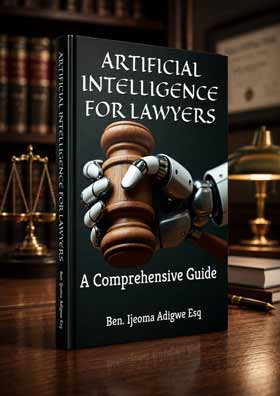 The book also examines Nigeria's legal ecosystem, focusing on the LPELR and NBA AI Guidelines. As a bonus, every purchase comes with a FREE eBook titled: How to Use the AI Features in LegalPedia and LawPavilion.
Ohio Books Ltd praises the publication, stating:
"....this is the only Nigerian book I know of on the topic."
How to Order:
📞 Call, Text, or WhatsApp: 08034917063 | 07055285878
📧 Email: benadigwe1@gmail.com
🌎 Website: www.benadigwe.com
Ebook Version: Access it directly online at https://selar.com/prv626
Authored by Ben Ijeoma Adigwe Esq., ACIarb (UK), LL.M, Dip. in Artificial Intelligence, Director at the Delta State Ministry of Justice, Asaba, Nigeria.
______________________________________________________________________
The book also examines Nigeria's legal ecosystem, focusing on the LPELR and NBA AI Guidelines. As a bonus, every purchase comes with a FREE eBook titled: How to Use the AI Features in LegalPedia and LawPavilion.
Ohio Books Ltd praises the publication, stating:
"....this is the only Nigerian book I know of on the topic."
How to Order:
📞 Call, Text, or WhatsApp: 08034917063 | 07055285878
📧 Email: benadigwe1@gmail.com
🌎 Website: www.benadigwe.com
Ebook Version: Access it directly online at https://selar.com/prv626
Authored by Ben Ijeoma Adigwe Esq., ACIarb (UK), LL.M, Dip. in Artificial Intelligence, Director at the Delta State Ministry of Justice, Asaba, Nigeria.
______________________________________________________________________