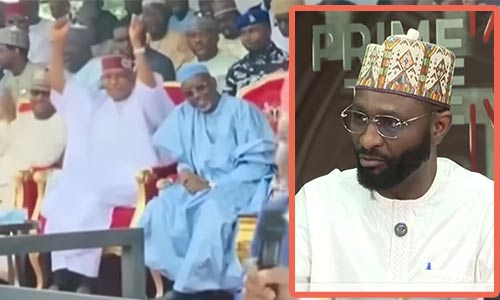
A policy strategist and group Chief Executive Officer of the Global Investment and Trade Company, Malam Baba Yusuf, has said that the reaction of the governors and political leaders seated at the Kano gathering where Sheikh Yahaya Jingir spoke was more troubling than the remarks themselves, and that their continued silence days afterwards is heartbreaking.

Yusuf spoke on Arise Prime Time alongside Dr Emmanuel Nkanta, Deputy Director of the Catholic Policy Research Institute, the Kukah Centre, and a peacebuilding and interreligious dialogue specialist, in a discussion of the cleric’s endorsement of a Muslim-Muslim ticket and his language about religious numbers.
The programme reported that Sheikh Jingir had thrown his weight behind the Muslim-Muslim ticket, praised President Bola Tinubu for championing the arrangement, and urged Muslims to obtain their permanent voter cards and mobilise politically behind Muslim-Muslim candidates.
Speaking at a political gathering in Kano attended by Governor Abba Kabir Yusuf of Kano State, Governor Dikko Umaru Radda of Katsina State, Governor Umar Namadi of Jigawa State and other political leaders, the cleric argued that Muslims constitute the majority and urged his audience to show “the infidels” their limit, language critics say risks converting a political contest into a religious confrontation.
The comments have drawn condemnation from figures including the former aviation minister and ambassador designate, Femi Fani-Kayode, and the former sports minister, Solomon Dalong, who warned against reducing democracy to a contest of religious numbers. The leadership of the Northern Christian Association has also expressed concern, particularly over the use of the word “infidel,” arguing that the rhetoric goes beyond campaigning and becomes inflammatory.
Asked what the description of fellow citizens of another faith as infidels does to the idea of a common Nigerian identity, Yusuf opened by stating his own position.
“I am a Muslim, and I say clearly, no to religious extremism. No to vitriol, bitter narrative by leaders, especially religious leaders,” he said.
He then distanced the wider Muslim community from the cleric’s words. “I will say this emphatically: Sheikh Jingir’s statement belongs to him and his belly and his pockets, because this is not what we expect from leaders even in a political cycle.”
He described the remarks as dangerous coming from a figure of that standing. “This statement is demagoguery. It risks religious bigotry, and a leader of that stature, by age, by his standing in society and the length of time he has been an Islamic cleric, should know that just a word from him can sink this country. So to that extent it is completely unacceptable.”
He added: “I dare say, and I stand to be corrected, that the majority of Muslims are not with this kind of irresponsible statement.”
Reminded by the anchor that three governors were visible in the video of the event, Yusuf said that was precisely the part that disturbed him most.
“I was heading there. What is more ominous for me was, I was scanning the background to see the reaction of the governors sitting and other political leaders and society leaders, their facial expressions, their demeanour. And what I saw, for me, was worse than the statement of Jingir.”
He said the failure to respond since then compounds it. “What is more heartbreaking is hours and hours and days later and counting, there is no counter position taken by political leaders to assuage the feelings of our brothers and sisters within the Muslim community and across the religions, particularly in this case the quote unquote people that are called infidels.”
He described the scene in a country where the word had been used publicly. “For the leaders that are sitting there and smiling away, I wonder what is going on in the mind of the First Lady of the Federal Republic of Nigeria, who is a Christian, and the President himself, whose oldest son at the moment is a Christian. So he is having a diverse home and running a diverse government. How is he feeling with this man that has called people infidels, and why, because he is trying to oversell a Muslim-Muslim ticket?”
He said the episode had changed his own assessment of the political class. “If we really want a united Nigeria, we should go beyond this. I didn’t know that the politics is so rotten till I saw this, because I expected a position to be taken to counter this.”
The exchange led the anchor to frame the question as one about what politicians are willing to trade for advantage, and Yusuf agreed that this is the central issue.
Pressed later on what he expected of political actors, he said the presidency, the ruling party and other leaders should publicly distance themselves from rhetoric of that kind.
Asked what responsible Muslim and Christian leaders should now be telling their followers, Yusuf argued that ordinary citizens are the ones who bear the cost of divisions manufactured above them.
“Christians and Muslims and even free thinkers in this country should realise that at the political level there is no division. They strike together. They loot this country and plunder it together, including some religious figures who collaborate with them,” he said.
Challenged by the anchor over whether he had evidence for that characterisation, and told that he should not point a finger without knowing, Yusuf did not withdraw it. “This didn’t start today, Charles. It started pre-2023, from this Muslim-Muslim conversation to this antagonistic behaviour. So I think even if he wants to sue, I stand by what I said.”
He continued: “At the generality of the populace, these differentials are injected to continue fomenting division, while the Christians and Muslims at the top level, even the ones that fight tooth and nail, whether it is Peter Obi, Atiku and Tinubu, don’t be surprised, some years again they will come and hug each other while we kill ourselves at the lower level.”
Yusuf said religious leaders ought to be guides for society but are not to be followed without question.
“Religious leaders should be the torchbearers and the guiding lines of the society, but as a Muslim also, in the Holy Quran there is an injunction as to how we follow religious leaders. We don’t follow them blindly. We should go back to the tenets of the religion and ask ourselves, is this really what it is?”
He closed his argument with a historical illustration drawn from early Islamic history.
He recalled that the first migration by Muslims, prompted by persecution in Mecca, was directed by the Prophet Muhammad to Abyssinia, present day Ethiopia, whose ruler, King Najashi, was a Christian. “He said King Najashi is one that doesn’t do harm to others. He’s a Christian,” Yusuf said, noting that the Prophet’s own daughter was among those who made the journey.
He recounted that when emissaries were sent with gifts to secure their return, the king, having heard them recite verses from the chapter of Mariam concerning the conception of Jesus, refused, and Yusuf quoted the king’s words as recorded in the tradition: “By Allah, what you have recited and what Jesus brought come from the same source.” Asylum was granted, more migrants followed, and they lived peacefully among their Christian hosts for years before returning.
He drew the lesson for the present. “Today we have a situation where people are calling others infidels. What I am saying is that we should clear our eyes as people and follow leaders with our brains and eyes open, not blindly, and not hero worship these people that actually have political objectives rather than religious leadership.”
Speaking earlier, Dr Emmanuel Nkanta said the most dangerous feature of the intervention was its timing and the way such messages travel.
“Everyone has freedom of speech. We can say what we want to say, but we have to be cautious about how we say it, the audience, and probably the intention as well,” he said. “The Sheikh’s speech is coming at a critical time in our country, especially as we are gearing up towards the 2027 general elections, and it is quite sensitive.”
He said the risk lies in how the message is received and relayed. “The dangerous aspect is that it could get to the extreme. People may begin to read it differently, to say, are you now saying it is not just about competence, are you saying it just has to be religious?”
He noted the further danger of transmission across languages and repetition. “It could be communicated in English and then some people don’t really understand the English itself. It could be in a different language and then another person tends to cascade it as, this is what the Sheikh said. So by the time it gets to the tenth person, the trigger will be at the point when people begin to look at the sentimental or the emotional aspect of it, not really looking at how competent this person could be.”
Asked whether Christians might respond emotionally and so produce the very confrontation everyone says they want to avoid, Nkanta said that was a real danger, and he addressed himself to both sides.
“We are at a time in our country where we are trying to build interfaith coalition and interfaith dialogue, where the Christians and the Muslims say, let us come together. We have come a long way, even before independence and after independence,” he said.
He said the response of Christian clerics would matter as much as the original remarks. “What you say from the pulpit and in churches really matters, even in Christian centres. So the reaction to the Sheikh is going to go a long way to tell what happens even beyond 2027.”
He said his own experience working across both communities points to a shared foundation. “What really brings Christians and Muslims together is the idea of unity in diversity. Together we have all it takes to build a better Nigeria.”
He then made his central appeal. “It would be appalling to see a situation whereby young people take to the street to say, this is what the Sheikh is saying and it represents the entirety of what the Muslim represents. But I want to say here today that the Sheikh’s voice is not the representation of the voices of the Muslims.”
He added that Christians must also carry the message into their own gatherings. “For the Christians too, we take it towards the church, not just the church but also in our interfaith gatherings, to say that yes, we believe in a country called Nigeria, we believe in a better Nigeria, but it shouldn’t be reposed on the content of speeches projected by clerics.”
[A MUST HAVE] Evidence Act Demystified With Recent And Contemporary Cases And Materials

Available now for NGN 40,000 at ASC Publications, 10, Boyle Street, Onikan, Lagos. Beside High Court, TBS. Email publications@ayindesanni.com or WhatsApp +2347056667384. Purchase Link: https://paystack.com/buy/evidence-act-complete-annotation
______________________________________________________________________ “Enhance Legal Practice With Authoritative Reports” — Alexander Payne Offers Comprehensive Law Reports, Spanning Over A Century Of Nigerian Jurisprudence Interested buyers are encouraged to place their orders and enquiries via:
0704 444 4777, 0704 444 4999, 0818 199 9888
Website: www.alexandernigeria.com
Interested buyers are encouraged to place their orders and enquiries via:
0704 444 4777, 0704 444 4999, 0818 199 9888
Website: www.alexandernigeria.com