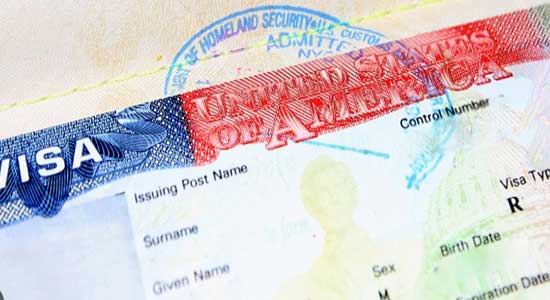
The United States government has made permanent a visa bond programme requiring nationals of 50 countries, predominantly in Africa, to deposit between $10,000 and $20,000 before obtaining certain business and tourist visas.

The programme, which takes effect permanently on Monday, August 3, 2026, formalises a pilot scheme introduced by the Trump administration in August 2025 as part of efforts to reduce visa overstays and strengthen compliance with United States immigration laws.
A draft final regulation published in the Federal Register on Friday said a review of the nearly year-long pilot generated sufficient data to demonstrate that visa bonds were an effective tool for enforcing compliance with visa conditions.
The pilot programme previously allowed consular officers to impose bonds of $5,000, $10,000 or $15,000. Under the permanent regulation, the lowest amount has been increased to $10,000, while the maximum bond has risen to $20,000.
Applicants covered by the programme may therefore be required to deposit $10,000, $15,000 or $20,000, depending on an assessment conducted by a United States consular officer.
Factors expected to influence the amount include the purpose of the proposed visit, the applicant’s employment and financial circumstances, travel history and evidence of strong ties to the applicant’s home country.
The requirement applies to eligible applicants seeking B-1 and B-2 visas, which cover temporary travel to the United States for business, tourism and related purposes.
The bond is refundable without interest where an application is denied or where a successful applicant enters the United States, complies with the conditions of the visa and leaves within the authorised period.
However, the money may be forfeited where the visitor overstays, works without authorisation or otherwise violates the terms of admission.
The United States government said the measure was introduced to address high overstay rates, inadequate information-sharing arrangements, weaknesses in identity management and concerns over the security of travel documents issued by some countries.
The programme is backed by Executive Order 14159, titled “Protecting the American People Against Invasion,” which directed federal agencies to strengthen immigration enforcement and compliance mechanisms, including the administration of visa bonds.
The State Department said the pilot programme produced a substantial reduction in overstays among nationals of the countries covered.
According to the final notice, 45,488 visitors from the affected countries overstayed their visas in 2024. During the first 10 months of the visa bond pilot, fewer than 50 overstays were recorded among bonded visa holders.
“The 2025 visa bond pilot, which provided a framework for the Department of State, the Department of Homeland Security and the Department of the Treasury to assess the feasibility of administering a visa bond programme, has provided sufficient data to suggest that a visa bond programme is an effective tool for enforcing compliance among bonded visa holders,” the department stated.
United States authorities estimate that arresting and removing a visitor who has overstayed a visa costs the government approximately $18,000.
Although the department initially projected that about 2,000 applicants would be required to post bonds during the pilot period, approximately 20,000 applicants were eventually subjected to the requirement.
Nearly half of those applicants reportedly declined to pay the bond, contributing to an 83 per cent decline in the number of B-1 and B-2 visas issued to citizens of the listed countries between August 2025 and July 2026.
Total deposits collected during the pilot were estimated at approximately $115 million.
“The department expects that this final rule will contribute to the continued reduction of demand for B-1/B-2 visa applications from nationals of countries subject to the programme,” the notice stated.
The government said the policy was intended not merely to impose financial consequences on individual applicants but also to encourage foreign governments to improve identity verification, document security and compliance by their citizens.
“This programme responds to, and is intended to encourage, foreign governments to take immediate action to reduce the overstay rates by encouraging their nationals to comply with US immigration laws,” the notice said.
Government data showed that countries outside the United States Visa Waiver Programme recorded a significantly higher rate of overstays than participating countries.
In 2024, there were 269,382 B-1 and B-2 visa overstays involving nationals of non-Visa Waiver Programme countries, excluding Canada and Mexico.
The overstay rate for those countries was reported at 2.06 per cent, compared with 0.44 per cent among countries participating in the Visa Waiver Programme.
The maximum bond amount will be reviewed every seven years to account for inflation, with the first review scheduled to begin on October 1, 2027.
Countries identified in the supplied material as covered by the programme include Algeria, Tunisia, Benin, Cabo Verde, Côte d’Ivoire, The Gambia, Guinea, Guinea-Bissau, Mauritania, Senegal, Togo and São Tomé and Príncipe.
Others are Angola, Burundi, the Central African Republic, Djibouti, Gabon, Ethiopia, Tanzania, Uganda, Botswana, Lesotho, Malawi, Mauritius, Mozambique, Namibia, Seychelles, Zambia and Zimbabwe.
The regulation allows additional countries to be included based on overstay rates, information-sharing deficiencies, identity-management concerns and document-security assessments.
Although separate reports claimed that Nigerians would be required to pay the bond, Nigeria was not included among the countries listed in the material announcing the permanent programme. Nigerian applicants would therefore require official clarification before assuming that the requirement applies to them.
The policy has attracted criticism from immigration advocates, who argue that deposits of up to $20,000 create an excessive financial burden for people from lower-income countries seeking to visit relatives, pursue business opportunities or travel temporarily to the United States.
Critics also contend that the bond requirement effectively limits access to United States visas to wealthier applicants, regardless of whether less affluent travellers have legitimate reasons for visiting and strong incentives to return home.
United States officials have, however, described the pilot as successful, citing the sharp reduction in overstays among bonded travellers.
Separately, the United States Mission in Nigeria has warned visa applicants against submitting altered, digitally manipulated or artificial intelligence-generated passport photographs.
The mission said photographs must have been taken within the preceding six months and must accurately reflect the applicant’s current appearance.
“Your photo should be recent, taken within the past six months, and look like you. The TSA or CBP agent must be able to tell it’s you,” the mission stated.
[A MUST HAVE] Evidence Act Demystified With Recent And Contemporary Cases And Materials

Available now for NGN 40,000 at ASC Publications, 10, Boyle Street, Onikan, Lagos. Beside High Court, TBS. Email publications@ayindesanni.com or WhatsApp +2347056667384. Purchase Link: https://paystack.com/buy/evidence-act-complete-annotation
______________________________________________________________________ “Enhance Legal Practice With Authoritative Reports” — Alexander Payne Offers Comprehensive Law Reports, Spanning Over A Century Of Nigerian Jurisprudence Interested buyers are encouraged to place their orders and enquiries via:
0704 444 4777, 0704 444 4999, 0818 199 9888
Website: www.alexandernigeria.com
Interested buyers are encouraged to place their orders and enquiries via:
0704 444 4777, 0704 444 4999, 0818 199 9888
Website: www.alexandernigeria.com