By Olarinre Salako

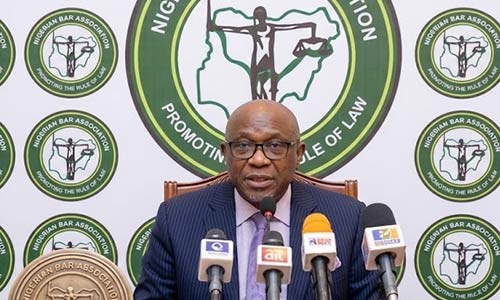
THE Nigerian Bar Association recently elected Mrs Oyinkansola Badejo-Okusanya, SAN, as its 33rd President, making her only the second woman to lead the Association and the first elected to the office. That historic achievement was quickly overshadowed by controversy. The election was disrupted by a reported cyberattack and technical failures. Badejo-Okusanya polled 12,317 votes, ahead of Lateef Omoyemi Akangbe, SAN (7,934) and Olumuyiwa Akinboro, SAN (5,855). Yet only 26,184 of the Association’s 82,172 registered members voted—a turnout of 31.86 per cent.
Low turnout alone does not prove disenfranchisement. More troubling, however, were reports from lawyers who said they repeatedly attempted to vote but were unable to do so. One presidential candidate, Lateef Akangbe, SAN, reportedly could not even cast his own vote.
Curious about these developments, I asked a senior lawyer and notary public in a group conversation:
Me: “Madam, should we congratulate you and your NBA colleagues for electing the second woman President and the first through an election? I read there were irregularities. Could you educate us?”
She: “The election was very chaotic. More than 70 per cent of our members were completely disenfranchised. They were unable to vote, not because they didn’t want to, but because they were prevented from doing so.”
Me: ”Even lawyers—the supposed democratic guardians! But are you at least happy that a fellow woman emerged?”
She :”Ordinarily, I would have been happy if she had emerged on merit.”
Merit may qualify a candidate for office; only a credible election legitimises the office holder.
Me: “Would the matter go to court?”
She: ”Maybe they will, but it will likely be an effort in futility. The case may not be concluded before the winner completes the two-year tenure.”
Me: “If members of the Temple of Justice can be prevented—whether by technological failure, administrative incompetence or something more troubling—from exercising their franchise, and cannot obtain justice before the disputed tenure expires, what then is the hope for Nigerian democracy?”
ALSO READ: Tinubu’s latest power idea is my 21-year-old blueprint — Atiku
At the time of writing, the Electoral Committee had acknowledged technical disruptions and announced investigations. However, the scope and implications of those disruptions remained the subject of dispute among many members.
Not an isolated incident
The 2026 NBA election did not occur in isolation. Since adopting electronic voting in 2016, successive elections have attracted allegations of irregularities, technical failures, cybersecurity concerns and litigation. These point to recurring institutional weakness requiring credible reform.
Wondering why a professional association’s election had generated such controversy, a veteran journalist offered a simple explanation: “People use these professional organisations to negotiate real power. They are ladders to something higher. Hence the heat.” If democratic processes can be compromised within the Bar because of the pursuit of political and institutional influence beyond it, then Nigerians have every reason to worry.
Pervasive democratic guardians
Few professions are as deeply embedded in constitutional order as the legal profession. They are democracy’s most pervasive institutional guardians. Let us look at this in more detail.
The Judiciary: A democracy without a dependable judiciary is a collapsing bridge. It may stand for a while, but it will soon rupture completely—losing the weight placed upon it. In Nigeria, every judge enters the Temple of Justice through the legal profession. Before citizens meet judges, they first meet the Bar. The ethical culture of the Bar significantly influences the quality and integrity of the Bench. Integrity at the Bar strengthens the Bench; manipulation weakens it.That is why every Nigerian lawyer is described as a minister in the Temple of Justice. The title carries a moral obligation to place justice above convenience, law above political pressure and constitutional order above personal advantage.
The constitution making & legislature: A democracy without a functioning constitution is like a luxury vehicle riding on deflated tyres. Its engine may run, but it cannot carry a nation safely forward. Nigeria owes much of its constitutional architecture to lawyers. Professor Ben Nwabueze, SAN, helped shape Nigeria’s constitutional architecture by drafting Chapter II of the 1979 Constitution and leading the design of the presidential system. Ironically, Nwabueze later became one of its strongest critics, arguing that the excessive concentration of power at the centre—intended to promote national unity—instead intensified disunity by making control of the Federal Government the ultimate political prize. The NBA often calls for constitutional reform. Its moral authority to do so depends on its ability to uphold constitutional principles in its own elections.
The Attorney-General: Nigeria gives the office of Attorney-General an especially important constitutional status. Section 150(1) of the 1999 Constitution provides that: “There shall be an Attorney-General of the Federation who shall be the Chief Law Officer of the Federation and a Minister of the Government of the Federation.”Unlike ministries that a President may reorganise or merge, the office of Attorney-General is constitutionally entrenched. By constitutional design, thirty-seven Attorneys-General occupy the highest legal offices in the Federation. The health of the legal profession is therefore inseparable from the health of Nigerian democracy.
Implications
The NBA election cannot be dismissed as an internal affair of a professional association. It has at least three implications for Nigerian democracy.
Judicialisation of democracy: Today, election petitions have become a defining feature of Nigeria’s democracy. Presidential, governorship and legislative elections are settled not only at the polling units but also in the courtrooms. As legal contests increasingly shape political outcomes, lawyers at the Bar and judges on the Bench have become central actors in Nigeria’s electoral process. That reality places an even greater responsibility on the legal profession. If confidence in the Bar’s own democratic processes is weakened, it inevitably raises questions about the institutions Nigerians rely upon to resolve electoral disputes. Where the courtroom becomes an extension of the polling unit, the integrity of the legal profession is inseparable from the integrity of the electoral process.
Constitutional leadership: The NBA is one of Nigeria’s most influential voices on constitutional reform, judicial independence and electoral integrity. That voice carries greater weight when the Association demonstrates the democratic standards it expects of the nation. Institutional credibility is itself constitutional capital. If the NBA seeks to shape Nigeria’s constitutional future, it must first show that it can faithfully uphold constitutional principles in its own elections.
Institutional reform: The NBA should commission an independent forensic audit of the 2026 election, publish anonymised technical data, strengthen the independence of its Electoral Committee, establish a resilient backup voting platform and resolve electoral disputes within strict timelines. It should also publicly explain what went wrong, what worked and what will change before the 2028 election. Other professional bodies, including the Nigerian Association of Petroleum Explorationists (NAPE) and the Nigerian Society of Engineers (NSE), have adopted structured electoral rules, independent electoral committees, defined timetables and transparent governance processes that help strengthen confidence in their elections. The NBA should study such institutional practices and continually strengthen confidence in its own electoral system.
Conclusion
During military rule, courageous lawyers defended detainees, challenged unlawful decrees and risked imprisonment in defence of constitutional government. That tradition endures today. The present controversy should therefore be met not with denial, but with credible investigation, transparency and institutional reform. The question before the NBA is larger than who won the election. It is whether the institution from which Nigeria draws its democratic guardians can demonstrate the democratic standards it expects of the nation.
The NBA cannot credibly demand from INEC an electoral standard it is unable to apply to itself. It cannot remain the nation’s conscience without first examining its own. Nigerian lawyers cannot effectively guard Nigerian democracy unless they first guard democracy within the Nigerian Bar Association.
The guardians must first guard their own ballot.
[A MUST HAVE] Evidence Act Demystified With Recent And Contemporary Cases And Materials

Available now for NGN 40,000 at ASC Publications, 10, Boyle Street, Onikan, Lagos. Beside High Court, TBS. Email publications@ayindesanni.com or WhatsApp +2347056667384. Purchase Link: https://paystack.com/buy/evidence-act-complete-annotation
______________________________________________________________________ “Enhance Legal Practice With Authoritative Reports” — Alexander Payne Offers Comprehensive Law Reports, Spanning Over A Century Of Nigerian Jurisprudence Interested buyers are encouraged to place their orders and enquiries via:
0704 444 4777, 0704 444 4999, 0818 199 9888
Website: www.alexandernigeria.com
Interested buyers are encouraged to place their orders and enquiries via:
0704 444 4777, 0704 444 4999, 0818 199 9888
Website: www.alexandernigeria.com