*Says Accord’s Deregistration Was Aimed at Stopping Adeleke’s Re-Election

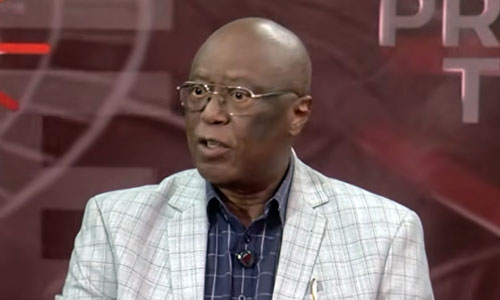
The National Legal Adviser of the African Democratic Congress, Prof. Oserheimen Osunbor, a former Governor of Edo State, has disclosed that the party has already filed a formal petition against Justice Peter Lifu of the Federal High Court before the National Judicial Council, following the Court of Appeal’s decision setting aside his judgment ordering the deregistration of the ADC and four other political parties.
Osunbor spoke on Arise News in an extensive interview in which he described the appellate judgment as a victory for democracy, alleged that the APC’s strategy is to deploy elements in the judiciary to destroy opposition parties, said the deregistration of the Accord Party was designed to stop Osun State Governor Ademola Adeleke from contesting the August 15 governorship election, and warned that the ADC is “not quite out of the wood” because another case remains before the same judge.
The Court of Appeal, in a unanimous decision, nullified the Federal High Court judgment that had ordered INEC to deregister the ADC alongside the Action Peoples Party, Action Alliance, Accord Party and Zenith Labour Party, ruling that the lower court lacked jurisdiction to entertain the suit in the first place, describing the proceedings as incompetent, and restoring all five parties to their status as duly registered political parties.
The appellate panel also held that Justice Lifu proceeded to deliver judgment despite an earlier order directing him to stay proceedings pending appeal, describing his conduct as judicial impertinence.
“It’s a huge relief for us in ADC, and indeed the other political parties that were affected by the judgment of the trial court, and indeed to all lovers of democracy in Nigeria,” Osunbor stated.
“Once again, it has restored confidence in our judiciary. There are some segments of society that have formed the impression that our judiciary is gone. But when you see this kind of judgment, then it restores hope that there’s a future, a good future for Nigeria,” he said.
“People have been congratulating me, but I also congratulate Nigerians. This is a victory for all of us,” Osunbor stated.
Osunbor explained that the appeal arose from the trial court’s dismissal of what he described as germane applications at the early stages, which caused the parties to suspect they would not get justice.
“The Court of Appeal agreed that the judge should stay further proceedings until they disposed of the appeal already filed. But it appears the trial judge, Justice Peter Lifu, had made up his mind on what he wanted to do. And he said effectively that the Court of Appeal can go to hell, effectively. And that he was going to deliver the judgment anyway. That the Court of Appeal cannot stop him. You can’t do me anything. I will proceed with what I want to do,” Osunbor stated.
“But of course there’s a hierarchy of courts in Nigeria, and that must be respected. The Federal High Court is a lower court to the Court of Appeal, and they ought to respect any order or directive from the Court of Appeal. But not Justice Lifu. He proceeded to deliver his judgment,” he said.
“Today we are happy that the Court of Appeal has put him where he truly belongs, and used adjectives on him which are really not complimentary at all,” Osunbor stated.
“When you hear a judge being referred to as being guilty of judicial indiscipline, judicial rascality, judicial insubordination or gross insubordination, you begin to wonder whether there’s a place for that judge to remain in the judiciary of Nigeria,” Osunbor stated.
“So I think it is left to the NJC to look at the conduct of this judge. This is not the first time that he has behaved in this manner. So it is now left for the NJC to decide what they want to do with this kind of judge that is sitting as a judge of the Federal High Court handling very sensitive matters,” he said.
He noted the Supreme Court’s own precedent: “The Supreme Court in the past has had to pronounce on this kind of conduct being executed by judges. And they said that a judge who behaves in this manner is unfit for the bench.”
Asked whether a process exists to sanction the judge and who may initiate it, Osunbor explained the NJC framework and then confirmed the party has acted.
“There’s a process. One of the reasons the National Judicial Council was established under the 1999 Constitution, it didn’t exist before, we had the Advisory Judicial Council before, was to guarantee the independence of the judiciary, including financial independence, and also independence in terms of appointment, discipline and sanction,” he stated.
“That process starts with a formal petition. The NJC has a procedure, and you must depose to an affidavit to discourage frivolous petitions,” he said.
Asked who may file, he replied: “Any aggrieved person.” Asked whether the ADC could file, he answered: “We can file, indeed. We have filed. We have already filed. Yes, a petition to the NJC against this particular Justice Lifu.”
On the substance of the judgment, Osunbor said the interpretation of Section 225A of the Constitution had long been settled.
“The law as it is now, as it has been ever since, is that even if you win one councillorship, any political party that wins one councillorship in the whole of Nigeria can escape the deregistration hammer. And not to talk of ADC winning two House of Reps seats and one House of Assembly seat in Kogi, amongst others,” he stated.
“Section 225A provides grounds on which INEC, and it is INEC who shall have the power, may deregister a political party that fails to win 25 per cent in a presidential election, or 25 per cent in a governorship election, or win seats in the National Assembly or State Assembly, or chairmanship or councillorship. They are not cumulative. They are disjunctive. So if you fulfil one of the conditions, then you escape the deregistration hammer,” Osunbor stated.
He cited authority: “The Supreme Court has said, I think in the case of NUP v. INEC, that once you establish that even one councillorship has been won, then you are eligible to remain.”
He then turned to the defection finding.
“Strangely, and even against the decisions of the Supreme Court and other courts before now, the judge said you must win 25 per cent. ADC didn’t win 25 per cent in the presidential election, which is irrelevant because we fulfilled the conditions about winning two House of Reps seats and the House of Assembly seat. But the judge now said that those people have defected,” Osunbor stated.
“The first question is, how did he know? Because that evidence was not before the court. And that was again a point that was strongly made by the Court of Appeal. How did you know? First of all, INEC deposed to the fact that these political parties met the threshold, and it is INEC’s job to make that determination,” he said.
He made a further point about the plaintiffs’ own pleadings: “The plaintiff, the National Forum, didn’t state that ADC won these seats. They carefully avoided saying that ADC won any seats. So having said that, they couldn’t be seen to be saying that the people who won those seats have defected. It is now the judge who did the job for them by saying even though ADC won seats, those people have defected.”
On the Attorney General of the Federation’s support for the deregistration suit, Osunbor was careful but unambiguous.
“Let me say that the Honourable Attorney General of the Federation and Minister of Justice is a personal friend of mine. He’s a fine gentleman. But he’s working in the midst of people who I cannot describe in those terms. It’s a difficult job. I know him. He tells me he’s not a politician really. He’s there to do a professional thing,” Osunbor stated.
“It would appear that the political forces around him have made him take this action, which ordinarily I know Lateef Fagbemi SAN is beyond. It must be political pressure that made him take that position on a fact which is very clear. He’s a learned Senior Advocate of Nigeria. He knows. He can interpret the constitution very well,” he said.
“So for him to have taken that position, the only logical conclusion in my mind is that he was forced to do it by those who are looking for one way or another to ensure that they do not meet on the field against a formidable presidential candidate of the calibre of the ADC presidential candidate in the person of Alhaji Atiku Abubakar,” Osunbor stated.
Osunbor repeated an allegation he said he had made previously on the same programme.
“We suspect that this whole thing is being orchestrated. I said these people are afraid of confronting the opposition in the 2027 general elections. And one of their strategies is to deploy some elements in the judiciary to destroy opposition political parties so that only APC can field candidates in future elections,” he stated.
He gave a specific illustration: “Our Accord Party Governor Adeleke of Osun is running for re-election in the August 15 governorship election in Osun. So the idea was to disqualify, deregister Accord Party so that Governor Adeleke cannot run for re-election in Osun. But thank God that this beautiful Court of Appeal judgment came today, and Governor Adeleke, I can imagine he’s celebrating now and getting ready for his election on the 15th of August.”
The interviewer noted for the record that these remained allegations without substantial supporting evidence, which Osunbor did not dispute.
Asked whether the ADC’s legal troubles are over, Osunbor said they are not.
“Not quite. Because there’s still a case before this same Justice Lifu. They find a way of channelling all these cases to his court. The case of Gombe is still before him. He has adjourned that to the 14th of September for hearing,” he stated.
He then quoted an observation now widely repeated in legal circles: “There’s a learned scholar who said once a case is before Justice Lifu, the outcome is very predictable.”
“This avalanche of cases is a strategy that has been adopted to destabilise and distract ADC with this plethora of litigation,” Osunbor stated.
On any appeal to the Supreme Court by the plaintiffs, he said: “It’s within their rights to appeal to the Supreme Court, but we’ll be waiting for them. We’ll be ready for them, and the Supreme Court will now have the opportunity of deciding whether to abide by their previous positions. But I don’t think so. It’s very clear. If you read Section 225A yourself, you will not have any doubt in your mind about what it says.”
He added that the case “shouldn’t even have gone to the court” in the first place.
Asked whether the alleged interference operates at the lower levels because the higher courts are harder to influence, Osunbor gave a detailed answer.
“Of course, for many reasons. At the higher level, to get to the Supreme Court you have been a High Court judge, maybe a Justice of the Court of Appeal, and then you have more experience. You are wiser. You are older. You have a reputation to protect. You are not hungry for wealth or material benefits,” he stated.
“Younger people are more excited about those material benefits, immediate returns, and they can easily be influenced, and they have less of a reputation built over the years that they can just allow to be destroyed in order to please somebody else,” he said.
He identified a further dynamic: “A judge who is being pressurised at the lower level may cave in, believing that his errors will be corrected at the Court of Appeal. And even the Court of Appeal, if they are unable to resist, may yield in the belief that it will be corrected in the Supreme Court. But Justices of the Supreme Court know that beyond them, there’s nothing else, except appealing to God. So generally, Justices of the Supreme Court are more mindful of this and are not prone to making the kind of mistakes that you see happening at the lower courts.”
Asked whether the episode restores or damages confidence in the courts, Osunbor gave both answers.
“The more of the kind of judgments that Justice Lifu delivered, the more demoralised Nigerians are, the more they lose faith in the judiciary. And the more corrective measures are taken by superior courts, the more the system restores people’s hope in the judiciary. That is a practical reality,” he stated.
He cited the ADC’s own leadership case as an example: “We almost were crippled by the judgment which said INEC should not recognise our leadership, David Mark and Aregbesola as national chairman and national secretary. That appeared to be the end of the road for us. We appealed to the Court of Appeal and they seemed to have compounded the situation. But undeterred, we went to the Supreme Court and our hopes were restored, and the status quo ante bellum was thrown away.”
“That should give everybody hope, that no matter what is going on at the lower level, at least at the Supreme Court you can get justice. The Supreme Court can correct a lot of genuine mistakes, or deliberate action to subvert the process using the judiciary,” Osunbor stated.
Invited to reflect on his own removal as Governor of Edo State by the same court system, Osunbor was reluctant but candid.
“I often don’t want to talk about myself. People will say, oh, he’s personalising issues,” he began. But when he had said earlier that people sometimes lose on earth and appeal to God, he confirmed: “I’m one of those. Even though I didn’t get justice on earth, the heavens had my prayers.”
He then gave his account of what happened: “What happened to me was caused essentially by the PDP. It’s PDP leaders who sat down with some elements of the opposition to say President Yar’Adua admitted that his election was flawed. How do we placate the opposition? And they then agreed we have to cede five states, starting with Edo. That was the beginning of my removal.”
He recounted a conversation with the then PDP national chairman: “I met the national chairman of PDP at that time when I heard about this conspiracy to remove me. You know what he told me? He said PDP has 28 states, and PDP is not bound to win every state. I said, what? So it means they will be satisfied with 23 states. Wamakko escaped. Wamakko was supposed to be the fifth state.”
“I said I left vengeance or judgment to God. The PDP that empowered the opposition is today at the receiving end. The PDP that you have today is a caricature of the PDP that we knew when we were 28 governors,” Osunbor stated.
On the legal reasoning that removed him, he said: “As a lawyer, it struck me as unexpected. Because when my case was in the tribunal, I looked at the law and I knew that the law was on my side and the facts were on my side. But one of the things they said in the judgment removing me was that irregularity has a way of spreading from one unit to other units. Irregularity doesn’t have to be proved unit by unit. It has a way of spreading from one unit to other units.”
The interview was conducted by Charles Aniagolu on Arise News. Prof. Oserheimen Osunbor is the National Legal Adviser of the African Democratic Congress, a former Governor of Edo State, and a former Senator.
[A MUST HAVE] Evidence Act Demystified With Recent And Contemporary Cases And Materials

Available now for NGN 40,000 at ASC Publications, 10, Boyle Street, Onikan, Lagos. Beside High Court, TBS. Email publications@ayindesanni.com or WhatsApp +2347056667384. Purchase Link: https://paystack.com/buy/evidence-act-complete-annotation
______________________________________________________________________ “Enhance Legal Practice With Authoritative Reports” — Alexander Payne Offers Comprehensive Law Reports, Spanning Over A Century Of Nigerian Jurisprudence Interested buyers are encouraged to place their orders and enquiries via:
0704 444 4777, 0704 444 4999, 0818 199 9888
Website: www.alexandernigeria.com
Interested buyers are encouraged to place their orders and enquiries via:
0704 444 4777, 0704 444 4999, 0818 199 9888
Website: www.alexandernigeria.com