*Says Impunity In The Bar Has Never Been Sanctioned

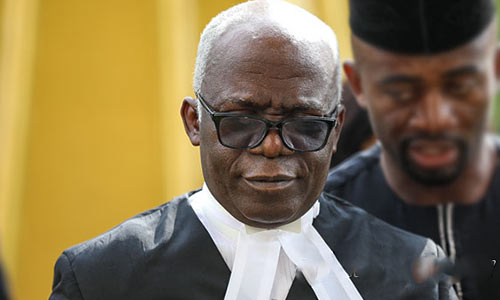
Human rights lawyer Femi Falana, SAN, has responded to Chief J.S. Okutepa, SAN’s extensive critique of the 2026 Nigerian Bar Association national officers election with a series of eight questions addressed directly to his learned colleague, arguing that the mismanagement of the NBA poll should surprise no one because the same senior members of the profession who now lament it have, over the years, defended election riggers, headed compromised electoral bodies, delivered technical judgments that legitimise manipulation, and shielded those accused of rigging the Bar’s own elections from prosecution.
Falana’s intervention, titled “Questions for J.S. Okutepa SAN,” takes the form of a rhetorical examination in which each question is framed as a matter Okutepa is presumed already to know.
Falana’s first question locates the NBA’s problem within the wider conduct of the profession in Nigeria’s electoral system.
“Are you not aware that riggers of presidential, legislative, gubernatorial and local government elections in Nigeria are defended by very senior lawyers?” Falana asked.
The point is that the legal profession is not a bystander to Nigeria’s electoral dysfunction. The lawyers who appear for those accused of manipulating elections at every level are drawn from the senior ranks of the same Bar that now expresses shock at manipulation within its own house.
His second question addresses the practical collapse of election petition practice.
“Are you not aware that many lawyers no longer accept the briefs of petitioners as it is very difficult to upturn the results of fraudulent elections?” Falana asked.
The observation reflects a documented reality: the near-impossibility of successfully challenging election results in Nigeria has produced a profession in which representing petitioners is regarded as unprofitable and futile, leaving aggrieved candidates and voters without effective legal representation.
Falana’s third question turns to the state independent electoral commissions, notorious for declaring every local government result in favour of the ruling party in every state.
“Are you not aware that state independent electoral commissions that declare all election results in favour of the ruling party in every state are not headed by retired judges or very senior lawyers?” Falana asked.
The question, framed in the negative, makes the point by inversion: those commissions are in fact routinely headed by retired judges and senior lawyers, which means the most flagrant electoral outcomes in Nigeria are produced under the supervision of the legal profession’s own senior members.
The fourth question extends the indictment to the bench.
“Are you not aware that judges who resort to legal technicalities to justify the manipulation of election results at the national, state and local government levels are very senior lawyers?” Falana asked.
Falana’s fifth question establishes that the NBA’s electoral problems are neither new nor unlitigated.
“Are you not aware that the manipulation of the results of the NBA elections has been challenged in court since 2016?” he asked.
The reference is to the litigation that followed the introduction of universal suffrage and electronic voting in the NBA, including the challenge brought after the 2016 election that produced A.B. Mahmoud, SAN, as president, in which it was alleged that the electronic system was susceptible to manipulation from the backend.
Falana’s sixth question is the most damaging, because it identifies a specific occasion on which accountability was available and was deliberately abandoned.
“Have you forgotten that senior lawyers prevailed on the complainants to withdraw the criminal case against the two lawyers that were charged for the digital rigging of the 2018 NBA election?” Falana asked.
The recollection establishes that the Bar has already had before it a criminal prosecution arising from the digital manipulation of its own election, and that the prosecution was abandoned at the urging of senior members of the profession. The implication is that the 2026 crisis is the predictable consequence of that earlier decision not to punish.
The seventh question moves from history to the present.
“As there is no sanction for impunity in the affairs of the NBA, have the senior lawyers who deliberately mismanaged the conduct of the 2026 NBA election apologised to the very many lawyers who were disenfranchised?” Falana asked.
Two things are notable in the formulation. First, Falana states as a premise that “there is no sanction for impunity in the affairs of the NBA,” presenting the absence of consequences as an established feature of the association rather than an open question. Second, he characterises the conduct of the 2026 election not as incompetence or misfortune but as deliberate mismanagement.
The question also sets a minimal bar. He does not ask whether anyone has been disciplined, removed, or prosecuted. He asks whether anyone has apologised, and the framing suggests the answer is no.
Falana’s final question is the one the entire piece builds toward.
“Seriously speaking, were you really surprised that the 2026 NBA electoral officials mismanaged the election?” he asked.
The question does not dispute anything in Okutepa’s account of what went wrong. It accepts it entirely. What it disputes is the expectation that it could have gone otherwise, given a profession in which those who rig elections are defended by senior lawyers, those who supervise fraudulent commissions are senior lawyers, those who deliver the technical judgments that ratify manipulation are senior lawyers, and those who quietly persuaded complainants to drop criminal charges against alleged digital riggers within the Bar itself were senior lawyers.
Falana’s questions follow Okutepa’s extensive interview on the State of the Nation programme, in which the Senior Advocate described the 2026 NBA election as “a coronation” rather than an election, alleged that the entire process was “geared towards a predetermined position,” questioned the unverified cyberattack narrative, said godfathers within the association have lined up presidents until 2038, and insisted that the disenfranchisement of approximately 56,000 lawyers renders the outcome indefensible.
Okutepa had said in that interview that the association is “like an incorrigible sinner who has defiled all sense of purity,” and that “it pains me to my bone marrow” to watch the NBA being destroyed by people who contributed nothing to its growth.
The 2026 election produced Mrs Oyinkansola Badejo-Okusanya, SAN, with 12,317 votes, ahead of Lateef Akangbe, SAN, with 7,934 and Olumuyiwa Akinboro, SAN, with 5,855, from a total of 26,106 votes cast out of 82,213 eligible voters.
Akangbe has since filed a formal election petition before the NBA National Officers Election Appeal Committee. Former NBA President J.B. Daudu, SAN, has declared the election illegitimate and called for a re-election. Former President O.C.J. Okocha, SAN, has urged the Bar to move on and focus on reform.
The questions were signed by Femi Falana, SAN.
[A MUST HAVE] Evidence Act Demystified With Recent And Contemporary Cases And Materials

Available now for NGN 40,000 at ASC Publications, 10, Boyle Street, Onikan, Lagos. Beside High Court, TBS. Email publications@ayindesanni.com or WhatsApp +2347056667384. Purchase Link: https://paystack.com/buy/evidence-act-complete-annotation
______________________________________________________________________ “Enhance Legal Practice With Authoritative Reports” — Alexander Payne Offers Comprehensive Law Reports, Spanning Over A Century Of Nigerian Jurisprudence Interested buyers are encouraged to place their orders and enquiries via:
0704 444 4777, 0704 444 4999, 0818 199 9888
Website: www.alexandernigeria.com
Interested buyers are encouraged to place their orders and enquiries via:
0704 444 4777, 0704 444 4999, 0818 199 9888
Website: www.alexandernigeria.com