Wigwe University, the Rivers State-based institution founded by the late banker and businessman Herbert Wigwe, is facing allegations of mass staff dismissals, intimidation and administrative high-handedness, even as the university’s Vice-Chancellor, Professor Marwan Al-Akaidi, has strongly denied wrongdoing and insisted that the institution follows due process in all employment matters.

The allegations come less than two years after Wigwe died in a helicopter crash in the United States on February 9, 2024, months before the university formally opened its doors. The institution was conceived as a world-class university aimed at raising fearless African leaders, innovators and entrepreneurs through international standards, technology, entrepreneurship, critical thinking and practical problem-solving.
One of the affected former employees, Dr. Nonyelum Okechukwu, who joined the university in November 2023 as University Librarian, alleged that she was served a termination notice on August 1, 2025, without being invited before any disciplinary panel or given an opportunity to respond to any allegation.
Okechukwu said she was informed that her appointment would end on October 30, 2025, adding that the letter did not state any misconduct against her. She said she later contacted the Chairman of the Board of Trustees, who reportedly asked her to give the university one week to respond to her complaint, but no feedback came.
She said the development had created uncertainty about her professional future, as prospective employers might want to know why her appointment was terminated.
Her account is one of several allegations made by former employees and sources familiar with developments at the institution. Documents reviewed in the report indicated that about 30 academic and non-academic employees either had their appointments terminated or resigned from Wigwe University within the period under review.
Some of the affected workers alleged that they were forced out through intimidation and what they described as an atmosphere of fear. Several former employees also alleged that they were dismissed without being accused of misconduct or appearing before a disciplinary panel.
Another former employee, Confidence Ihunwo, said she was employed on December 19, 2024, as College Secretary in the College of Engineering before she was later asked to temporarily replace an administrative officer in the Vice-Chancellor’s office.
Ihunwo alleged that her posting to the VC’s office exposed her to a workplace where staff lived in fear of sudden dismissal. She claimed that her appointment was terminated after she fell ill at work and sought permission to leave before closing time.
According to her, she was not allowed to leave at 4 p.m. despite being sick, and after a senior colleague took her to the hospital around 4:30 p.m., she returned the next morning and was issued a sack letter.
A lecturer recruited from Zimbabwe, who spoke anonymously, also alleged that his appointment was terminated without proper explanation. He said he had been attracted by Herbert Wigwe’s vision of building a Harvard-like university in Africa and was interviewed in January 2024 while Wigwe was still alive.
The lecturer claimed that although the original plan was for him to relocate to Nigeria with his family, the arrangement was later reviewed, with the university allegedly agreeing to sponsor one annual return trip to enable him visit his family in Zimbabwe.
He alleged that the university failed to honour the travel agreement and later terminated his appointment. He also claimed that after his employment ended, he had to raise money by himself to return to Zimbabwe, while several emails seeking assistance from the university received no response.
A former Deputy Registrar, who joined the university in December 2024 and resigned in August 2025, also alleged that he left because of frustration and loss of professional dignity.
He claimed he was asked to prepare the termination letter issued to the Zimbabwean lecturer after the lecturer requested the annual travel ticket allegedly contained in his contract. He further alleged that several senior administrative officers left the institution during the same period and that the university was left without a substantive bursar after the departures.
A lecturer in the College of Engineering, Professor Arinola Ajayi, also confirmed that he resigned because he was no longer comfortable working at the institution. Other anonymous staff members alleged that fear had become widespread among employees and claimed that senior staff perceived as threats risked being pushed out.
The controversy has also raised questions about compliance with labour laws and due process in private universities. Although Wigwe University is privately owned, its employment practices remain subject to Nigerian labour laws and the terms of employment agreed with staff.
Nigeria’s Labour Act, the Constitution and statutes governing industrial disputes provide frameworks for employment relationships, termination of employment, notice requirements and remedies where workers allege that their rights have been violated.
Civil society groups have called for an independent investigation into the allegations. The Chancellor of the International Society for Social Justice and Human Rights, Omenazu Jackson, said the university’s private status did not exempt it from complying with Nigerian labour laws.
He called for a thorough inquiry to determine the reasons for the reported dismissals and whether any affected workers committed misconduct warranting such action.
The Chairman of the Rivers State Civil Society Organisations, Enefa Georgewill, also said all employers are bound by Nigerian labour laws and urged that the allegations be investigated if workers were dismissed without due process.
Similarly, the President of the Committee for the Defence of Human Rights, Debo Adeniran, said every staff member’s conditions of service should guide the employment relationship. He, however, noted that the death of a private university’s proprietor could affect funding, patronage and management decisions, which may force difficult choices.
Legal experts also weighed in on the matter. A former Vice-President of the Nigerian Bar Association, Dr. Monday Ubani, SAN, said a university could not be run without regard to established structures and regulations.
Ubani said it was important to determine whether the termination decisions were taken by the university’s Governing Council or wrongly attributed to the Vice-Chancellor. He added that any staff member whose rights were violated could seek legal redress.
Human rights lawyer Tolu Babaleye said the legality of the reported dismissals would depend on the terms of the affected employees’ appointments and whether their appointments had been confirmed. He noted that if the appointments had been confirmed, whether due process was followed would be a matter for the court to determine.
Responding to the allegations, Professor Al-Akaidi denied personally sacking any staff member, saying the university has established procedures for disciplinary matters and that no employee could be dismissed solely at his discretion.
The Vice-Chancellor said he had no unilateral power to sack workers and maintained that dismissals require a disciplinary process, consideration by the Governing Council and the setting up of a high-level committee.
He said the university remained focused on achieving Herbert Wigwe’s vision of building one of Africa’s leading institutions, adding that the school was committed to high standards and expected diligence from its staff.
Al-Akaidi dismissed claims of arbitrary dismissals, saying there was a difference between dismissing workers, employees resigning and staff failing to perform their duties. He also said the institution had “no place for lazy people,” insisting that commitment and hard work remain central to the university’s mission.
 Interested buyers are encouraged to place their orders and enquiries via:
0704 444 4777, 0704 444 4999, 0818 199 9888
Website: www.alexandernigeria.com
Interested buyers are encouraged to place their orders and enquiries via:
0704 444 4777, 0704 444 4999, 0818 199 9888
Website: www.alexandernigeria.com

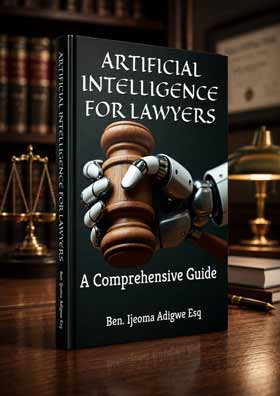 The book also examines Nigeria's legal ecosystem, focusing on the LPELR and NBA AI Guidelines. As a bonus, every purchase comes with a FREE eBook titled: How to Use the AI Features in LegalPedia and LawPavilion.
Ohio Books Ltd praises the publication, stating:
"....this is the only Nigerian book I know of on the topic."
How to Order:
📞 Call, Text, or WhatsApp: 08034917063 | 07055285878
📧 Email: benadigwe1@gmail.com
🌎 Website: www.benadigwe.com
Ebook Version: Access it directly online at https://selar.com/prv626
Authored by Ben Ijeoma Adigwe Esq., ACIarb (UK), LL.M, Dip. in Artificial Intelligence, Director at the Delta State Ministry of Justice, Asaba, Nigeria.
_______________________________________________________________________
The book also examines Nigeria's legal ecosystem, focusing on the LPELR and NBA AI Guidelines. As a bonus, every purchase comes with a FREE eBook titled: How to Use the AI Features in LegalPedia and LawPavilion.
Ohio Books Ltd praises the publication, stating:
"....this is the only Nigerian book I know of on the topic."
How to Order:
📞 Call, Text, or WhatsApp: 08034917063 | 07055285878
📧 Email: benadigwe1@gmail.com
🌎 Website: www.benadigwe.com
Ebook Version: Access it directly online at https://selar.com/prv626
Authored by Ben Ijeoma Adigwe Esq., ACIarb (UK), LL.M, Dip. in Artificial Intelligence, Director at the Delta State Ministry of Justice, Asaba, Nigeria.
_______________________________________________________________________