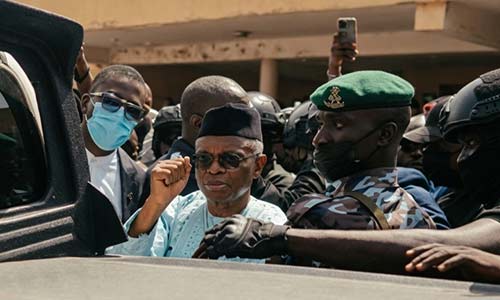
Proceedings have continued across multiple courts in the corruption and national security trials of former Kaduna State Governor Nasir El-Rufai, with the Federal High Court in Kaduna adjourning ruling on an application to vary his bail conditions to May 7, granting him permission to access medical treatment at specified hospitals under strict ICPC supervision, and the Kaduna State High Court fixing May 13 for hearing of a fresh bail application filed by the former governor despite the same court having earlier refused him bail on grounds of flight risk and potential interference with witnesses.

The developments, confirmed by the Independent Corrupt Practices and Other Related Offences Commission in a statement on Wednesday, paint a picture of a former governor fighting simultaneous legal battles in three different courts before three different judges, prosecuted by two separate agencies, on charges ranging from corruption and money laundering to alleged breach of national security through phone-tapping, while remaining in ICPC custody throughout.
At the Federal High Court in Kaduna before Justice Rilwan Aikawa, the matter came up on Wednesday for hearing of an application by the defence seeking a variation of the bail conditions earlier granted to El-Rufai.
El-Rufai and a co-defendant, Joel Adoga, face 10 charges of conversion and possession of proceeds of corruption, as well as money laundering offences under the Money Laundering (Prevention and Prohibition) Act 2022 and other relevant laws. Both defendants pleaded not guilty at their arraignment.
At an earlier sitting, Justice Aikawa had granted El-Rufai bail in the sum of N200 million with two sureties in like sum, while an administrative bail earlier granted to Adoga was adopted. However, El-Rufai has remained in ICPC custody, with reports indicating the bail conditions, which include the requirement for a traditional ruler and a senior civil servant as sureties, the deposit of passports, and other strict terms, have not yet been perfected.
On Wednesday, defence counsel Oluwole Olaniyan SAN urged the court to vary the bail conditions, presumably seeking a relaxation of the terms that have kept the former governor in custody despite the bail having been granted.
The ICPC, through its lawyer Agada Akogwu, opposed the variation application and relied on a counter-affidavit already filed with the court.
After hearing arguments from both sides, Justice Aikawa adjourned ruling on the variation application to May 7, meaning the question of whether El-Rufai’s bail conditions will be relaxed remains unresolved pending the court’s determination.
In a separate request during the same proceedings, the defence asked the court to allow the former governor access to medical care in Abuja.
Justice Aikawa granted the request but imposed strict conditions. The court granted permission for El-Rufai to be conveyed under strict ICPC supervision to Mile Dental Clinic and Skipper Eye-Q Hospital, or any other approved facility of his choice, and returned to custody immediately after treatment.
“All movements must remain under the strict supervision of the Commission,” the court directed.
The medical access order addresses the practical reality of a detained individual’s need for healthcare while ensuring the prosecution’s interest in maintaining custody is not compromised. The specification of named hospitals, rather than a general permission to seek medical care, and the requirement for immediate return to custody after treatment demonstrate the court’s approach of accommodating medical needs without creating opportunities for circumvention of detention.
The ICPC stated it would comply with the court’s directive while maintaining lawful custody of the defendant.
In a related but separate development, proceedings also took place at the Kaduna State High Court, where El-Rufai faces an amended nine-count charge of fraud, abuse of office, and corruption before Justice Darius Khobo.
On Tuesday, the ICPC filed a counter-affidavit opposing a fresh bail application filed by El-Rufai before the Kaduna State High Court.
At the resumed hearing, defence counsel Ubong Akpang informed the court of the pending bail application, while ICPC lawyer Ibrahim Mukhtar stated he had only just been served with additional processes and needed time to respond.
The court adjourned the matter to May 13 for the hearing of the bail application.
The fresh bail application is notable because Justice Khobo had earlier refused bail to El-Rufai in a previous application, citing alleged flight risk, potential interference with witnesses, and concerns over obstruction of investigation. The court also dismissed health-related claims for lack of supporting evidence.
That earlier bail denial had drawn condemnation from Professor Chidi Odinkalu, who described it as “a new low” that is “neither law nor justice,” and from activist Omoyele Sowore, who declared he would “never support the lawfare being waged against El-Rufai” and called bail “a constitutional right, not a tool for punishment or intimidation.”
Despite the earlier refusal, the defence has filed a fresh application, presumably on new grounds or with additional evidence to address the court’s previous concerns. The ICPC is opposing the fresh application, maintaining its position that bail should be denied.
The May 13 hearing will determine whether Justice Khobo’s position has changed or whether El-Rufai will be denied bail for a second time in the Kaduna State High Court proceedings.
The ICPC’s statement also referenced the separate proceedings before the Federal High Court in Abuja, where the Department of State Services arraigned El-Rufai on five amended counts of alleged breach of national security.
The charges relate to El-Rufai’s televised claim on Arise Television’s “Prime Time” programme that he intercepted a phone conversation involving National Security Adviser Nuhu Ribadu, during which Ribadu allegedly ordered security operatives to effect his arrest.
The charges were filed under the Cybercrimes (Prohibition, Prevention, etc.) Amendment Act 2024 and the Nigerian Communications Act 2003. El-Rufai pleaded not guilty to all five counts before Justice Joyce Abdulmalik.
At the hearing, prosecution counsel Oluwole Aladedoye SAN informed the court that the earlier three-count charge had been replaced with an amended five-count charge and requested the court to strike out the previous one. Defence counsel Oluwole Iyamu SAN raised no objection.
The prosecution sought accelerated trial dates, but the defence objected, arguing that the defendant, currently in ICPC custody, may face logistical challenges for consecutive hearing days, a practical concern given that El-Rufai is being held by one agency (ICPC) while being prosecuted by another (DSS) in a different city.
The court adjourned proceedings for further consideration of bail arrangements and trial scheduling.
Three Courts, Three Cases
El-Rufai now faces proceedings in three courts simultaneously, each involving different charges, different judges, and different prosecution agencies, creating what is arguably the most complex multi-front legal battle facing any former Nigerian officeholder.
Federal High Court, Kaduna (Justice Rilwan Aikawa): Ten counts of conversion, possession of proceeds of corruption, and money laundering, prosecuted by the ICPC. Bail granted at N200 million but not yet perfected. Bail variation ruling adjourned to May 7. Co-defendant Joel Adoga also charged.
Kaduna State High Court (Justice Darius Khobo): Amended nine-count charge of fraud, abuse of office, and corruption, prosecuted by the ICPC. Bail previously denied. Fresh bail application to be heard on May 13.
Federal High Court, Abuja (Justice Joyce Abdulmalik): Five counts of alleged breach of national security relating to wiretapping of the NSA’s phone, prosecuted by the DSS. Bail application pending after proceedings were stood down over a missing affidavit. Trial dates under consideration.
The former governor remains in ICPC custody throughout, with the medical access order from Justice Aikawa providing the only authorised departure from detention, under strict supervision and with immediate return required.
The defence team’s simultaneous pursuit of bail variation in Kaduna Federal High Court and a fresh bail application in Kaduna State High Court reflects a strategy of attacking detention from multiple angles.
If Justice Aikawa grants the bail variation, making the N200 million bail conditions easier to meet, El-Rufai could potentially perfect his bail and be released on the Federal High Court case. However, even if that bail is perfected, the Kaduna State High Court’s denial of bail in the separate case means he could remain in custody on the state court charges unless the fresh bail application succeeds or unless an appeal against the bail denial is successful.
The dual-track approach addresses the “phased litigation” problem that El-Rufai’s lawyers have identified: where bail granted in one case is rendered meaningless by denial in another, keeping the defendant detained regardless of the outcome in any single proceeding.
The ICPC maintained its position across all proceedings, opposing bail variation at the Federal High Court and opposing the fresh bail application at the Kaduna State High Court.
The commission stated that “the prosecution is being pursued diligently and in accordance with due process” and that both the ICPC and the DSS “have maintained that their respective cases are based on evidence and are being pursued in line with due process.”
El-Rufai continues to deny all allegations against him across all three cases.
The immediate dates in El-Rufai’s legal calendar are May 7, when Justice Aikawa will rule on the bail variation application at the Federal High Court in Kaduna, and May 13, when Justice Khobo will hear the fresh bail application at the Kaduna State High Court.
The wiretapping case before Justice Abdulmalik in Abuja awaits further hearing dates for the bail application and trial scheduling.
For El-Rufai, each court date represents either a step toward freedom or another adjournment in what has become a prolonged period of detention across multiple agencies and jurisdictions. For the prosecution agencies, each hearing is an opportunity to maintain the custody that the defence is systematically challenging across every available forum.
The former governor who once wielded immense power as one of Nigeria’s most consequential state executives now navigates a legal labyrinth of three simultaneous trials, two prosecution agencies, and a custody arrangement that has kept him confined while the judicial process unfolds at the pace that courts, rather than defendants, determine.
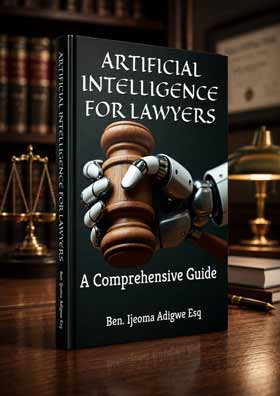 The book also examines Nigeria's legal ecosystem, focusing on the LPELR and NBA AI Guidelines. As a bonus, every purchase comes with a FREE eBook titled: How to Use the AI Features in LegalPedia and LawPavilion.
Ohio Books Ltd praises the publication, stating:
"....this is the only Nigerian book I know of on the topic."
How to Order:
📞 Call, Text, or WhatsApp: 08034917063 | 07055285878
📧 Email: benadigwe1@gmail.com
🌎 Website: www.benadigwe.com
Ebook Version: Access it directly online at https://selar.com/prv626
Authored by Ben Ijeoma Adigwe Esq., ACIarb (UK), LL.M, Dip. in Artificial Intelligence, Director at the Delta State Ministry of Justice, Asaba, Nigeria.
_______________________________________________________________________
“Enhance Legal Practice With Authoritative Reports” — Alexander Payne Offers Comprehensive Law Reports, Spanning Over A Century Of Nigerian Jurisprudence
The book also examines Nigeria's legal ecosystem, focusing on the LPELR and NBA AI Guidelines. As a bonus, every purchase comes with a FREE eBook titled: How to Use the AI Features in LegalPedia and LawPavilion.
Ohio Books Ltd praises the publication, stating:
"....this is the only Nigerian book I know of on the topic."
How to Order:
📞 Call, Text, or WhatsApp: 08034917063 | 07055285878
📧 Email: benadigwe1@gmail.com
🌎 Website: www.benadigwe.com
Ebook Version: Access it directly online at https://selar.com/prv626
Authored by Ben Ijeoma Adigwe Esq., ACIarb (UK), LL.M, Dip. in Artificial Intelligence, Director at the Delta State Ministry of Justice, Asaba, Nigeria.
_______________________________________________________________________
“Enhance Legal Practice With Authoritative Reports” — Alexander Payne Offers Comprehensive Law Reports, Spanning Over A Century Of Nigerian Jurisprudence
 Interested buyers are encouraged to place their orders and enquiries via:
0704 444 4777, 0704 444 4999, 0818 199 9888
Website: www.alexandernigeria.com
Interested buyers are encouraged to place their orders and enquiries via:
0704 444 4777, 0704 444 4999, 0818 199 9888
Website: www.alexandernigeria.com