*Condemns Executive’s Provision Of Infrastructure For Judges

The President of the Nigerian Bar Association, Mazi Afam Osigwe, SAN, has urged courts to avoid the use of complex Latin phrases in their rulings, calling instead for clear and unambiguous orders to prevent confusion and misinterpretation.
Osigwe also criticised the involvement of the executive arm of government in providing infrastructure and welfare items for judges, describing the practice as wrong and damaging to the integrity of the judiciary.
The NBA President made these remarks during an interview on Channels Television’s Politics Today programme on Friday, where he expressed concern over growing ambiguity in judicial pronouncements and the perception of judicial dependence on the executive.
Osigwe called on courts to stop using Latin maxims that create ambiguity.
“I think, considering the confusion that is arising in our body polity in recent times, our courts should not make orders using such Latin maxims like status quo ante bellum or pendente lite,” Osigwe stated.
“The court should make clear orders as to what it means so that there is no ambiguity. It creates confusion. We have rendered it almost meaningless.”
The NBA President said such phrases have lost their intended purpose.
“It has been stripped of any clear meaning, so our courts should avoid using such phrases and instead specify what orders they are making so that nobody will be left in doubt, and no administrative body will have to interpret it and try to give its own decision on it,” he stated.
Status quo ante bellum is a Latin phrase that means “the situation as it existed before the war.”
Osigwe stated that vague court orders often lead to multiple interpretations, with different parties claiming victory.
“I see situations where people go away rejoicing that the order was in their favour, thereby giving room for mischief or for anybody to interpret it the way they want,” he stated.
“Where a court has chosen to make an order, it should state clearly what it has set out to do and not hide behind any Latin maxims.”
The NBA President noted that while such legal expressions may not pose challenges in other jurisdictions, Nigeria’s peculiar environment makes their use confusing.
His remarks came amid controversy surrounding the interpretation of a Court of Appeal ruling involving the leadership crisis in the African Democratic Congress.
The court directed the parties to maintain the status quo ante bellum, but its interpretation sparked a dispute between the Independent National Electoral Commission and party factions.
INEC delisted the David Mark-led National Working Committee from its portal, but the Mark faction rejected the decision, insisting its leadership represents the last legitimate structure.
The disagreement also led to protests by the factions at the INEC headquarters in Abuja.
In a separate but related criticism, Osigwe condemned the practice of the executive arm providing infrastructure and welfare items for judges.
“It is wrong for the executive to build courtrooms, buy cars for judges, invite judges and hand over vehicles to them,” Osigwe stated.
He lamented that the growing trend portrays judges as beneficiaries of political patronage and weakens public trust in the justice system.
“Sometimes it would appear that the judiciary is happy. The judges are happy to be paraded by politicians receiving cars, as if the person were doing them a favor. As if the governor or minister or whoever is spending his own personal money. It demeans the judges. It demeans the judiciary,” Osigwe stated.
According to him, such actions create a troubling perception of closeness between the judiciary and the executive.
The NBA President described the issue as a moral concern, stressing that it raises doubts about fairness in the justice system.
“Judicial needs should be handled through proper budgetary processes. If the courts need houses, they should be put in their budget, and the courts should be allowed to handle it. The public display is demeaning and robs them of the perception of being independent,” he stated.
On judicial independence, Osigwe said: “Constitutionally, yes. But in reality, the perception is that the judiciary is not fully independent.”
He attributed the lack of genuine independence to financial control by governors.
“Sometimes the Chief Judge is reduced to going to the Government House to beg for release of statutory allocations. To that extent, it is not independent,” Osigwe stated.
The NBA President also warned against the increasing judicialisation of politics.
“Over the years, there have been worries that the electoral process has been overly judicialised, with fears of corrupt practices affecting judgments,” he said.
He urged restraint by legal practitioners.
“Lawyers should not be a tool in the hands of politicians, not to use litigation to manipulate the political process,” Osigwe stated.
The NBA President sounded a grave warning about the consequences of misusing the legal system.
“If the legal and judicial process is put to the wrong use, we may have the tendency of truncating democracy,” he stated.
Osigwe’s call for courts to avoid Latin maxims like “status quo ante bellum” directly addresses the confusion that has arisen from the Court of Appeal’s order in the ADC leadership dispute.
The term which means “the situation as it existed before the war” has been interpreted differently by INEC, the David Mark faction, and the Nafiu Bala Gombe faction, leading to protests and accusations of bias against the electoral commission.
By calling for “clear orders” that leave “nobody in doubt,” Osigwe is essentially suggesting that the judiciary bears some responsibility for the current confusion by using language that allows for multiple interpretations.
His criticism of the executive providing cars and courtrooms for judges strikes at the heart of concerns about judicial independence. When governors present vehicles to judges in public ceremonies, it creates a perception — whether accurate or not — that judges may be beholden to the executive.
The revelation that Chief Judges are sometimes “reduced to going to Government House to beg for release of statutory allocations” paints a troubling picture of a judiciary that, despite constitutional guarantees, may not be truly independent in practice.
For lawyers, Osigwe’s warning against being “tools in the hands of politicians” and using “litigation to manipulate the political process” echoes the NBA’s earlier press release threatening disciplinary action against lawyers who file cases in violation of the Electoral Act 2026.
The NBA President’s remarks represent a comprehensive critique of the current state of Nigeria’s legal and judicial system — from ambiguous court orders to compromised judicial independence to the weaponisation of litigation for political ends.
Whether these concerns will be addressed before the 2027 elections remains to be seen, but Osigwe’s warning that misuse of the legal process “may truncate democracy” underscores the high stakes involved.
 Interested buyers are encouraged to place their orders and enquiries via:
0704 444 4777, 0704 444 4999, 0818 199 9888
Website: www.alexandernigeria.com
Interested buyers are encouraged to place their orders and enquiries via:
0704 444 4777, 0704 444 4999, 0818 199 9888
Website: www.alexandernigeria.com

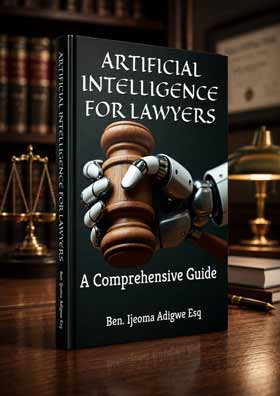 The book also examines Nigeria's legal ecosystem, focusing on the LPELR and NBA AI Guidelines. As a bonus, every purchase comes with a FREE eBook titled: How to Use the AI Features in LegalPedia and LawPavilion.
Ohio Books Ltd praises the publication, stating:
"....this is the only Nigerian book I know of on the topic."
How to Order:
📞 Call, Text, or WhatsApp: 08034917063 | 07055285878
📧 Email: benadigwe1@gmail.com
🌎 Website: www.benadigwe.com
Ebook Version: Access it directly online at https://selar.com/prv626
Authored by Ben Ijeoma Adigwe Esq., ACIarb (UK), LL.M, Dip. in Artificial Intelligence, Director at the Delta State Ministry of Justice, Asaba, Nigeria.
_______________________________________________________________________
The book also examines Nigeria's legal ecosystem, focusing on the LPELR and NBA AI Guidelines. As a bonus, every purchase comes with a FREE eBook titled: How to Use the AI Features in LegalPedia and LawPavilion.
Ohio Books Ltd praises the publication, stating:
"....this is the only Nigerian book I know of on the topic."
How to Order:
📞 Call, Text, or WhatsApp: 08034917063 | 07055285878
📧 Email: benadigwe1@gmail.com
🌎 Website: www.benadigwe.com
Ebook Version: Access it directly online at https://selar.com/prv626
Authored by Ben Ijeoma Adigwe Esq., ACIarb (UK), LL.M, Dip. in Artificial Intelligence, Director at the Delta State Ministry of Justice, Asaba, Nigeria.
_______________________________________________________________________