Forensic experts and key stakeholders have applauded the Federal Government and Tantita Security Services Nigeria Limited for their collaborative efforts in strengthening pipeline security, which has driven higher crude oil production and boosted national revenue.

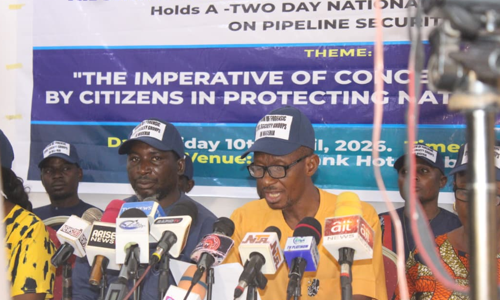
The commendation came at the end of a two-day National Dialogue on Pipeline Security held in Abuja, where participants linked recent gains in oil output to coordinated surveillance
The Forum of Forensic Civil Society Groups in Nigeria, in collaboration with the Centre for Social Justice, Equity and Transparency, convened the dialogue.
Under the theme: “The Imperative of Concerted Efforts by Citizens in Protecting National Asset,” the event gathered civil society organisations, security experts, policy analysts, community leaders, and government representatives to address challenges facing Nigeria’s critical oil infrastructure.
Participants noted that Nigeria’s oil pipelines remain the backbone of the economy, with improved security directly enhancing revenue generation and the government’s ability to deliver on public obligations.
They attributed recent rises in production levels and the decline in pipeline vandalism to structured surveillance, warning against any disruptive changes that could reverse these gains.
“The dialogue observed that recent improvements in crude oil production levels and the relative decline in pipeline vandalism are closely tied to more coordinated and structured surveillance frameworks. These gains, participants agreed, must be preserved and strengthened rather than subjected to disruptive experimentation,” the communique issued by Dr. Opialu Fabian said.
“The Forum expressed concern over increasing calls to fragment pipeline surveillance arrangements under the guise of inclusion, warning that such approaches risk undermining operational coherence, weakening accountability mechanisms, and creating vulnerabilities that could be exploited by criminal networks.
“Participants emphasised that pipeline protection is not a routine contractual engagement but a sensitive national security function requiring discipline, trust, intelligence coordination, and a clear chain of command. As such, it cannot be treated as an avenue for political accommodation or patronage distribution.”
Stakeholders at the dialogue stressed that introducing unvetted actors into surveillance operations could compromise intelligence and embolden oil theft syndicates, which have previously caused billions in lost revenue. While acknowledging the need for host community involvement, they insisted that inclusivity must come through structured engagement and capacity-building without sacrificing efficiency or security.
The forum highlighted that breaches in pipeline security affect the entire nation through reduced public spending, economic instability, and stalled development, urging that protection of national assets rise above sectional interests.
They also cautioned against politicising the debate, saying inflammatory narratives could heighten tensions in the Niger Delta and divert attention from core security goals.
“While recognising the legitimate concerns of host communities and the need for inclusivity, the Forum stressed that inclusion must be pursued through structured engagement, capacity-building, and clearly defined roles that do not compromise efficiency or security outcomes.
“Participants agreed that the protection of national assets must transcend sectional interests, as the consequences of pipeline breaches are borne collectively through reduced public spending, economic instability, and weakened national development.
“The Forum also cautioned against the politicisation of pipeline security debates, noting that inflammatory narratives around entitlement risk aggravating tensions in the Niger Delta and distracting from the primary objective of safeguarding national infrastructure.”
In their resolutions, the forum called for consolidation of current gains by sustaining effective coordinated surveillance models. They urged that any reforms be evidence-based, prioritising national interest and rigorous security assessments over pressures from interest groups, while strengthening oversight, transparency, and accountability in existing frameworks.
Stakeholders were encouraged to use constructive channels for concerns to avoid disrupting operations, alongside continuous civic education to foster collective responsibility in protecting national assets.
The dialogue emphasised deepening collaboration between government, communities, and credible security actors to improve intelligence sharing without undermining operational integrity.
“That the current gains in pipeline security should be consolidated through sustained support for coordinated surveillance frameworks that have demonstrated effectiveness.
“That any proposed reforms to pipeline surveillance arrangements must be evidence-based, guided by national interest, and subjected to rigorous security evaluation rather than driven by pressure from competing interest groups.
“That government should prioritise strengthening oversight, transparency, and accountability within existing frameworks to ensure optimal performance and public trust.”
The communiqué concluded that safeguarding oil infrastructure demands precision, coordination, and a shared national commitment rather than broad distribution of sensitive responsibilities.
It issued a renewed call for unity, urging all parties to place national interest above sectional considerations in securing the country’s economic lifeline.
The forum resolved that stakeholders, particularly aggrieved groups, should adopt constructive engagement channels and that there is an urgent need for continuous civic education to reinforce citizens’ collective responsibility against sabotage.
“The Forum concluded that safeguarding Nigeria’s oil infrastructure requires not just participation, but precision, coordination, and a shared commitment to national stability. In this regard, participants reaffirmed that some responsibilities, by their nature, demand structured control and strategic discipline rather than broad-based distribution.
“The dialogue closed with a renewed call for unity of purpose, urging all stakeholders to place national interest above sectional considerations in the ongoing effort to secure Nigeria’s economic lifeline.”
 Interested buyers are encouraged to place their orders and enquiries via:
0704 444 4777, 0704 444 4999, 0818 199 9888
Website: www.alexandernigeria.com
Interested buyers are encouraged to place their orders and enquiries via:
0704 444 4777, 0704 444 4999, 0818 199 9888
Website: www.alexandernigeria.com