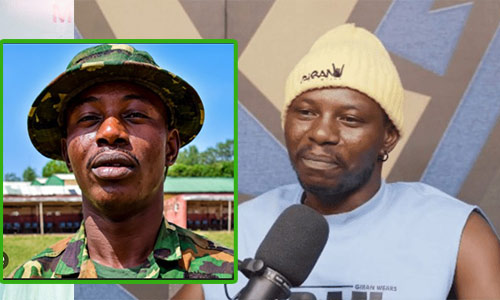
A dismissed Nigerian soldier, Rotimi Olamilekan, popularly known as “Soja Boi,” has escalated his dispute with the Nigerian Army, challenging the military authorities to make their payroll public amid a growing controversy over soldiers’ welfare and remuneration.

Olamilekan, a former lance corporal, made the demand in a video posted on Tuesday, shortly after the Army dismissed his earlier claims as false and misleading. In the video, he attempted to substantiate his allegations by displaying bank transaction alerts, which he said reflected his earnings while in service.
According to him, his monthly salary stood at ₦112,061.59, alongside a ₦20,000 “grumbling allowance.” He also identified a ₦45,000 operational allowance, which he said was only paid to personnel deployed to active conflict zones such as Maiduguri, and a ₦6,000 security allowance. He stressed that the operational and security allowances were not regular entitlements but were tied strictly to deployment in operational theatres.
He explained that soldiers not deployed to such operations receive only their basic salary and the ₦20,000 allowance. “If you are not on operation, they don’t pay you that one,” he said, adding that personnel on routine barracks duty are limited to these earnings.
Olamilekan further alleged that soldiers are often required to purchase their own protective gear, including helmets and fragmentation jackets, a claim he urged Nigerians to verify through relatives serving in the military.
“I am not trying to spoil the Nigerian Army’s image,” he said. “I am simply stating the facts and backing them with evidence.”
To reinforce his claims, he displayed three bank alerts: one dated February 2, 2026, showing a credit of ₦112,061.59; another dated February 4, 2026, reflecting ₦20,000; and a third dated November 4, 2025, indicating ₦45,000. However, while one of the alerts referenced “NIC-ARMY AC,” the others did not clearly identify the Nigerian Army or any government institution as the source of payment. The documents also lacked official payroll markings or letterheads, making independent verification difficult.
Despite this, Olamilekan maintained that his claims were factual and challenged the Army to publicly disclose its payroll structure. “If they say I am lying, they should bring out their payroll. How much are they paying soldiers?” he asked.
The Nigerian Army had earlier rejected his allegations, describing them as baseless and intended to misinform the public. In a statement issued by its Acting Director of Army Public Relations, Colonel Appolonia Anele, the Army insisted that it operates a structured and transparent salary system governed by the Manual of Financial Administration for the Armed Forces of Nigeria.
According to the Army, personnel receive consolidated monthly salaries along with uniform allowances, operational allowances, and other mission-specific benefits, all paid directly into their accounts. It also maintained that troops deployed to operational theatres receive additional entitlements such as Ration Cash Allowance and Habit Allowance, alongside feeding arrangements.
The Army further refuted claims that soldiers purchase their own uniforms or protective gear, stating that all necessary equipment, including helmets and bulletproof vests, are provided through established logistics systems. While acknowledging that some personnel may choose to supplement issued kits for personal comfort, it stressed that such actions are voluntary and do not reflect systemic failure.
“The Nigerian Army prioritises the welfare, safety, and force protection of its personnel,” Anele said, adding that no soldier is deployed without adequate equipment.
On the issue of discipline, the Army clarified that Olamilekan’s dismissal was not related to his public comments but resulted from repeated violations of military regulations. These included unauthorised media appearances, misuse of military identity, and breaches of the Armed Forces Social Media Policy.
The Army noted that his dismissal followed due process in line with military laws.
Olamilekan first gained public attention in February 2026 after a viral video in which he urged political leaders to send their children to serve in the military. He was subsequently arrested, spent his birthday in detention, and was later dismissed from service.
As the controversy continues, Olamilekan insists his intention is not to discredit the Army but to highlight what he describes as the realities faced by soldiers, while the military authorities maintain that his claims are misleading and undermine public confidence and troop morale.
[A MUST HAVE] Evidence Act Demystified With Recent And Contemporary Cases And Materials

Available now for NGN 40,000 at ASC Publications, 10, Boyle Street, Onikan, Lagos. Beside High Court, TBS. Email publications@ayindesanni.com or WhatsApp +2347056667384. Purchase Link: https://paystack.com/buy/evidence-act-complete-annotation
______________________________________________________________________ “Enhance Legal Practice With Authoritative Reports” — Alexander Payne Offers Comprehensive Law Reports, Spanning Over A Century Of Nigerian Jurisprudence Interested buyers are encouraged to place their orders and enquiries via:
0704 444 4777, 0704 444 4999, 0818 199 9888
Website: www.alexandernigeria.com
Interested buyers are encouraged to place their orders and enquiries via:
0704 444 4777, 0704 444 4999, 0818 199 9888
Website: www.alexandernigeria.com