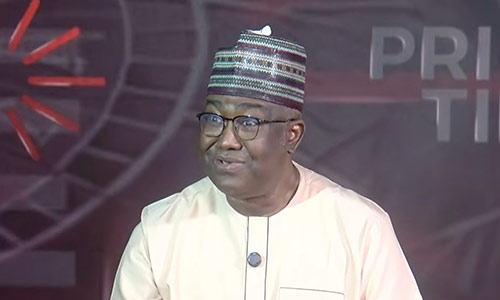
Dr. Wale Hashim, a founding member of the Peoples Democratic Party who recently resigned from the party, has lamented the decline of Nigeria’s judiciary, recalling a time when other African countries would request Nigerian judges to serve as their chief justices.

Speaking on Arise News Prime Time, Hashim contrasted the current state of the judiciary with a past era when Nigerian justices were internationally respected and sought after by other nations.
Hashim recalled his time serving in Botswana alongside Dr. Akinola Aguda, noting how Nigerian judges were once exported to lead judiciaries across the African continent.
“I was served in Botswana with Dr. Aura when other African countries used to request for Nigerian judges to be their chief justice. That was the quality of justices that were turning out at that particular time. I mean those were great men,” Hashim stated.
“So if Botswana will request for Aura to be chief judge, that tells you I mean in those days even under military rule the soldiers were never able to completely put the judiciary under their feet. They were not able to do that.”
Hashim recalled revered Supreme Court justices whose erudition Nigerians once looked forward to.
“I mean the Supreme Court where you had people like Justice Chukwudifu Oputa, Justice Kayode Eso, and all that we all looked forward, even though we were not lawyers, we all looked forward to the erudition, the judgment of the Supreme Court,” he stated.
“You were proud to be a Nigerian and Nigerians were regarded highly in the international scene.”
The former PDP chieftain expressed concern that Nigeria’s institutions, built over decades, are being dismantled.
“So this country has developed big institutions, you know, that small men are trying to bring down now. So what is at stake is the entire legacy of the democratic system, you understand, and our culture as a modern state that Nigeria has been as an example for even other countries,” Hashim stated.
Hashim identified himself as a product of Nigeria’s pro-democracy struggles.
“I am not of this era. I’m a product of the mass movements that struggled for democracy. And there are still quite a number of us in this country today. And thank God, God has preserved us for a day like this,” he stated.
“So for me, it’s not just about wanting to be president. It’s more serious than that.”
The former PDP chieftain recalled his own experience testing the judiciary’s independence during military rule.
“In 1989 as a young student leader, I was detained under Decree 2. And then when you were detained under Decree 2, no court of law could look at it. We tested the whole process and myself and my colleague were the first Nigerians to be released under Decree 2 because the judge then at Federal Court was bold enough to assume jurisdiction after four months detention in solitary confinement,” Hashim recalled.
“So we tested the will of the judiciary and we had good men in the judiciary in those days.”
Hashim also criticised the current state of governance, claiming that laws are not being published for citizens to know.
“Have you ever seen a copy of the Electoral Act? Do you have a clean copy of the signed Electoral Act? You don’t. Nobody has. In the days of even under military rule, when a decree is made, as draconian as the military system was, the government printer will publish the copy of the decree. Every Nigerian will have access to it,” he stated.
“Right now under this government, it’s only the president and his attorney general that knows what a law is talking about. It’s not published. It’s not gazetted. It’s a secret document. So the rule of law cannot exist when people don’t even know what the law is. Not to talk about the judiciary having the nerve to give a fair interpretation of it.”
Hashim, a founding convenor of the PDP in 1998 and its first elected deputy national publicity secretary, announced his resignation from the party, citing its deepening internal crisis.
He expressed concern that the Wike-led faction planned to ratify President Tinubu for 2027 at their convention.
“I wouldn’t be part of a process that would simply go and coronate the incumbent. The PDP was founded as a serious party. Its history was deeply rooted in the struggle against military dictatorship,” Hashim stated.
“When the PDP now degenerates to a party in the pocket of a minister in an opposition working with a party that is not the PDP, then calamity really has finally struck.”
Despite his resignation from the PDP, Hashim confirmed he would run for president in 2027.
“I’m going to run in 2027 for the presidency. Absolutely,” he stated when asked about his political future.
When asked under what party, he responded: “Well, just wait for the time for it to be unveiled.”
Dr. Hashim’s reflection on Nigeria’s judicial history highlights a stark contrast between the past and present.
The reference to Justice Akinola Aguda who served as Chief Justice of Botswana from 1971 to 1975 after a distinguished career in Nigeria — recalls an era when Nigerian legal expertise was so highly regarded that other nations sought to import it.
Today, Nigerian judges are rarely, if ever, appointed to international judicial positions, and the country’s judiciary faces persistent questions about independence and integrity.
Hashim’s lament that “small men are trying to bring down big institutions” speaks to broader concerns about the erosion of institutional independence in Nigeria.
For those who remember justices like Chukwudifu Oputa, Kayode Eso, and others whose judgments were celebrated as models of legal erudition, the current controversies surrounding the judiciary — including allegations of compromised judgments in electoral matters — represent a painful decline.
Hashim’s comments add to a growing chorus of voices expressing concern about the state of Nigeria’s democracy and its institutions ahead of the 2027 elections.
His warning that Nigeria is “being transformed from being a republic into an imperial state where the president is an emperor” reflects deep anxieties about the direction of the country — anxieties that his resignation from the PDP, after nearly three decades, symbolically underscores.
[A MUST HAVE] Evidence Act Demystified With Recent And Contemporary Cases And Materials

Available now for NGN 40,000 at ASC Publications, 10, Boyle Street, Onikan, Lagos. Beside High Court, TBS. Email publications@ayindesanni.com or WhatsApp +2347056667384. Purchase Link: https://paystack.com/buy/evidence-act-complete-annotation
______________________________________________________________________ “Enhance Legal Practice With Authoritative Reports” — Alexander Payne Offers Comprehensive Law Reports, Spanning Over A Century Of Nigerian Jurisprudence Interested buyers are encouraged to place their orders and enquiries via:
0704 444 4777, 0704 444 4999, 0818 199 9888
Website: www.alexandernigeria.com
Interested buyers are encouraged to place their orders and enquiries via:
0704 444 4777, 0704 444 4999, 0818 199 9888
Website: www.alexandernigeria.com