
By Olumide Babalola

I must concede that arriving at a fitting title for this article proved more difficult than anticipated, as I found myself piecing together multiple phrases in an attempt to capture its scope. Nonetheless, recent developments within Nigeria’s privacy landscape over the past few weeks have made a reflection on this subject both timely and necessary, even if the resulting formulation appears somewhat improperly structured.
Notably, on 13 March 2026, the Nigeria Data Protection Commission (NDPC) issued a notice to content creators in Nigeria, urging them to respect individuals’ privacy in public, specifically in response to a content creator who recorded passengers at a bus stop in Lagos. The NDPC’s notice, which carried implicit threats of enforcement, sparked widespread public debate regarding its appropriateness and tone. Remarkably, just four days later, the Federal High Court delivered a landmark judgment affirming citizens’ right to record police officers while performing their official duties.
In my capacity as Chair of the NBA Data Protection Committee, I convened a discussion with several professionals to examine the NDPC’s notice. During the webinar, the Federal High Court’s judgment was cited, sparking divergent narratives both supporting and challenging the scope of privacy in public spaces. In this article, I provide a brief commentary on the privacy-related aspects of that judgment, while also reflecting on the still limited legal framework governing the reasonable expectation of privacy in Nigeria.
Stop and Search versus Privacy
The Applicant, a lawyer and managing partner of Lex Phronesis Solicitors, approached the court challenging police harassment forbidding him from recording them during stop and search on the road especially where the police officers were either uninformed or without wearing identification badges. Remarkably, one the issues he canvassed before the court was whether stop and search conducted by unidentifiable police officers constituted a violation of privacy under section 37 of the Constitution.
In answering his questions for determination, My Lord H.A. Nganjiwa, FJ remarkably held that: “By the above statutory provisions, a search carried out without proper uniform or identity is considered illegal, violating the citizen’s right to privacy as guaranteed under the constitution.” First, it must be noted that stop and searches on the road are mostly warrantless’ searches and sometimes conducted on phones, vehicles and everything inside including passengers. Hence, this pronouncement resonates with existing Court of Appeal decision that recognises instances where warrantless searches could violate privacy. See Hassan v. E.F.C.C. (2014) 1 NWLR (Pt. 1389) 607 were the Court of Appeal held that: “For any search conducted on a premises without a warrant is unlawful and unconstitutional because the said act would amount to an infraction of the Constitutional right to privacy as provided by section 37 of the Constitution which states that the privacy of citizens, their homes, correspondence, telephone conversations and telegraphic communications is guaranteed and protected.”
The Contradiction
On how citizens could protect their privacy during stop and search especially by unidentiable police officers, H.A. Nganjiwa, FJ interestingly held that: “I agree with the Applicant that Nigerian citizens have the right to record police officers performing their duties, including during a road search or traffic stop, in order to document and subsequently disseminate that information as this gives room for accountability provided a citizen does not obstruct or interfere with the police physically. I also agree with the submission of the Applicant that in accordance with a citizen’s right to privacy he or she can record acts of police officers as it relates to the search of their vehicle or property.”
The tension in the statement above is found in his lordship’s attempt to pull two principles from opposite directions. My Lord’s holding seeks to merge freedom of expression enforced by citizens’ right to record police to document public conduct and the right to privacy, which enables individuals to control access to their personal space, property, and information in this context.
The contradiction is however found in the court’s allusion that “citizens can record police because of their right to privacy.” This is not, with respect to his Lordship, adding up, from a privacy perspective. It must be appreciated that recording is not, strictly speaking, an exercise of privacy but an act of observation and documentation, and in itself, a potential intrusion into someone else’s sphere (including the officer or third parties), of course, except we are implying that public officers are not entitled to enjoy the right to privacy. Confirming public figures’ entitlement to privacy, the High Court of Lagos State, per Oresanya, J. in Falana, SAN v Meta (LD/17783MFHR/2025) held that: “I must add that the fact that the Applicant i s a public figure does not mean that he has no right to his privacy. The relevant Constitutional provision on privacy (Section 37, 1999 Constitution) did not make a distinction between a public figure and a private person, the right to privacy is available to all persons irrespective of their status, ethnicity, origin, sex, nationality, race or colour and so on.”
So while privacy protects individuals from being watched or recorded without justification, in a conceptually inconsistent position, My Lord Justice Nganjiwa’s holding, seeks to justify recording by privacy. With respect to the court, the decision rightly positions privacy as a shield but wrongly justifies it with recording, which is a tool used to document intrusion. There lies the confusion and contradiction where the court essentially held that “One can invade (i.e record) privacy to protect against invasion of privacy”
Regardless of the conceptual mix-up, I chose to see this as a judicial contrivance to the effect that individuals have the right to record police based on public accountability and freedom of expression, as well as the right to privacy, which protects them during searches and limits how police can intrude into their personal space. Ultimately, in this context, recording then becomes a tool to enforce privacy, but not a right derived from privacy itself, but from freedom of expression
Privacy in public spaces
Going by the wording of section 37 of the Constitution and our caselaw, it is usually taken for granted that our privacy jurisprudence does not recognise a reasonable expectation of privacy in public. This position is further compounded by the lack of court decisions or literature on this issue; however, it is my respectful opinion that privacy can be enforced outside the home, in other words, in public.
The Court of Appeal made this clear, albeit not directly in Nwali v. Ebonyi State Independent Electoral Commission (EBSIEC) & ORS (2014) LPELR-23682 (CA), where an electoral body opted for open ballot system requiring voters to queue behind the candidate of their choice in the full glare of everybody in public. The Appellant approached the court that such a requirement and practice constituted a violation of their right to privacy under section 37 of the Constitution but the trial court was of the opinion that privacy was only meant for the home when his lordship held that: “The complaint of the applicant is not that he is being prevented from picking a candidate of his own choice. His complaint is that he will be made to publicly vote for his candidate. In my humble view, it is pretty difficult to see how this violates his privacy. The right to privacy contemplates right to privacy at home, privacy of one’s communication, privacy in private family life and matters incidental thereto. It is not right to privacy in every activity under the sun”
On appeal, while setting aside the trial court’s position, the Court of Appeal held that: “Therefore requiring or compelling him to vote openly in the public watch and knowledge by queuing in front of the poster carrying the portrait of the candidate he has decided to vote for intrudes into, interferes with, and invades the privacy of his said decision, choice and voting, completely removing that privacy, therefore amounting to a clear violation of his fundamental right to the privacy of a citizen guaranteed him and protected by S.37 of the 1999 Constitution. The decision of the trial Court that it does not see how making the appellant to vote publicly violates his privacy is therefore clearly wrong.”
The decision of the Court of Appeal clearly affirms that the constitutional right to privacy under Section 37 is not confined to strictly private or secluded spaces, but can extend into public settings where personal autonomy and confidentiality are implicated. The Court reasoned that such enforced openness does not merely make the act visible; it fundamentally invades the privacy of the voter’s decision, thereby undermining the constitutional guarantee. It rejected the trial court’s narrow interpretation of privacy as being limited to physical seclusion, and instead adopted a broader, more purposive approach, recognizing that privacy also encompasses informational and decisional autonomy, even where the individual is physically present in a public space. This reasoning is significant because it demonstrates that privacy rights are not extinguished merely because an act occurs in public view. Rather, where a public process compels the disclosure of inherently personal information, it may amount to a violation of the right to privacy. The essence of the breach lies not in the location, but in the forced exposure of a protected personal choice.
Conclusion
The foregoing analysis reveals that Nigeria’s privacy jurisprudence is at a critical, if somewhat unsettled, stage of development. While Section 37 of the Constitution has traditionally been interpreted through the narrow lens of spatial privacy, focused on the home, correspondence, and communications, recent regulatory interventions and judicial pronouncements suggest an emerging shift toward a more expansive understanding. The Federal High Court’s decision commendably reinforces the need for accountability in law enforcement by affirming the right of citizens to record police officers in the course of their official duties. However, its attempt to root that right in privacy doctrine exposes a conceptual inconsistency that, if left unclarified, may blur the boundaries between distinct constitutional guarantees. Recording, properly situated, is an incident of freedom of expression and civic accountability; privacy, on the other hand, operates as a protective shield against unwarranted intrusion. Conflating both risks and doctrinal uncertainty.
Notwithstanding this tension, the decision of the Court of Appeal in Nwali v. EBSIEC & Ors provides a more stable jurisprudential anchor. It affirms, in clear terms, that privacy under Section 37 is not extinguished by mere presence in a public space. Rather, it extends to the protection of deeply personal choices against compelled public disclosure. This recognition aligns with a more modern conception of privacy as encompassing informational and decisional autonomy, beyond mere physical seclusion.
In this light, the ongoing discourse, prompted in part by the intervention of the Nigeria Data Protection Commission, should not be viewed as disjointed or haphazard, but as part of an evolving legal conversation. The real task for courts, regulators, and scholars is to delineate with greater precision the contours of privacy in public: to acknowledge that while visibility in public may reduce expectations of anonymity, it does not amount to a wholesale surrender of dignity, autonomy, or control over personal information. Ultimately, a coherent framework must emerge, one that preserves the citizen’s right to hold power to account through recording and documentation, while simultaneously safeguarding the residual, yet significant, privacy interests that subsist even in public spaces. Until then, the law will continue to develop incrementally, shaped by judicial ingenuity, regulatory guidance, and scholarly interrogation.
[A MUST HAVE] Evidence Act Demystified With Recent And Contemporary Cases And Materials

Available now for NGN 40,000 at ASC Publications, 10, Boyle Street, Onikan, Lagos. Beside High Court, TBS. Email publications@ayindesanni.com or WhatsApp +2347056667384. Purchase Link: https://paystack.com/buy/evidence-act-complete-annotation
______________________________________________________________________ “Enhance Legal Practice With Authoritative Reports” — Alexander Payne Offers Comprehensive Law Reports, Spanning Over A Century Of Nigerian Jurisprudence Interested buyers are encouraged to place their orders and enquiries via:
0704 444 4777, 0704 444 4999, 0818 199 9888
Website: www.alexandernigeria.com
Interested buyers are encouraged to place their orders and enquiries via:
0704 444 4777, 0704 444 4999, 0818 199 9888
Website: www.alexandernigeria.com
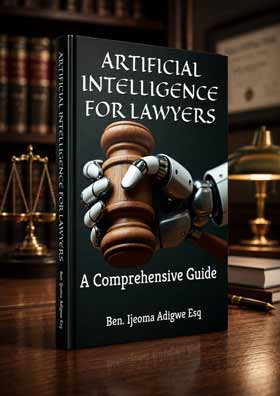 The book also examines Nigeria's legal ecosystem, focusing on the LPELR and NBA AI Guidelines. As a bonus, every purchase comes with a FREE eBook titled: How to Use the AI Features in LegalPedia and LawPavilion.
Ohio Books Ltd praises the publication, stating:
"....this is the only Nigerian book I know of on the topic."
How to Order:
📞 Call, Text, or WhatsApp: 08034917063 | 07055285878
📧 Email: benadigwe1@gmail.com
🌎 Website: www.benadigwe.com
Ebook Version: Access it directly online at https://selar.com/prv626
Authored by Ben Ijeoma Adigwe Esq., ACIarb (UK), LL.M, Dip. in Artificial Intelligence, Director at the Delta State Ministry of Justice, Asaba, Nigeria.
______________________________________________________________________
The book also examines Nigeria's legal ecosystem, focusing on the LPELR and NBA AI Guidelines. As a bonus, every purchase comes with a FREE eBook titled: How to Use the AI Features in LegalPedia and LawPavilion.
Ohio Books Ltd praises the publication, stating:
"....this is the only Nigerian book I know of on the topic."
How to Order:
📞 Call, Text, or WhatsApp: 08034917063 | 07055285878
📧 Email: benadigwe1@gmail.com
🌎 Website: www.benadigwe.com
Ebook Version: Access it directly online at https://selar.com/prv626
Authored by Ben Ijeoma Adigwe Esq., ACIarb (UK), LL.M, Dip. in Artificial Intelligence, Director at the Delta State Ministry of Justice, Asaba, Nigeria.
______________________________________________________________________