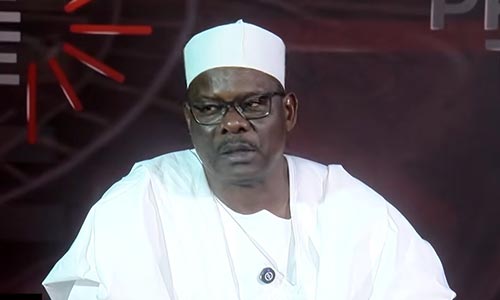
The Presidency has cautioned Senator Ali Ndume against making sweeping claims about terrorism on television, urging him to channel any credible intelligence directly to the Chief of Defence Staff, the National Security Adviser, and other intelligence bodies — even as the senator insists that Nigerian soldiers are being outgunned by terrorists due to inadequate equipment, with entire communities in Borno State reduced to rubble.

The exchange between the Presidency and the lawmaker representing Borno South highlights the growing tension between the Tinubu administration and prominent voices in the Northeast over the government’s handling of the worsening security crisis in the region.
Senator Ndume raised the alarm after an assessment visit to Ngoshe and Pulka communities in Gwoza Local Government Area of Borno State, alongside Governor Babagana Zulum, following coordinated assaults by Boko Haram fighters in collaboration with the Islamic State West Africa Province.
The attacks killed several soldiers, the village head and community elders, including a woman. Women and children were also abducted during the raid.
Ndume described scenes of total devastation.
“I have visited Ngoshe; it is something you cannot fully describe unless you have seen it. It has been brought down to ground zero. The destruction is complete. There is nothing left standing except one small mosque,” the senator stated.
He disclosed that Nigerian troops were initially overwhelmed by the superior firepower of the insurgents and had to withdraw from Ngoshe and Pulka before reinforcements enabled them to reclaim the communities days later.
“I gathered that our soldiers lacked adequate ammunition and had to withdraw from Ngoshe and Pulka because the terrorists overwhelmed them. It was days after reinforcement that they regained the area. Nothing was left standing in Ngoshe and Pulka,” Ndume stated.
In a subsequent appearance on Channels Television, Ndume went further, alleging that insurgents use commercial tricycles to transport explosives and maintain a network of informants embedded within local communities.
“What they do is hit and run. They gather, share information among themselves, and most dangerously, they get information from some citizens too. They have informants within society,” the senator stated.
He also criticised the government’s response directly: “The government, I must say, are not walking the talk. Security agencies and soldiers still do not have the training, equipment, ammunition, and motivation they need.”
Special Adviser to the President on Information and Strategy, Bayo Onanuga, responded by cautioning Ndume against discussing intelligence matters on television.
“If Senator Ndume has credible intelligence beyond what security agencies already know, the appropriate step is to share it with the Chief of Defence Staff, the National Security Adviser, or relevant intelligence bodies, not to discuss it on television,” Onanuga stated.
He stressed that such information requires confidential handling to enable effective operational response, warning that disclosing specific operational details in the media could be counterproductive.
Onanuga defended the Tinubu administration’s security record, citing several measures taken to address the crisis.
He pointed to increased defence spending in the 2026 Appropriation Bill, which he described as the highest budgetary allocation to defence in Nigeria’s history. He also highlighted the acquisition of military hardware from France and the United Kingdom, and President Tinubu’s directive for security chiefs to relocate to Maiduguri following the March 16 suicide bombings that killed 23 people and injured over 100.
“The President has demonstrated commitment by approving the highest budgetary allocation to defence in the 2026 Appropriation Bill, securing military equipment from France and the United Kingdom, and directing security chiefs to relocate to Maiduguri,” Onanuga stated.
Ndume’s position, however, is that despite budgetary allocations and equipment procurement, the reality on the ground remains dire. His first-hand account of visiting devastated communities and his disclosure that soldiers had to withdraw due to inadequate ammunition present a picture that contradicts the Presidency’s narrative of progress.
The senator called on the Federal Government to double its efforts in equipping the army with sophisticated arms and ammunition and to urgently support the Borno State Government in rebuilding devastated communities and providing relief to displaced persons.
He commended Governor Zulum for personally visiting the affected areas and spending a night in Pulka, noting the psychological impact on displaced residents.
“The people are resilient. I interacted with them and many are determined to return home rather than relocate to cities. Since they have that determination, the government must act swiftly to rebuild the communities,” Ndume stated.
He disclosed plans to raise the matter at the National Assembly, hinting at a possible motion to galvanise legislative intervention.
The exchange exposes a fundamental tension between the government’s messaging on security — which emphasises budgets, hardware acquisitions, and directives — and the lived reality of communities in the Northeast, where soldiers are reportedly still underequipped, insurgents carry out coordinated attacks with impunity, and entire towns are reduced to rubble.
Ndume’s insistence on speaking publicly, despite the Presidency’s warning, reflects his position as the senator representing one of the worst-affected areas. His argument, implicit in his statements, is that confidential reporting has not produced results and that public pressure is necessary to force urgent action.
The Presidency’s counter-argument — that intelligence should be handled through proper channels — raises valid operational security concerns but also carries the risk of appearing to prioritise message control over substantive response to a crisis that continues to claim lives and displace communities across the Northeast.
[A MUST HAVE] Evidence Act Demystified With Recent And Contemporary Cases And Materials

Available now for NGN 40,000 at ASC Publications, 10, Boyle Street, Onikan, Lagos. Beside High Court, TBS. Email publications@ayindesanni.com or WhatsApp +2347056667384. Purchase Link: https://paystack.com/buy/evidence-act-complete-annotation
______________________________________________________________________ “Enhance Legal Practice With Authoritative Reports” — Alexander Payne Offers Comprehensive Law Reports, Spanning Over A Century Of Nigerian Jurisprudence Interested buyers are encouraged to place their orders and enquiries via:
0704 444 4777, 0704 444 4999, 0818 199 9888
Website: www.alexandernigeria.com
Interested buyers are encouraged to place their orders and enquiries via:
0704 444 4777, 0704 444 4999, 0818 199 9888
Website: www.alexandernigeria.com