The Federal High Court sitting in Abuja on Wednesday dismissed an objection raised by the Chief of Staff (CoS) to Governor Usman Ododo of Kogi State, Ali Bello, to the admissibility of extrajudicial statements he made in the alleged N10 billion money laundering trial.

The trial judge, Justice James Omotosho, in a ruling, also dismissed the objection by Bello’s co-defendant, Dauda Suleiman, to the tendering of his two statements as evidence by the Economic and Financial Crimes Commission (EFCC).
The judge held that the EFCC complied with the provisions of Sections 15(4) and 17(2) of the Administration of Criminal Justice Act (ACJA), 2015, in obtaining the statements in dispute.
“Consequently, the statements of the defendants are admissible in evidence, as they were made voluntarily,” the judge ruled.
Bello (the first defendant), also a nephew of former Governor Yahaya Bello, and Suleiman (the second defendant) had told the court that the extra-judicial statements sought to be tendered by EFCC as evidence against them were made under duress.
The Kogi CoS was said to have made those statements on 29, 30 November 2022, and 1, 10, 11 and 12 December 2022, respectively, while Suleiman made two statements on 30 November and 1 December 2022.
The defendants are being prosecuted by the anti-graft agency for allegedly laundering Kogi State’s funds to the tune of N10 billion.
The charges relate to alleged unlawful activities during the tenure of ex-Governor Yahaya Bello, who is also facing two different charges bordering on alleged money laundering at the Federal High Court and the High Court of the Federal Capital Territory (FCT), Abuja.
The duo, through their lawyers, Abubakar Aliyu, SAN, and Olusegun Jolaawo, SAN, had, on February 16, objected to the plan by the EFCC’s lawyer, Rotimi Oyedepo, SAN, to tender the eight statements they allegedly made as exhibits while leading Ahmed Audu Abubakar, the 17th prosecution witness (PW17), in evidence.
While Aliyu, who appeared for Bello, insisted that the six statements made by his client were not made voluntarily, Jolaawo, counsel for Sulaiman, equally told the court that his client was threatened by the commission’s operatives who took his two statements.
However, Oyedepo disagreed with the defence submissions, arguing that most of the statements were obtained in the presence of their lawyer, Z. E Abbas.
Justice Omotosho then ordered a trial-within-trial and directed Abubakar, who is PW-17, to give evidence as PW-1 in the trial-within-trial.
After the anti-graft agency called its three witnesses, Bello and Sulaiman opened their case in the trial-within-trial.
However, Bello opted not to call any oral evidence.
Instead, he tendered the Certified True Copies (CTCs) of a judgement and an enrolled order of the Kogi High Court in his defence of allegations that the extra-judicial statements made were not voluntarily obtained by the EFCC operatives.
But Suleiman testified as the 1st defence witness (DW-1) and narrated how he was drafted into the case.
After the parties adopted their written addresses in the trial-within-trial, Justice Omotosho fixed Wednesday for ruling.
Delivering the ruling, the judge observed that the EFCC’s witnesses denied threatening the defendants while obtaining their statements and that the statements were not confessional, as the defendants denied some allegations in the statements.
He equally observed that Suleiman, who testified as DW-1, though alleging that the officers threatened him with an electric chair, stated during cross-examination that he never saw any electric chair where the statement was being taken.
The judge noted that Suleiman confirmed that a lawyer, “Z.E. Abbas Esq”, actually endorsed the statements, indicating they were made in his presence.
He said the defendants did not deny that they were the ones who wrote the statements themselves; their only complaint was that they were threatened into making them.
Justice Omotosho held that the defendants ought to have called Abbas to give evidence in the trial-within-trial and that their failure to do so was a fundamental error.
“Now, the said Z.E. Abbas Esq. is a known person and has appeared for the defendants in this matter. For the defendants to succeed on their claims that the statements were not made voluntarily, they ought to have called Z.E. Abbas Esq. to testify. The defendants failed to call Z.E. Abbas Esq. This failure raises the presumption that the evidence of Z.E. Abbas would have been against their interest if they had called him. This omission by the defendants raises a presumption of withholding evidence under Section 167 of the Evidence Act, 2011. Apart from being a case of withholding evidence, the defendants’ failure to call their counsel, Z.E. Abbas Esq., is an admission of the prosecution’s evidence that the statements were obtained voluntarily. The second defendant even testified to the credibility of Z.E. Abbas Esq., stating that he is a truthful person and that he agrees with whatever he says,” the judge said.
The judge also agreed that the statements made by Bello on 30 November 2022, 1 December 2022, and 12 December 2022, before Z.E. Abbas, were all made voluntarily.
According to him, these are very credible proof that the statements were made voluntarily without further corroboration.
Justice Omotosho, therefore, admitted the six statements made by Bello as “Exhibits R to R5” and admitted the two statements made by Suleiman as “Exhibits S and S1.”
The judge, who adjourned the matter until 21 and 24 April for the prosecution to close its case, threatened that if the EFCC fails to produce all their witnesses, the case would be deemed closed.
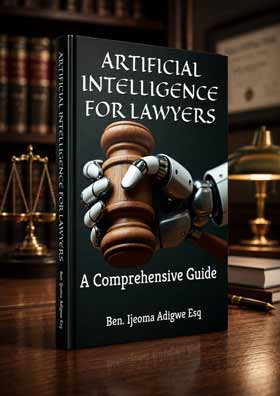 The book also examines Nigeria's legal ecosystem, focusing on the LPELR and NBA AI Guidelines. As a bonus, every purchase comes with a FREE eBook titled: How to Use the AI Features in LegalPedia and LawPavilion.
Ohio Books Ltd praises the publication, stating:
"....this is the only Nigerian book I know of on the topic."
How to Order:
📞 Call, Text, or WhatsApp: 08034917063 | 07055285878
📧 Email: benadigwe1@gmail.com
🌎 Website: www.benadigwe.com
Ebook Version: Access it directly online at https://selar.com/prv626
Authored by Ben Ijeoma Adigwe Esq., ACIarb (UK), LL.M, Dip. in Artificial Intelligence, Director at the Delta State Ministry of Justice, Asaba, Nigeria.
______________________________________________________________________
[A MUST HAVE] Evidence Act Demystified With Recent And Contemporary Cases And Materials
The book also examines Nigeria's legal ecosystem, focusing on the LPELR and NBA AI Guidelines. As a bonus, every purchase comes with a FREE eBook titled: How to Use the AI Features in LegalPedia and LawPavilion.
Ohio Books Ltd praises the publication, stating:
"....this is the only Nigerian book I know of on the topic."
How to Order:
📞 Call, Text, or WhatsApp: 08034917063 | 07055285878
📧 Email: benadigwe1@gmail.com
🌎 Website: www.benadigwe.com
Ebook Version: Access it directly online at https://selar.com/prv626
Authored by Ben Ijeoma Adigwe Esq., ACIarb (UK), LL.M, Dip. in Artificial Intelligence, Director at the Delta State Ministry of Justice, Asaba, Nigeria.
______________________________________________________________________
[A MUST HAVE] Evidence Act Demystified With Recent And Contemporary Cases And Materials

 Interested buyers are encouraged to place their orders and enquiries via:
0704 444 4777, 0704 444 4999, 0818 199 9888
Website: www.alexandernigeria.com
Interested buyers are encouraged to place their orders and enquiries via:
0704 444 4777, 0704 444 4999, 0818 199 9888
Website: www.alexandernigeria.com