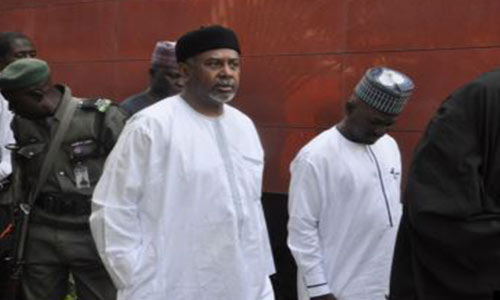
A witness told the FCT High Court, Abuja, on Tuesday that former National Security Adviser (NSA) Sambo Dasuki’s co-defendant in a security funds diversion trial voluntarily gave his statements and was treated well in custody in 2015.

The witness, Halima Kazeem, an assistant commandant 1 at the Economic and Financial Crimes Commission (EFCC), testified during the trial-within-trial conducted to test the voluntariness of some extra-judicial statements credited to Mr Dasuki’s co-defendant, Aminu Baba-Kusa.
“There was no torture of any kind, whether verbal or physical. He (Mr Baba-Kusa) was treated with the utmost respect as a suspect,” Ms Kazeem said, adding that she was not aware of any mishandling of the defendant.
For over a decade, the EFCC has been prosecuting Mr Dasuki, a retired colonel, alongside Mr Baba-Kusa on 32 counts of diversion of N33.2 billion arms and security funds entrusted to the NSA office.
Also facing the charges along with the two men are two of Mr Baba-Kusa’s companies – Acacia Holdings Limited and Reliance Referral Hospital Limited – which allegedly received part of the suspicious funds from the Office of the National Security Adviser (ONSA).
The anti-graft agency re-arraigned the defendants in March last year after the case was reassigned to Judge Charles Agbaza. They all denied charges.
On 14 January, the EFCC tried to tender Mr Baba-Kusa’s statements as evidence, but his lawyers objected to their admissibility on the grounds that they were obtained under duress.
Mr Baba-Kusa’s lawyer argued that a statement made by someone while being held in the underground cell of the EFCC could not be said to have been freely made.
He also said there was no compliance with Section 15(4) and 17 (2) of the Administration of Justice Act 2015.
This prompted the judge to order a trial within a trial to ascertain the voluntariness of the statements.
Both of Messrs Dasuki and Baba-Kusa were present at Tuesday’s proceedings, where Ms Kazeem took the stand to testify for the EFCC in the trial-within-trial.
She said as of November 2015 when Mr Baba-Kusa made the disputed statements, “the issue of video coverage was not mandatory.”
She also insisted that Mr Baba-Kusa’s lawyer was present when his seven statements were taken. Ms Kazeem said Mr Baba-Kusa had access to many visitors.
EFCC’s prosecution lawyer, Rotimi Jacobs, a Senior Advocate of Nigeria (SAN), then presented Mr Baba-Kusa’s statements written between November and December 2015, through the witness.
Under cross-examination by defence lawyer Solomon Umoh, also a SAN, the witness insisted that the second defendant reported at the commission with his financial secretary, company secretary and his son.
However, not all the statements Mr Baba-Kusa made were taken by her, the witness said. Referring to the fourth statement, she noted that it was not counter-signed by any other person but the defendant alone.
The statement was obtained by a member of the investigations team on the day the EFCC searched his office and house and spanned over three hours.
On the day of the EFCC search, Ms Kazeem said, Mr Baba-Kusa’s statement was taken by an assigned investigator over the course of three hours.
According to the witness, the length of time was “based on the volume of items recovered from his house and office.”
When asked if Mr Baba-Kusa was induced to act as a witness against Mr Dasuki, the witness replied, “I did not induce the second defendant. “All questions and interactions between the second defendant and me were based on the facts of the investigations.”
Mr Umoh also grilled Ms Kazeem over the circumstances of Mr Baba-Kusa’s seven-day detention.
But she explained that the relatively long detention was due to Mr Baba-Kusa’s inability to meet his bail conditions.
She also said he had access to his phone and visitors anytime he wanted during the detention period.
Reading from Mr Baba-Kusa’s statement, the lawyer said, “The witness begged to be allowed for two weeks.” However, Mr Jacobs interjected that Mr Umoh could not rely on the statement following his argument that it was involuntary.
But the trial judge, Mr Agbaza, allowed Mr Umoh to continue.
Mr Umoh said he was trying to create a picture of a man in bondage.
He said the defendant requested two weeks out of custody to dispose of his properties worth 2.2 billion. ‘It was here you induced him to serve as a witness,” Mr Umoh said, referring to Ms Kazeem.
Replying, the witness maintained that Mr Baba-Kusa made his choices, and that “he has not refunded the money to date.”
Fielding question from another defence lawyer, Ebie Richard, who represented one Mr Baba-Kusa’s companies, on whether Mr Baba-Kusa was detained in an underground facility.
The witness replied, “The cell in Idiagbon House, based on the topology, is in the basement.”
The judge adjourned the matter till tomorrow (Wednesday).
So far, the EFCC has called one prosecution witness in the substantive trial in which the defendants face allegations of diverting N33.2 billion arms and security funds entrusted to the NSA office.
In January, Michael Adarikun, the first prosecution witness, who is a detective with the EFCC, narrated how N2.2 billion intended for election security was allegedly diverted from the NSA office under the leadership of Mr Dasuki.
So far, he has testified about transfers from ONSA’s account, with the approval of Mr Dasuki, to Mr Babba-Kusa, who allegedly used the proceeds to buy properties and foreign currencies in euros and dollars.
The decade-old trial suffered multiple adjournments in its early years, largely due to the State Security Services (SSS) refusing to release Mr Dasuki on bail despite multiple court orders.
Mr Dasuki served as NSA between 2012 and 2015, in the heat of Boko Haram attacks in Nigeria’s North-east, under the administration of then-President Goodluck Jonathan.
The N33.2 billion fraud trial is one of several cases the EFCC filed in the aftermath of the scandal of alleged diversion of funds meant for procurement of arms to firm up the Nigerian military’s offensive against Boko Haram terrorists between 2014 and 2015, during the President Jonathan administration.
An audit panel, established by President Muhammadu Buhari following his 2015 election victory, found that approximately $2 billion for arms procurement was unaccounted for. These funds were managed by the NSA, led by Mr Dasuki.
Mr Dasuki is also standing trial alongside former Sokoto State Governor Attahiru Bafarawa, his son Sagir Bafarawa, former Minister of State for Finance Bashir Yuguda, and Dalhatu Investment Limited for N4.6 billion arms procurement fraud.
The charges accused them of diverting N4.6 billion from the NSA office’s account. The money was said to be meant for the procurement of arms to firm up the offensive against Boko Haram terrorists between 2014 and 2015.
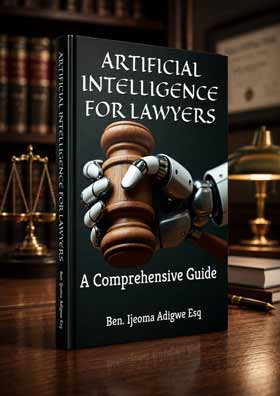 The book also examines Nigeria's legal ecosystem, focusing on the LPELR and NBA AI Guidelines. As a bonus, every purchase comes with a FREE eBook titled: How to Use the AI Features in LegalPedia and LawPavilion.
Ohio Books Ltd praises the publication, stating:
"....this is the only Nigerian book I know of on the topic."
How to Order:
📞 Call, Text, or WhatsApp: 08034917063 | 07055285878
📧 Email: benadigwe1@gmail.com
🌎 Website: www.benadigwe.com
Ebook Version: Access it directly online at https://selar.com/prv626
Authored by Ben Ijeoma Adigwe Esq., ACIarb (UK), LL.M, Dip. in Artificial Intelligence, Director at the Delta State Ministry of Justice, Asaba, Nigeria.
______________________________________________________________________
[A MUST HAVE] Evidence Act Demystified With Recent And Contemporary Cases And Materials
The book also examines Nigeria's legal ecosystem, focusing on the LPELR and NBA AI Guidelines. As a bonus, every purchase comes with a FREE eBook titled: How to Use the AI Features in LegalPedia and LawPavilion.
Ohio Books Ltd praises the publication, stating:
"....this is the only Nigerian book I know of on the topic."
How to Order:
📞 Call, Text, or WhatsApp: 08034917063 | 07055285878
📧 Email: benadigwe1@gmail.com
🌎 Website: www.benadigwe.com
Ebook Version: Access it directly online at https://selar.com/prv626
Authored by Ben Ijeoma Adigwe Esq., ACIarb (UK), LL.M, Dip. in Artificial Intelligence, Director at the Delta State Ministry of Justice, Asaba, Nigeria.
______________________________________________________________________
[A MUST HAVE] Evidence Act Demystified With Recent And Contemporary Cases And Materials

 Interested buyers are encouraged to place their orders and enquiries via:
0704 444 4777, 0704 444 4999, 0818 199 9888
Website: www.alexandernigeria.com
Interested buyers are encouraged to place their orders and enquiries via:
0704 444 4777, 0704 444 4999, 0818 199 9888
Website: www.alexandernigeria.com