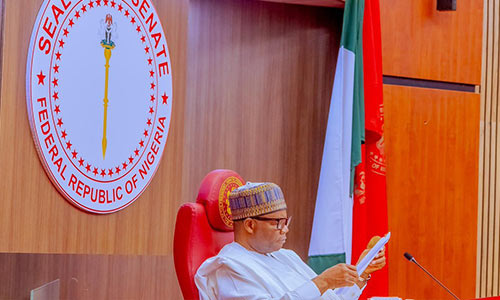
The Senate on Tuesday appointed a 12-member conference committee to harmonise differences between its version of the Electoral Act (Amendment) Bill and that of the House of Representatives, as protests under the #OccupyNASS movement entered Day Two at the National Assembly complex.


Senate President Godswill Akpabio announced the composition of the committee during a rowdy emergency plenary session convened to address the mounting public outcry over the Senate’s handling of the Electoral Act Amendment Bill.
“After consultation with the leadership, we have moved the number from nine to 12. I will now read out the names of the conference committee members from the Senate,” Akpabio said on the floor of the Senate.
The members are:
- Senator Simon Bako Lalong – Chairman
- Senator Mohammed Tahir Monguno – Member
- Senator Adamu Aliero – Member
- Senator Orji Uzor Kalu – Member
- Senator Abba Moro – Member
- Senator Asuquo Ekpenyong – Member
- Senator Aminu Iya Abbas – Member
- Senator Tokunbo Abiru – Member
- Senator Niyi Adegbonmire (SAN) – Member
- Senator Jibrin Isah – Member
- Senator Ipalibo Banigo – Member
- Senator Onyekachi Nwebonyi – Member
Akpabio subsequently struck the gavel, formally constituting the committee.
The Senate President urged the committee to treat its assignment as urgent, expressing optimism that the process could be concluded swiftly.
“When you meet, you should recognise that this is a matter of urgency. I believe that if you are able to conclude within the next few days or one week, the President should be able to sign the amended Electoral Bill into law within the month of February,” he said.
He said that the outcome would be transmitted promptly to President Bola Tinubu for assent within February.
The Senate approved its Votes and Proceedings allowing for electronic transmission of election results, but without the “real-time” provision contained in the House of Representatives version of the Electoral Act Amendment Bill.
The Senate decided that the Presiding Officer shall electronically transmit results to the IReV portal after being signed and stamped by the Presiding Officer and countersigned by Polling Agents present.
However, if transmission fails due to communication issues, the Form EC8A, after being signed by the Presiding Officer and the Polling Agents, shall in such a case be the primary source of evidence.
Akpabio aligned with a proposal that recognises electronic transmission as the primary method, with manual submission of results using Form EC8A permitted only in cases of technical failure.
This outcome still differs from the House of Representatives version of the Electoral Bill which includes “real-time transmission.” Civil society organisations are now calling on the Conference Committee to adopt the House of Representatives version.
Tuesday’s session tended towards rowdiness, with speakers interrupted intermittently at the Red Chamber.
Trouble started when the Senate Chief Whip, Senator Tahir Monguno (APC, Borno North), raised a Point of Order that the Senate should rescind its earlier decision on Clause 60(3) of the Electoral Act Amendment Bill.
Monguno came under Orders 1(b) and 52(6) of the Senate Standing Orders 2023 as amended. The Point of Order was seconded by Senator Abdul Ningi (PDP, Bauchi Central).
The hallowed Chamber became tense with shouts of “Point of Order” from Senator Enyinnaya Abaribe (APGA, Abia South) when Monguno moved his motion reading Clause 60(3) and amended the clause with “transfer” changed to “transmission.”
However, Monguno read Clause 60(3) without “real-time” in his motion.
According to page 45 of the report of the Senate Committee on Electoral Matters, Clause 60(3), the original provision states: “The Presiding Officer shall electronically transmit the results from each polling unit to IREV portal in real time and such transmission shall be done after the prescribed Form EC8A has been signed and stamped by the Presiding Officer and/or countersigned by the candidates or polling agents available at the polling unit.”
The proposal sparked debate, prompting Senator Enyinnaya Abaribe to call for individual voting, invoking Order 72 which has to do with division.
At this point, the President of the Senate, Senator Godswill Akpabio, acknowledged that Abaribe had raised a Point of Order calling for division and vote.
However, Abaribe later withdrew his Point of Order calling for division.
Akpabio clarified that the Senate had not rejected electronic transmission, explaining that the removal of the phrase “real time” was intended to prevent legal complications arising from network failures and to allow INEC operational flexibility.
While critics argue that the amendment weakens transparency, several senators insist that a majority of the chamber supports electronic transmission and that the disagreement is limited to the wording, not the principle itself.
The decision followed widespread public outrage triggered by the National Assembly’s passage of the Electoral Act 2022 (Repeal and Re-enactment) Amendment Bill 2026, particularly the removal of provisions mandating the real-time electronic transmission of election results from polling units.
The protests, which entered Day Two on Tuesday, saw civil society groups, opposition figures like Peter Obi and Sowore, youth organisations, and pro-democracy activists besiege the National Assembly complex in Abuja and stage demonstrations in several states, accusing lawmakers of attempting to weaken electoral transparency ahead of future elections.
Protesters under the #OccupyNASS banner carried placards and chanted slogans demanding the reinstatement of electronic transmission provisions and greater transparency in the legislative process.
They insist that the amendment undermines the credibility of Nigeria’s electoral process and reverses gains made since the introduction of technology into elections. They have demanded the immediate restoration of the real-time transmission clause and warned that failure to do so could erode public trust in future polls.
President of the Senate, Senator Godswill Akpabio, presided over the session, which was attended by the remaining senators following recent changes in the composition of the Upper Chamber.
In the last six months, the Senate lost two members — Senator Okechukwu Ezea of Enugu State and Senator Godiya Akwashiki of Nasarawa State — to death, while Senator Jimoh Ibrahim exited the chamber after his appointment as an ambassador-designate by President Bola Tinubu, reducing the number of senators from 109 to 106.
The emergency sitting was announced on Sunday in a statement signed by the Clerk of the Senate, Emmanuel Odo.
“The President of the Senate, Godswill Akpabio, has directed the reconvening of plenary for an emergency sitting on Tuesday, February 10, 2026,” the statement said.
The controversy centres on Clause 60(3), where the Senate removed the requirement for real-time electronic transmission, retaining the 2022 Act provision that empowers the Independent National Electoral Commission (INEC) to determine the mode of transmission.
Civil society organisations expressed concern that the Senate’s position still falls short of their demands.
“This is the proposed amendment to Section 60(3) as contained in the Senate’s Vote and Proceedings under consideration in the ongoing emergency plenary. It does not make provision for electronic transmission in real time. We hope they reconsider this stance and refrain from adopting a proposal that makes the results management process vulnerable to manipulation and legal contestation. Reforms should exemplify progress not recession,” one group stated.
The call remains for the Conference Committee to adopt the House of Representatives version which includes mandatory real-time electronic transmission of election results.
 The book also examines Nigeria's legal ecosystem, focusing on the LPELR and NBA AI Guidelines. As a bonus, every purchase comes with a FREE eBook titled: How to Use the AI Features in LegalPedia and LawPavilion.
Ohio Books Ltd praises the publication, stating:
"....this is the only Nigerian book I know of on the topic."
How to Order:
📞 Call, Text, or WhatsApp: 08034917063 | 07055285878
📧 Email: benadigwe1@gmail.com
🌎 Website: www.benadigwe.com
Ebook Version: Access it directly online at https://selar.com/prv626
Authored by Ben Ijeoma Adigwe Esq., ACIarb (UK), LL.M, Dip. in Artificial Intelligence, Director at the Delta State Ministry of Justice, Asaba, Nigeria.
_______________________________________________________________________
The book also examines Nigeria's legal ecosystem, focusing on the LPELR and NBA AI Guidelines. As a bonus, every purchase comes with a FREE eBook titled: How to Use the AI Features in LegalPedia and LawPavilion.
Ohio Books Ltd praises the publication, stating:
"....this is the only Nigerian book I know of on the topic."
How to Order:
📞 Call, Text, or WhatsApp: 08034917063 | 07055285878
📧 Email: benadigwe1@gmail.com
🌎 Website: www.benadigwe.com
Ebook Version: Access it directly online at https://selar.com/prv626
Authored by Ben Ijeoma Adigwe Esq., ACIarb (UK), LL.M, Dip. in Artificial Intelligence, Director at the Delta State Ministry of Justice, Asaba, Nigeria.
_______________________________________________________________________
“Order Justice Omolaye-Ajileye’s Electronic Evidence Books Now” — Essential Guides On Evidence Act, Case Law And Digital Proof
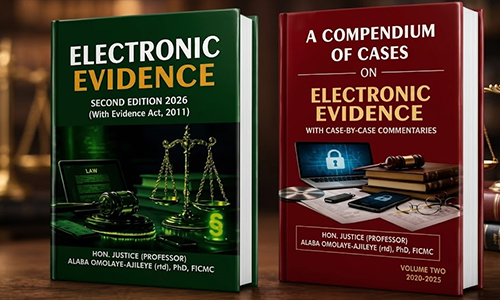

 Interested buyers are encouraged to place their orders and enquiries via:
0704 444 4777, 0704 444 4999, 0818 199 9888
Website: www.alexandernigeria.com
Interested buyers are encouraged to place their orders and enquiries via:
0704 444 4777, 0704 444 4999, 0818 199 9888
Website: www.alexandernigeria.com