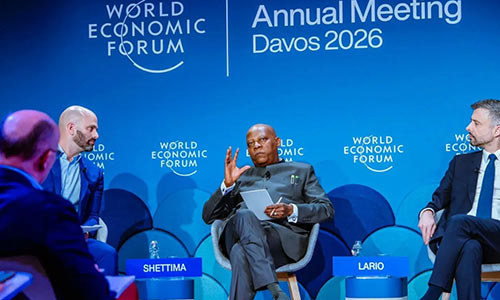
Vice President Kashim Shettima has announced the commencement of a multi-dimensional agricultural drive tagged the “Back to the Farm” initiative as part of broader efforts to address persistent food insecurity across Nigeria, while advocating for home-grown solutions to Africa’s economic challenges at the ongoing World Economic Forum in Davos, Switzerland.


Shettima disclosed the new agricultural programme on Thursday while speaking on a panel titled “When Food Becomes Security” at the Congress Centre during the 56th World Economic Forum meeting, according to a statement issued by Stanley Nkwocha, a senior special assistant to the President on Media and Communications at the Office of the Vice President.
The Vice President said the “Back to the Farm” initiative is designed to curb inflation, reduce foreign exchange spending on food imports, insulate Nigeria from global shocks, and restore productivity in the country’s key food basket regions.
During the discussion, Shettima emphasized that Nigeria no longer views food security through a narrow agricultural lens, but as a core macroeconomic, security, and governance issue.
“In Nigeria, we don’t look at food security purely as an agricultural issue. It is a macroeconomic, security and governance issue. Our focus is to use food security as a pillar for national security, regional cohesion and stability,” the Vice President stated.
The announcement comes against the backdrop of Nigeria’s severe cost-of-living crisis, largely triggered by President Bola Tinubu’s economic policies, particularly the removal of petrol subsidies and the floating of the naira. These measures have led to sharp increases in prices, with food inflation reaching alarming levels before a gradual decline following the rebasing of the Consumer Price Index by the National Bureau of Statistics early last year.
The crisis has sparked nationwide hunger protests, with many Nigerians expressing frustration over the government’s handling of the economy. Despite intervention measures such as an increased minimum wage and food subsidies, the impact has been limited, as food prices remain high amid a steep decline in citizens’ purchasing power. Fatal stampedes were also recorded during relief food distributions in several parts of the country during the 2024 festive season.
In a fresh warning on Thursday, the United Nations, through its Office for the Coordination of Humanitarian Affairs in Nigeria, said about 35 million Nigerians are at risk of acute hunger this year.
Shettima explained that the programme is designed to resettle displaced farmers by providing agricultural inputs, insurance, and access to capital to restart food production. Nigeria’s food security strategy, he said, is anchored on three pillars: increased food production, environmental sustainability, and deeper regional integration within the West African sub-region.
He stated that changing global trends and supply chain disruptions have forced Nigeria to look inward and rebuild its agricultural base by developing resilient food systems tailored to its diverse ecological zones.
“Nigeria is a very large country, and there is an incestuous relationship between economy and ecology. In the Sahelian North, we are dealing with desertification, deforestation and drought. In the riverine South and parts of the North Central, flooding is our major challenge,” the statement said.
To tackle these challenges, the Vice President said the government is promoting drought-resistant, flood-tolerant, and early-maturing varieties of staple crops such as rice, sorghum, and millet, while redesigning food systems in flood-prone southern regions to withstand climate shocks.
Security, he added, remains a major constraint, especially as many conflict-affected areas also serve as Nigeria’s primary food-producing zones.
“Most of the food baskets of our nation are security-challenged. That is why we are creating food security corridors and strengthening community-based security engagements so farmers can return safely to their land,” Shettima explained.
On Nigeria’s macroeconomic vulnerabilities, the Vice President identified import dependence and foreign exchange volatility as key drivers of food inflation.
“We largely import wheat, sugar and dairy products, and this has a direct impact on inflation. Our strategy is to accelerate local production and promote substitutes such as sorghum, millet and cassava flour to correct these structural imbalances,” he said.
Shettima stated that the government’s approach aligns food security with national stability, inflation control, and regional cooperation, positioning agriculture as a frontline response to both economic and security challenges.
At a separate High-level Accra Reset Initiative meeting held on the margins of the WEF Annual Meeting, Shettima emphasized the need for innovative, home-grown approaches for growth, development and prosperity on the African continent.
The Vice President welcomed the vision of the Accra Reset, describing the initiative as a bold reimagining of Africa’s shared future built through African-led cooperation, and rooted in sovereignty and self-definition.
“It is a call to action as well as a call to reset the mindset of African nations, from dependency to dignity, from aid to investment, from rhetoric to results. It is a call to prosper together. And I am confident that if we answer this call, the world will witness an African boom built not on the sands of commodity cycles, but on the bedrock of innovation, industry, and interdependence,” Shettima declared.
He stated that it was only by building domestic productive capacity that African nations could convert their population and natural talents into real, resilient wealth, adding that instead of expecting prosperity to be parachuted in, “it must be homegrown and earned.”
The Vice President observed that Africa was no longer the periphery but the pulse of the world’s demographic and economic future, citing Nigeria’s Dangote Refinery as an example of African industrial ambition.
“Africa cannot rise on applause alone. We rise when we build. After decades as a net importer of value, Nigeria is on the verge of becoming a net exporter of refined fuel, powered by Africa’s largest refinery in Lagos, Nigeria: the Dangote Refinery. This is what happens when African capital meets industrial ambition,” he stated.
Shettima noted that nations move from price takers to value makers when production is matched with infrastructure and policy clarity, adding that even as manufacturing’s share of Africa’s GDP fell from 16 percent in 1980 to under 10 percent by 2016, the continent chose not to retreat but to leapfrog using modular factories, artificial intelligence, and robotics.
The Vice President highlighted the significance of diaspora remittances, noting that in 2024 alone, Africans abroad sent home about $95 billion, more than five percent of the continent’s GDP and roughly equal to total foreign direct investment.
“That is not charity. This is why we are also championing free movement across Africa because mobility is a competitive advantage in a world where human capital is the most precious resource. Let skills and ideas flow as freely as goods and capital, and prosperity will follow,” he added.
Shettima maintained that the experience had been shaped by a simple lesson: “prosperity is not imported; it is built,” adding that Nigeria’s own market of over 200 million people has taught the nation that latent demand means little unless local supply is cultivated.
“Only by building domestic productive capacity can we convert our population and natural endowments into real, resilient wealth. Prosperity cannot be parachuted in – it must be homegrown and earned,” the Vice President emphasized.
President John Mahama of Ghana explained that the introduction of the Accra Reset Initiative at the last United Nations General Assembly in New York was not another declaration or a wish list, but a practical answer to a question millions of young Africans are asking about the continent’s future and response in changing global order.
The Ghanaian president called for synergy and cooperation among African leaders, stating that though no specific name has been coined for the new global system that will emerge, “Africa intends to be at the table in determining what that new global order will look like.”
Former President Olusegun Obasanjo dwelt on what Africa required to take its rightful place in the comity of nations, given the “new age of disruption, uncertainty and unpredictability.”
“The Accra Reset Initiative has come to inspire leaders to stop complaining about the system that has changed or is changing, and to build a way through it,” the former president added.
Former Vice President, Prof. Yemi Osinbajo, said that the essence of the forum was to galvanise support for governments in Africa to rethink their strategies for transforming economies and address challenges confronting the people.
This is not the first time the Vice President has unveiled strategies aimed at addressing Nigeria’s food insecurity challenges, though the impact of these initiatives has been largely negligible. In October 2024, Shettima announced the framework for a comprehensive national nutrition programme, the “Nutrition 774 Initiative,” aimed at improving nutritional outcomes across all 774 local government areas in the country.
Beyond weak policy implementation, food system experts have repeatedly identified climate change, poor post-harvest handling, inadequate storage and transportation infrastructure, and weak market regulation as major drivers of the food insecurity crisis.
Shettima expressed optimism that the Renewed Hope Agenda reforms would, in the coming months, translate climate adaptation efforts from pilot stages into reality and significantly boost intra-African trade beyond the current 10.7 percent. He further said Nigeria, often described as Africa’s giant, has “woken up from its slumber” under President Tinubu, adding that the government is working to make “it possible for smallholders and fishers to become investable at scale” within 12 months.
[A MUST HAVE] Evidence Act Demystified With Recent And Contemporary Cases And Materials

Available now for NGN 40,000 at ASC Publications, 10, Boyle Street, Onikan, Lagos. Beside High Court, TBS. Email publications@ayindesanni.com or WhatsApp +2347056667384. Purchase Link: https://paystack.com/buy/evidence-act-complete-annotation
______________________________________________________________________ “Enhance Legal Practice With Authoritative Reports” — Alexander Payne Offers Comprehensive Law Reports, Spanning Over A Century Of Nigerian Jurisprudence Interested buyers are encouraged to place their orders and enquiries via:
0704 444 4777, 0704 444 4999, 0818 199 9888
Website: www.alexandernigeria.com
Interested buyers are encouraged to place their orders and enquiries via:
0704 444 4777, 0704 444 4999, 0818 199 9888
Website: www.alexandernigeria.com