The Africa Cup of Nations will be held every four years instead of every two from 2028, the Confederation of African Football (CAF) has announced.

CAF President Dr. Patrice Motsepe made the announcement in Morocco on Saturday, ahead of the 2025 edition of AFCON, which kicks off with the hosts taking on Comoros on Sunday.
The tournament, which brings in an estimated 80% of CAF’s revenue, has been held every two years since its inception in 1957.
Since 1968, the tournament has been played biennially, with however a one-year gap between the 2012 and 2013 editions.
Sunday marks the start of the 35th edition, hosted in Morocco.
Motsepe said the next finals, scheduled for 2027 in Kenya, Tanzania and Uganda, will go ahead and another tournament would be held in 2028, but after that it will be hosted every four years.
“After the 2027 edition in East Africa and the next one in 2028, it will switch to a four-year cycle,” Motsepe stated.
The next edition after 2028 will be in 2032.
Motsepe announced the launch of an annual African Nations League from 2029 to fill the gap, following the example of Europe that holds its championship every four years.
“Historically the Nations Cup was the prime resource for us but now we will get financial resources every year,” he said.
“It is an exciting new structure which will contribute to sustainable financial independence and ensure more synchronisation with the FIFA calendar.”
The CAF President disclosed that the new African Nations League would be played in FIFA windows in September and October, with the finals in the November window every year.
The teams will be split into four regions, with six teams in the North, and 16 in the other three.
Motsepe also announced that prize money will increase from $7 million to $10 million for the winners.
Holding AFCON every four years had been proposed by the FIFA president, Gianni Infantino, but this had been rebuffed by CAF because of their reliance on the revenues the tournament generates.
The timing of AFCON has long courted controversy because it has usually been hosted in the middle of the European season, forcing clubs to release players.
This was supposed to be solved by moving it to mid-year from 2019, but the tournaments in Cameroon in 2022 and Côte d’Ivoire in 2024 were again hosted at the start of the year.
This year’s tournament in Morocco was moved back six months when FIFA introduced the new-look Club World Cup, which was hosted in the US in June and July.
“We have the most exciting new structure for African football,” Motsepe said.
“I do what is in the interests of Africa. The global calendar has to be significantly more synchronised and harmonised.”
The decision to move AFCON to a four-year cycle represents a significant shift in African football’s calendar and revenue model.
While the tournament has been CAF’s primary revenue generator, the introduction of the annual African Nations League is expected to provide consistent yearly income and reduce dependence on the biennial AFCON.
The new structure also addresses longstanding complaints from European clubs about player release during the season, as the four-year cycle will better align with global football calendars.
However, the success of this model will largely depend on the African Nations League’s ability to generate comparable revenue and maintain fan engagement during the years between AFCON tournaments.
The 2025 AFCON in Morocco will be one of the last three consecutive editions before the tournament transitions to the new four-year format, marking the end of an era in African football.

 ARTIFICIAL INTELLIGENCE FOR LAWYERS: A COMPREHENSIVE GUIDE
Reimagine your practice with the power of AI “...this is the only Nigerian book I know of on the topic.” — Ohio Books Ltd
Authored by Ben Ijeoma Adigwe, Esq., ACIArb (UK), LL.M, Dip. in Artificial Intelligence, Director, Delta State Ministry of Justice, Asaba, Nigeria.
Bonus:
Get a FREE eBook titled “How to Use the AI in Legalpedia and Law Pavilion” with every purchase.
ARTIFICIAL INTELLIGENCE FOR LAWYERS: A COMPREHENSIVE GUIDE
Reimagine your practice with the power of AI “...this is the only Nigerian book I know of on the topic.” — Ohio Books Ltd
Authored by Ben Ijeoma Adigwe, Esq., ACIArb (UK), LL.M, Dip. in Artificial Intelligence, Director, Delta State Ministry of Justice, Asaba, Nigeria.
Bonus:
Get a FREE eBook titled “How to Use the AI in Legalpedia and Law Pavilion” with every purchase.
How to Order: 📞 Call, Text, or WhatsApp: 08034917063 | 07055285878 📧 Email: benadigwe1@gmail.com 🌐 Website: www.benadigwe.com
Ebook Version: Access directly online at: https://selar.com/prv626
________________________________________________________________________ The Law And Practice Of Redundancy In Nigeria: A Practitioner’s Guide, Authored By A Labour & Employment Law Expert Bimbo Atilola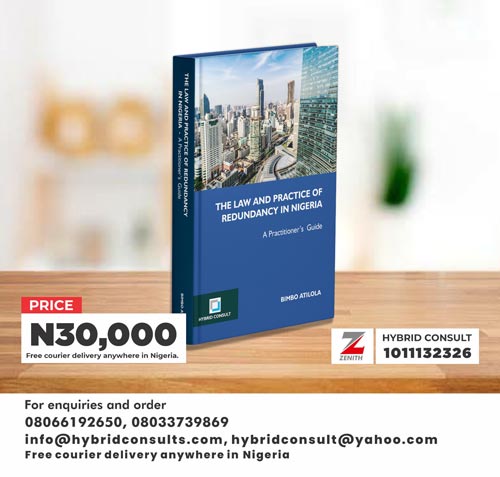 _______________________________________________________________________