By Obinna Kalu

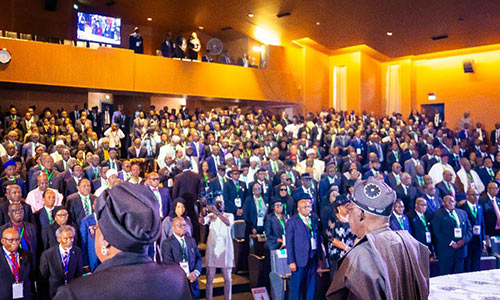
The moment was brief, almost easy to overlook, yet it carried an undertone that unsettled many Nigerians. At the 2025 All Nigerian Judges Conference, just before the President delivered his remarks, the ceremonial band played “On the mandate we shall stand,” the tune recognised across the country as a partisan campaign anthem of President Bola Ahmed Tinubu. Unfortunately, the sound of this political anthem, which should ordinarily not have a place in a judicial gathering, echoed across the hall where eminent judges, symbols of impartiality, gathered. As the anthem sounded, some rose out of courtesy, others smiled lightly, while a few remained confusingly still. For millions who later heard about it or watched on television, the moment sparked deep unease: an institution meant to stand apart was seemingly enmeshed in political symbolism.
For a judiciary that is now vulnerable to political forum shopping, rather than standing as the last hope of the common man, this episode came as no accident.
It seemed like another step in a slow shift towards the regularisation of political influence within spaces that should remain neutral. The concern was not merely the anthem but the setting, the audience and the non-rebuttal that followed the breach in the hall. It hinted at a system growing more comfortable with gestures that weaken institutional independence.
Organisers of the conference had, following public outcry explained that the band chose the tune and that judges stood only out of protocol. But this explanation has not resolved the worries of concerned Nigerians who are asking why such a politically charged song was allowed in the first place, why there was no preventive oversight and why organisers assume their responsibility ends when they claim no direct involvement. Authority carries obligations; vigilance cannot be outsourced.
Legally, accountability does not vanish simply because a third party executes an act. Supervisors and organisers bear responsibility for what occurs under their watch. If a partisan anthem is performed in a judicial setting, the obligation to explain and correct rests squarely with those who managed the event. It cannot be delegated to performers.
Constitutional principles reinforce this duty. Section 17(2)(e) of the Nigerian Constitution mandates that justice be delivered without fear or favour. Section 36 guarantees every citizen the right to an impartial tribunal. In effect, these clauses do more than prohibit bias; they demand the avoidance of any appearance of bias. Public trust is the currency of the judiciary and without it the institution’s legitimacy is weakened.
The symbolic breach in that hall, brief as it was, reflected a troubling reality. The judiciary appeared, aligned with political expression rather than standing apart from it. Nigerians who watched the scene could not avoid noticing that a space meant to be insulated from political sentiment had been seemingly compromised.
The concern deepens when considered alongside other recent events. Recall that Nigeria’s elected lawmakers sang the same “On your mandate we shall stand” song at the 2025 budget presentation by President Tinubu. The National Assembly is constitutionally tasked to provide oversight, to challenge and scrutinise the executive. Instead, it had become an avenue for political celebration, leaving citizens to question whether their representatives still understand their role as a check on power.
The media, too, has shown signs of discomforting proximity to authority. The Nigerian Guild of Editors convened opening ceremonies of its 2025 annual conference inside the State House, Abuja. While the choice may have been practical, the symbolism was striking: a body tasked with holding government accountable gathering under the direct roof and backyard of the Presidency. Such optics erode public confidence in media independence, raising concerns about how freely journalists can critique the policies of the Tinubu administration.
These symbolic handshakes with the President by the legislature, judiciary and media may appear isolated but, jointly, they reveal a pattern of institutions gradually aligning with the executive, often unconsciously, sometimes under social or political pressure. This convergence matters even more in a context where opposition party politics is weakening.
In the last two years, Nigeria’s opposition parties have struggled to maintain cohesion, credibility, and visibility. Internal divisions, disobedience to court orders, defections, strategic errors, systemic obstacles, selective/selfish enforcement of party constitution, difficulties accessing public spaces, financial constraints, unequal media opportunities have contributed to the collapse of vibrant opposition politics. As a result, Nigerians are increasingly experiencing one-party politics as the opposition parties are unable to present a strong counter-narrative or hold the government to account effectively.
There is no doubt that democracy cannot thrive when the opposition is constrained and oversight institutions begin to favour incumbency subtly. The anthem incidents in the judiciary, and the legislature, as well as the Guild of Editors’ State House conference do not occur in a vacuum. They indicate a broader drift toward consolidation of influence, which is particularly concerning given the dwindling capacity of opposition forces to resist these shifts.
This is how state capture quietly emerges. It is not necessarily imposed through force or abrupt constitutional changes; it grows gradually through symbolic gestures, procedural accommodations and unholy acquiescence. Over time, when bodies such as the legislature, judiciary, opposition parties and media derail from their constitutional and ideological mandates, the combined effect subtly reshapes governance structures and erodes accountability.
International norms have long warned against such dynamics. The United Nations Basic Principles on the Independence of the Judiciary emphasise safeguarding judges from both direct and indirect political pressures. The African Charter obliges member states to protect institutional autonomy, promote political pluralism and safeguard dissent. Nigeria’s recent patterns test these commitments, demonstrating how easily symbolic compromises can accumulate into structural risks.
Back to “On your mandate we shall stand” song at the conference of judges. Citizens’ concern is not about the song itself, it is about what the song represents: a gradual encroachment of politics into spaces designed to remain impartial. For many Nigerians, the judiciary has been an anchor of hope amid the shrinking of civic space, the entanglement of institutions with political messaging, and the diminished role of opposition parties. But even anchors shift if vigilance lapses.
The anthem episode confirmed fears many had long held: that institutional drift is real and accelerating. Even if judges intended no endorsement of any political message, responsibility for safeguarding impartial spaces rests with them. Accountability is about reinforcing norms, not assigning blame.
What follows must be more than explanations or defensive statements. The judiciary should acknowledge the lapse publicly and offer a sincere apology. Such a step would not weaken the institution; it would restore confidence and reaffirm the judiciary’s commitment to impartiality.
Concrete measures must accompany the apology. Event protocols should explicitly ban partisan performances; programmes should be carefully vetted and external participants must receive clear guidance about neutrality. These safeguards are not mere formalities, they are essential to protecting democratic integrity.
Nigeria stands at a critical juncture. Democracies rarely fail in a single moment; they erode gradually through small, unchallenged compromises, symbolic concessions and cultural shifts that go unnoticed, until their cumulative effect is significant. A song at a judicial conference may seem minor, yet its implications for perception and trust are substantial. Symbols shape culture, and culture shapes governance.
The deterioration of opposition politics compounds the risk. Without credible alternatives and robust critique, institutions are more likely to drift into alignment with incumbency. Citizens perceive this imbalance, which can breed disengagement, cynicism and acceptance of diminished accountability. Reversing this trend requires vigilance not just from the judiciary or legislature but also from civil society, media and political actors across the spectrum.
If Nigeria is to prevent a subtle slide into state capture, the warning signs must be recognised and addressed promptly. Institutional leaders must act decisively to protect the independence of their organisations, ensure impartiality, and restore public confidence. Citizens, too, must remain engaged, observant and willing to hold institutions accountable.
Ultimately, democracy depends on more than elections; it depends on the constant maintenance of institutional integrity, pluralism and public trust. The judiciary’s brief lapse, the legislature’s symbolic chant, the guild’s relocation to State House and the weakened opposition are all connected threads in a larger story. Left unaddressed, they form a pattern that threatens the balance of power, the fairness of governance, and the trust of Nigerians in the very institutions meant to serve them. Vigilance, transparency, and accountability remain the country’s most potent tools against this quiet drift toward capture.
•Dr. Kalu is a legal practitioner
[A MUST HAVE] Evidence Act Demystified With Recent And Contemporary Cases And Materials

Available now for NGN 40,000 at ASC Publications, 10, Boyle Street, Onikan, Lagos. Beside High Court, TBS. Email publications@ayindesanni.com or WhatsApp +2347056667384. Purchase Link: https://paystack.com/buy/evidence-act-complete-annotation
______________________________________________________________________ “Enhance Legal Practice With Authoritative Reports” — Alexander Payne Offers Comprehensive Law Reports, Spanning Over A Century Of Nigerian Jurisprudence Interested buyers are encouraged to place their orders and enquiries via:
0704 444 4777, 0704 444 4999, 0818 199 9888
Website: www.alexandernigeria.com
Interested buyers are encouraged to place their orders and enquiries via:
0704 444 4777, 0704 444 4999, 0818 199 9888
Website: www.alexandernigeria.com
 The book also examines Nigeria's legal ecosystem, focusing on the LPELR and NBA AI Guidelines. As a bonus, every purchase comes with a FREE eBook titled: How to Use the AI Features in LegalPedia and LawPavilion.
Ohio Books Ltd praises the publication, stating:
"....this is the only Nigerian book I know of on the topic."
How to Order:
📞 Call, Text, or WhatsApp: 08034917063 | 07055285878
📧 Email: benadigwe1@gmail.com
🌎 Website: www.benadigwe.com
Ebook Version: Access it directly online at https://selar.com/prv626
Authored by Ben Ijeoma Adigwe Esq., ACIarb (UK), LL.M, Dip. in Artificial Intelligence, Director at the Delta State Ministry of Justice, Asaba, Nigeria.
______________________________________________________________________
The book also examines Nigeria's legal ecosystem, focusing on the LPELR and NBA AI Guidelines. As a bonus, every purchase comes with a FREE eBook titled: How to Use the AI Features in LegalPedia and LawPavilion.
Ohio Books Ltd praises the publication, stating:
"....this is the only Nigerian book I know of on the topic."
How to Order:
📞 Call, Text, or WhatsApp: 08034917063 | 07055285878
📧 Email: benadigwe1@gmail.com
🌎 Website: www.benadigwe.com
Ebook Version: Access it directly online at https://selar.com/prv626
Authored by Ben Ijeoma Adigwe Esq., ACIarb (UK), LL.M, Dip. in Artificial Intelligence, Director at the Delta State Ministry of Justice, Asaba, Nigeria.
______________________________________________________________________