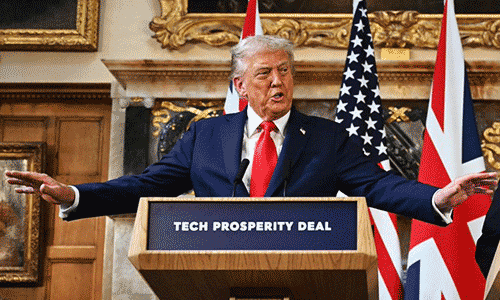
U.S. President Donald Trump declared Wednesday that South Africa no longer deserves a seat at the G20 table, citing alleged “land confiscation and genocide” against white farmers as justification for his decision to skip the group’s upcoming summit in Johannesburg.

“South Africa shouldn’t even be in the G’s anymore, because what’s happened there is bad,” Trump told the American Business Forum in Miami, drawing applause from the crowd. “I’m not going. I’m not going to represent our country there. It shouldn’t be there.”
The remarks, delivered just weeks before the November 22-23 G20 Leaders’ Summit, escalate a year-long feud between Trump and South African President Cyril Ramaphosa. Trump will send Vice President JD Vance in his place, a move his administration framed as a protest against what it calls “massive human rights violations” in South Africa.
Trump’s rhetoric echoes months of escalating tensions. In April, he questioned how the U.S. could attend a G20 meeting “when land confiscation and genocide are the primary topics of conversation.” His claims center on South Africa’s Expropriation Act, signed into law earlier this year, which allows the government to seize land without compensation in limited cases to address historical inequalities from apartheid. White South Africans, who comprise just over 7 percent of the population but own the majority of private farmland, have been the focus of Trump’s statements.
In February, Trump signed Executive Order 14204, directing U.S. agencies to fast-track refugee applications for white Afrikaner farmers, labeling them “victims of unjust racial discrimination.” The order also reduced U.S. aid to South Africa, a decision Pretoria criticized as politically motivated.
South African officials have strongly denied the allegations. Presidential spokesperson Vincent Magwenya, speaking to the BBC, expressed confidence in hosting a “very successful” summit. “We reject these claims, which rest on a premise that is factually inaccurate,” a government statement read last week, following the U.S. prioritization of Afrikaner refugee claims.
Crime statistics further undermine the “genocide” narrative. South Africa’s latest data shows no disproportionate victimization of white citizens in violent crimes compared to other racial groups. Fact-checkers have widely discredited assertions of systematic killings of white farmers, often traced to fringe online narratives amplified during Trump’s first term.
Efforts to repair the rift have faltered. In May, Ramaphosa visited the White House with a delegation including white coalition members and prominent South African golfers to showcase unity. But Trump reportedly raised unsubstantiated claims of persecution during the meeting, producing evidence later debunked by experts.
Tensions escalated in August when the U.S. imposed 30 percent tariffs on South African exports, the highest in sub-Saharan Africa, further straining Africa’s largest economy.
“This is not about facts; it’s about politics,” said Chrispin Phiri, spokesperson for South Africa’s Foreign Ministry. Phiri highlighted the summit’s theme of “solidarity, equality, and sustainability,” adding, “Drawing on our journey from racial division to democracy, South Africa is positioned to champion shared prosperity that bridges inequalities and addresses the legacies of colonialism.”
The G20, founded in 1999 amid the Asian financial crisis and formalized during the 2008 global meltdown, represents over 85 percent of the world’s GDP. Unlike the treaty-bound United Nations, it is an informal forum operating by consensus, with no codified expulsion process.
Experts say removing South Africa would require near-unanimous agreement among members, a difficult task given the group’s diversity.
“If a country were kicked out, it would mean exclusion from meetings by the host,” explained Dr. Andrew Gawthorpe of the UK-based Foreign Policy Centre. “But no host would act without broad buy-in from others.”
Chris Vandome, a senior research fellow at Chatham House’s Africa Programme, cited historical precedents like Russia’s 2014 expulsion from the G8 over Crimea, noting it remains in the G20 despite calls for exclusion following the 2022 Ukraine invasion. “The U.S. has often been the disruptor in G20 working groups,” Vandome told the BBC. “Ironically, this could rally support for South Africa. Europe has pledged major financial aid to the continent, and China would never tolerate a rejection of an African voice.”
[A MUST HAVE] Evidence Act Demystified With Recent And Contemporary Cases And Materials

Available now for NGN 40,000 at ASC Publications, 10, Boyle Street, Onikan, Lagos. Beside High Court, TBS. Email publications@ayindesanni.com or WhatsApp +2347056667384. Purchase Link: https://paystack.com/buy/evidence-act-complete-annotation
______________________________________________________________________ “Enhance Legal Practice With Authoritative Reports” — Alexander Payne Offers Comprehensive Law Reports, Spanning Over A Century Of Nigerian Jurisprudence Interested buyers are encouraged to place their orders and enquiries via:
0704 444 4777, 0704 444 4999, 0818 199 9888
Website: www.alexandernigeria.com
Interested buyers are encouraged to place their orders and enquiries via:
0704 444 4777, 0704 444 4999, 0818 199 9888
Website: www.alexandernigeria.com