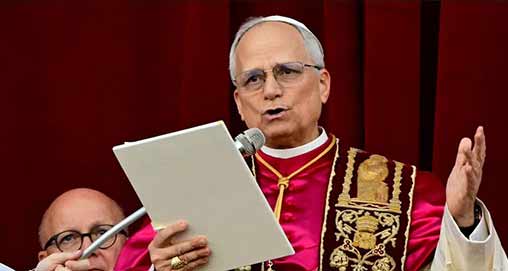
In a historic decree sparking widespread debate across the global Catholic community, the Vatican has officially prohibited the use of the title “Co-Redemptrix” for the Virgin Mary, emphasizing that Jesus Christ alone redeemed humanity from sin and damnation. The ruling, personally approved by Pope Leo XIV, resolves a centuries-old theological controversy that has divided scholars, clergy, and even popes.

Issued by the Vatican’s Dicastery for the Doctrine of the Faith the Church’s top doctrinal authority the instruction, titled Mater Populi Fidelis (“Mother of the Faithful People”), was scheduled for official release today. Major portions, however, leaked online via Italian Catholic outlets such as MessaInLatino.it and Non Silere Possum, highlighting the sensitivity of the announcement.
At its core, the decree rejects “Co-Redemptrix” as an inappropriate descriptor for Mary’s role in salvation history. Section 22 states:
“Given the need to explain Mary’s subordinate role to Christ in the work of Redemption, it is always inappropriate to use the title ‘Co-Redemptrix.’ This title risks obscuring the unique salvific mediation of Christ and can generate confusion and imbalance in the harmony of the truths of the Christian faith. … When an expression requires continuous explanation to prevent misinterpretation, it does not serve the faith of the People of God and becomes inappropriate.”
The Vatican stresses that while Mary’s maternal cooperation is “singular and pre-eminent,” it is fundamentally distinct from her Son’s redemptive act. She is portrayed not as a direct participant in saving humanity, but as a guide who leads the faithful to Christ. Key biblical references, such as Mary’s “fiat” at the Annunciation, are highlighted to show her role in preparing the way for redemption, which was completed solely through Jesus’ sacrifice on the Cross. The decree underscores:
“Jesus alone redeemed the world. Mary’s faith opened the door, but only Christ walked through it.”
The document also examines other Marian titles “Mediatrix,” “Advocate,” and “Mother of the Redeemer” clarifying that all must remain subordinate to Christ’s unique mediation to preserve doctrinal harmony.
Debates over Mary’s cooperation in salvation intensified in the 20th century, with differing interpretations: direct participation at the Cross, indirect involvement via her consent to the Incarnation, or receptive embodiment as the Church receiving Redemption’s fruits. The decree warns that ambiguity in these interpretations blurs the boundary between the Redeemer and the redeemed.
The controversy traces back to the 10th century with the use of “Redemptrix,” evolving into “Co-Redemptrix” by the 15th century. Grassroots movements in the 20th century repeatedly petitioned for a dogmatic definition elevating Mary to co-redeemer, but successive popes consistently resisted.
Papal perspectives have varied:
- Pope John Paul II referenced “Co-Redemptrix” multiple times in the 1990s, though he later refrained.
- Pope Benedict XVI (as Cardinal Ratzinger) criticized the term as “too far from Scripture,” warning it could overshadow Christ.
- Pope Francis dismissed it outright in 2019, calling the push “foolishness” and reaffirming Mary as a mother entrusted to the Church, “not as … co-redeemer.”
Pope Leo XIV now decisively prohibits the term in both formal teaching and popular devotion, reinforcing a Christocentric focus.
The decree arrives amid a wave of ecumenical goodwill, just days after Pope Leo XIV’s historic meeting with King Charles III the first British monarch in 500 years to pray publicly alongside a pope. Many see this as a “new era of Christian unity,” with the decree emphasizing doctrinal precision as a stabilizing force.
Reactions have been mixed. Progressive theologians praise the decree for restoring clarity and preventing “imbalance” in Marian devotion, while traditionalist Catholics lament that it downplays Mary’s “unique spiritual role” in salvation history. Online forums are abuzz with disappointment, some noting that “Mary stood at the Cross; her suffering was part of our redemption.”
As the full Mater Populi Fidelis is released, the Vatican seeks to quell decades of confusion, reminding the faithful: Mary may have opened the door, but only Christ walked through it.
[A MUST HAVE] Evidence Act Demystified With Recent And Contemporary Cases And Materials

Available now for NGN 40,000 at ASC Publications, 10, Boyle Street, Onikan, Lagos. Beside High Court, TBS. Email publications@ayindesanni.com or WhatsApp +2347056667384. Purchase Link: https://paystack.com/buy/evidence-act-complete-annotation
______________________________________________________________________ “Enhance Legal Practice With Authoritative Reports” — Alexander Payne Offers Comprehensive Law Reports, Spanning Over A Century Of Nigerian Jurisprudence Interested buyers are encouraged to place their orders and enquiries via:
0704 444 4777, 0704 444 4999, 0818 199 9888
Website: www.alexandernigeria.com
Interested buyers are encouraged to place their orders and enquiries via:
0704 444 4777, 0704 444 4999, 0818 199 9888
Website: www.alexandernigeria.com