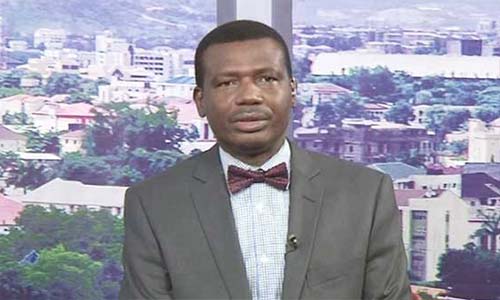
Ebun Olu-Adegboruwa, SAN, a prominent human rights lawyer, has raised alarm over conflicting judgments from Nigeria’s Supreme Court, warning that they breed uncertainty, erode judicial credibility, and fuel allegations of corruption. Speaking at the Vanguard Mid-Term Assessment Mini-Summit in 2025, Olu-Adegboruwa also lamented the declining vibrancy of civil society organizations (CSOs) and criticized the politicization of Nigeria’s anti-corruption efforts, linking corruption to bad governance.

Olu-Adegboruwa acknowledged that human errors are inevitable, even in the judiciary, but stressed that the Supreme Court, as the apex court, must exercise utmost caution to ensure predictability in its rulings. “The purpose of law is to predict and determine human conduct,” he said, noting that conflicting decisions, particularly in political cases, create ambiguity and arbitrariness. He cited instances where similar facts yield inconsistent outcomes without explanation, violating the doctrine of judicial precedent, which requires lower courts to follow the Supreme Court’s “jurisprudential fountain.”
Such conflicts, especially in electoral disputes, complicate legal advice to clients and raise suspicions of corruption or political influence. “Some people read corrupt motives into these conflicting decisions, especially in political cases,” Olu-Adegboruwa said, highlighting the damage to the judiciary’s reputation. To address this, he proposed deploying technology, such as software to profile cases by legal categories (e.g., criminal, electoral, family law), enabling researchers to detect potential conflicts before judgments. He also urged outsourcing software development to experts and creating a comprehensive legal database to reduce errors, given the enormous workload on judges.
Olu-Adegboruwa traced the historical role of CSOs as watchdogs ensuring government adherence to the rule of law, from pre-independence activism to post-independence opposition against military regimes. However, he noted a decline since Nigeria’s return to civil rule in 1999, exacerbated under the Buhari and Tinubu administrations. Governments have co-opted CSO leaders, weaponized poverty to stifle protests, and repressed movements like #EndSARS and #EndBadGovernance, with some protesters killed.
Despite this, Olu-Adegboruwa highlighted the resilience of organizations like the Socio-Economic Rights and Accountability Project (SERAP) and other activists. He attributed the broader decline to weak political opposition, a passive legislature, and judicial lethargy, compounded by the misuse of the Cybercrimes Act to suppress free speech. “We will continue to play our roles as the mouthpiece of the masses,” he vowed, urging CSOs to remain committed to their ideals despite government intolerance.
Olu-Adegboruwa criticized Nigeria’s anti-corruption efforts as politically motivated, serving to garner public sympathy or silence opposition. He pointed to politicians defecting to ruling parties to evade prosecution, citing a party leader’s claim that joining absolves past sins. “This translates to a withdrawal of criminal charges,” he said, undermining justice. He noted that past Economic and Financial Crimes Commission (EFCC) leaders faced investigations themselves, suggesting they were tolerated only to serve political interests.
For Olu-Adegboruwa, the root of corruption lies in bad governance. “So long as citizens run generators, insecurity drives air travel, and public schools and hospitals are neglected, there will always be corruption,” he argued. He called for independent, well-funded anti-corruption agencies led by principled individuals and emphasized that good governance—delivering infrastructure, employment, and economic empowerment—is the most effective antidote to corruption. He urged monitoring of federal, state, and local governments to ensure resources benefit the masses.
 Interested buyers are encouraged to place their orders and enquiries via:
0704 444 4777, 0704 444 4999, 0818 199 9888
Website: www.alexandernigeria.com
Interested buyers are encouraged to place their orders and enquiries via:
0704 444 4777, 0704 444 4999, 0818 199 9888
Website: www.alexandernigeria.com

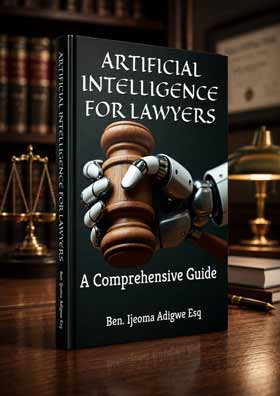 The book also examines Nigeria's legal ecosystem, focusing on the LPELR and NBA AI Guidelines. As a bonus, every purchase comes with a FREE eBook titled: How to Use the AI Features in LegalPedia and LawPavilion.
Ohio Books Ltd praises the publication, stating:
"....this is the only Nigerian book I know of on the topic."
How to Order:
📞 Call, Text, or WhatsApp: 08034917063 | 07055285878
📧 Email: benadigwe1@gmail.com
🌎 Website: www.benadigwe.com
Ebook Version: Access it directly online at https://selar.com/prv626
Authored by Ben Ijeoma Adigwe Esq., ACIarb (UK), LL.M, Dip. in Artificial Intelligence, Director at the Delta State Ministry of Justice, Asaba, Nigeria.
_______________________________________________________________________
The book also examines Nigeria's legal ecosystem, focusing on the LPELR and NBA AI Guidelines. As a bonus, every purchase comes with a FREE eBook titled: How to Use the AI Features in LegalPedia and LawPavilion.
Ohio Books Ltd praises the publication, stating:
"....this is the only Nigerian book I know of on the topic."
How to Order:
📞 Call, Text, or WhatsApp: 08034917063 | 07055285878
📧 Email: benadigwe1@gmail.com
🌎 Website: www.benadigwe.com
Ebook Version: Access it directly online at https://selar.com/prv626
Authored by Ben Ijeoma Adigwe Esq., ACIarb (UK), LL.M, Dip. in Artificial Intelligence, Director at the Delta State Ministry of Justice, Asaba, Nigeria.
_______________________________________________________________________