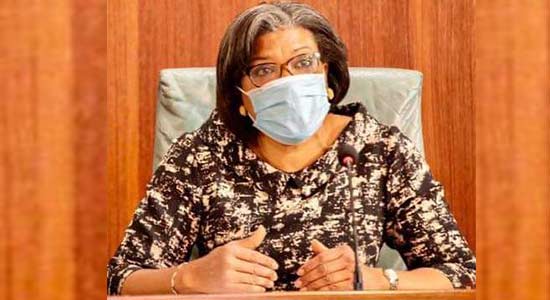
The Director General of the Debt Management Office, Patience Oniha, has said that high debt levels lead to high debt services and affect investment in infrastructure.

This is according to a document by her, which was presented during a workshop for civil society organisations organised by the SFTAS programme coordination unit held in Abuja on July 15, 2022.
It was entitled, ‘Why Debt Sustainability Is Important at the Subnational Level in Nigeria: Challenges and Prospects’ and a copy of it was obtained by our correspondent.
According to the DMO DG, “High debt levels lead to heavy debt service which reduces resources available for investment in infrastructure and key sectors of the economy.”
In the document, she stressed the need for debt sustainability, which she defined as the ability to service all current and future obligations, while maintaining capacity to finance policy objectives without resort to unduly large adjustments or exceptional financing such as arrears accumulation, debt restructuring, which could otherwise compromise its stability.
She added that, “A country’s public debt is considered sustainable if the government is able to meet all its current and future payment obligations without recourse to exceptional financial assistance or going into default.”
However, despite the high debt service, the DMO has constantly insisted on the sustainability of Nigeria’s rising debt, using the debt to Gross Domestic Product ratio as justification.
The International Monetary Fund had earlier warned that debt servicing might gulp 100 per cent of the Federal Government’s revenue by 2026 if the government failed to implement adequate measures to improve revenue generation.
According to the IMF’s Resident Representative for Nigeria, Ari Aisen, based on a macro-fiscal stress test that was conducted on Nigeria, interest payments on debts might wipe up the country’s entire earnings in the next four years.
Aisen said, “The biggest critical aspect for Nigeria is that we have done a macro-fiscal stress test, and what you observe is the interest payments as a share of revenue and as you see us in terms of the baseline from the federal government of Nigeria, the revenue of almost 100 per cent is projected by 2026 to be taken by debt service.
“So, the fiscal space or the amount of revenues that will be needed and this without considering any shock is that most of the revenues of the federal government are now, in fact, 89 per cent and it will continue if nothing is done to be taken by debt service.”
However, The Minister of Finance, Budget and National Planning, Dr Zainab Ahmed, recently disclosed that Nigeria’s debt service cost surpassed its revenue in the first four months of this year.
Debt service gulped N1.94tn between January and April 2022, against a retained revenue of N1.63tn.
[A MUST HAVE] Evidence Act Demystified With Recent And Contemporary Cases And Materials

Available now for NGN 40,000 at ASC Publications, 10, Boyle Street, Onikan, Lagos. Beside High Court, TBS. Email publications@ayindesanni.com or WhatsApp +2347056667384. Purchase Link: https://paystack.com/buy/evidence-act-complete-annotation
______________________________________________________________________ “Enhance Legal Practice With Authoritative Reports” — Alexander Payne Offers Comprehensive Law Reports, Spanning Over A Century Of Nigerian Jurisprudence Interested buyers are encouraged to place their orders and enquiries via:
0704 444 4777, 0704 444 4999, 0818 199 9888
Website: www.alexandernigeria.com
Interested buyers are encouraged to place their orders and enquiries via:
0704 444 4777, 0704 444 4999, 0818 199 9888
Website: www.alexandernigeria.com