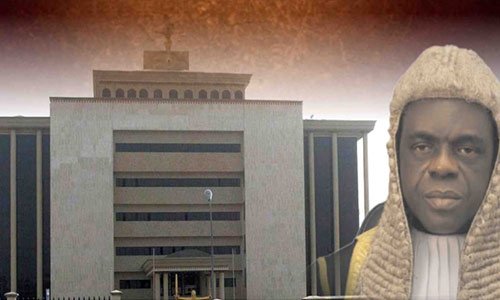
Human Rights group, Centre for Human Rights and Anti-Corruption Crusade (CHURAC) institutes action against the Chief Judge of the Federal High Court of Nigeria in Suit No: FHC/WR/CS/116/2021 Between the Registered Trustees of the Centre for Human Rights and Anti-Corruption Crusade and Chief Judge of the Federal High Court of Nigeria. The Group is challenging the Chief Judge over the new Practice Directions he has made for the payment of default fees in Fundamental Rights proceedings on the 26th of October, 2021. The matter is filed at the Federal High Court, Warri Judicial Division on the 10th of November 2021.

The Federal High Court had in a Practice Direction dated 26th October, 2021 signed by Chief Judge of the Court, Hon. Justice T. Tsoho, directed that “Any process filed outside the time provided for in the Fundamental Rights (Enforcement Procedure) Rules, 2009, shall be liable to default fees as provided in Order 48 Rule 4 of the Federal High Court (Civil Procedure) Rules, 2019.” And” The directive in the circular letter issued by this Court on the 12th day of February, 2021 exempting the payment of default February on late filing of processes in Fundamental Rights applications is hereby rescinded.” The Chief Judge noted that the directive is pursuant to the powers conferred on him by Order 57 Rule 3 of the Federal High Court (Civil Procedure) Rules 2019.
However, in a suit filed on Friday via Originating Summons against the Chief Judge as the sole defendant, CHURAC is challenging the power of the Chief Judge to issue such directive. The group wants the Federal High Court to declare “that by the combined reading of the provisions of section 46(3) of the 1999 Constitution of Federal Republic of Nigeria (as amended), Order XV Rule 4 of the Fundamental Rights (Enforcement Procedures) Rules 2009, Order 48 Rule 4 and Order 57 Rule 3 of Federal High Court (Civil Procedure) Rules 2019 the Defendant lacks the authority, power and vires to issue the Federal High Court of Nigeria (Payment of Default Fees on Late Filing of Fundamental Rights Enforcement Court Processes) Practice Directions, 2021 for the purpose of regulating fees payable in human rights proceedings. “
They also want the court to declare that the Chief Judge acted ultra vires his powers when he issued the Practice Direction is and that “the provisions of the Federal High Court of Nigeria (Payment of Default Fees on Late Filing of Fundamental Rights Enforcement Court Processes) Practice Directions, 2021 are not the Civil Procedure Rules of Court contemplated by the provisions of Order XV Rule 4 of the Fundamental Rights (Enforcement Procedure) Rules 2009 and therefore, cannot be resorted to in the event of inadequacy in any of the provisions of the Fundamental Rights (Enforcement Procedures) Rules 2009.”
The Group also seeks a declaration that the provisions of the Practice Direction are grossly inconsistent with the provisions of the Constitution of the Federal Republic of Nigeria, 1999 (as amended) and therefore, null and void ab initio.
They also sought the following reliefs: “AN ORDER of this Honorable Court striking down, nullifying and/or setting aside the entire provisions of the Federal High Court of Nigeria (Payment of Default Fees on Late Filing of Fundamental Rights Enforcement Court Processes) Practice Directions, 2021 forthwith as same are inconsistent with the provisions of Sections 1(3) and 46(3) of the 1999 Constitution of the Federal Republic of Nigeria (as amended).
“AN ORDER OF INJUNCTION restraining the Defendant from further issuing Practice Directions for the Federal High Court of Nigeria for matters pertaining to or arising from fees payable (default or otherwise) in respect of filing of processes under the Fundamental Rights (Enforcement Procedure) Rules 2009 or any matter related to or incidental therefrom in any human rights proceedings in the Federal High Court of Nigeria.”
The summons was filed on behalf of the Plaintiff by its lawyers, Ebun-Olu Adegboruwa, SAN; Olukunle Ogheneovo Edun (the NBA National Welfare Secretary); E. C. Alaowei; Fred Ogunli; and Faith Anigboro
In a 15 paragraphs affidavit deposed to by its secretary, Stella Ebie, the Plaintiff claims to be a Non-Governmental Organization registered in accordance with PART C of the Companies and Allied Matters Act for the purpose of advocating and advancing the cause of human rights, accountability and transparency and the suit “was filed on behalf of the poor, down-trodden and vulnerable in the Nigerian society, who most times seek for pro bono services to enforce their fundamental human rights and also sued as Respondents by oppressive Applicants.“
While giving the background of the suit, the group deposed that on the 26th day of October, 2021 the Chief issued the Federal High Court of Nigeria (Payment of Default Fees on Late Filing of Fundamental Rights Enforcement Court Processes) Practice Directions, which Directs that directed that processes filed outside the time prescribed by the Fundamental Rights (Enforcement Procedure) Rules 2009 will attract default fees as prescribed in the Federal High Court (Civil Procedure) Rules, 2019.
That the said Practice Directions also directed the Federal High Court and parties who are in default of filing their applications within time to adopt the practice and procedure of the Federal High Court regarding payment of default fees.
They said the new Direction is contrary to the position made known to them by their lawyers: Olukunle O. Edun and E. C. Alaowei to the effect that the Fundamental Rights (Enforcement Procedure) Rules 2009 issued by the Honorable Chief Justice of Nigeria has adequate provisions for the payment of fees in human rights proceedings.
The group further deposed their lawyers informed them that “the Federal High Court of Nigeria (Payment of Default Fees on Late Filing of Fundamental Rights Enforcement Court Processes) Practice Directions, 2021 is not a Civil Procedure Rules of Court contemplated by the Fundamental Rights (Enforcement Procedure) Rules 2009.” And that the “Federal High Court (Civil Procedure) Rules 2019 has no provision for filing fees in human rights proceedings.”
According to them, their lawyers also informed them that “the Defendant has no constitutional power to issue Practice Directions for fundamental rights proceedings.
“That it is only the Chief Justice of Nigeria that has the power to issue directions and rules for the practice and procedure for the enforcement of fundamental rights proceedings in the Federal High Courts, High Courts of State and any other Court competent to hear fundamental rights enforcement actions.
“That no Court in Nigeria has issued any Practice Direction or Rules of Procedure in human rights proceedings except the Defendant.
“That the Fundamental Rights (Enforcement Procedure) Rules, 2009 did not make reference/resort to Practice Directions in the event that the Fundamental Rights (Enforcement Procedure) Rules, 2009 has no adequate provision in the Rules.
“That the Defendant acted ultra vires his power when he issued the Federal High Court of Nigeria (Payment of Default Fees on Late Filing of Fundamental Rights Enforcement Court Processes) Practice Directions, 2021.
“That the victims of human rights proceedings are usually the poor, down-trodden, the vulnerable and despised in the society; hence many human rights proceedings are filed pro bono.
“That the Fundamental Rights (Enforcement Procedure) Rules, 2009 encourage pro bono and public interest litigations.
“That the Federal High Court charges N1,000 per day as default fees in civil proceedings for processes filed out of time pursuant to the Federal High Court (Civil Procedure) Rules, 2019.
“That human rights proceedings are special proceedings and outside the general purview of the Federal High Court (Civil Procedure) Rules, 2019.
#That the Federal High Court does not have the exclusive jurisdiction over Fundament Rights matters.
“That the said the Federal High Court of Nigeria (Payment of Default Fees on Late Filing of Fundamental Rights Enforcement Court Processes) Practice Directions, 2021 will cause great injustice and sufferings to applicants (who are mainly indigents) of fundamental rights proceedings at the Federal Court as they will be denied justice as a result of this Practice Direction, should their processes be filed out of time.”
The Group raised five issues for determination in their Written Address. They argued that Order XV Rule 4 of the FREP Rules which provides that; “Where in the course of any Human Rights proceedings, any situation arises for which there is or appears to be no adequate provisions in these rules, the Civil Procedure Rules of the court for the time being in force shall apply.” do not make provision for Practice Direction but only mentioned specifically the “CIVIL PROCEDURE RULES OF COURT.” They also draw the attention of the court to the principle of law that “expressio unius exclusio alterius” i.e “the express mention of one thing is the exclusion of another”. They relied on om the case of Ehuwa V O.S.I.E.C (2006) 10 NWLR (PT.1012) 554 @ 568 – 569. Per Ogbuinya J.C.A P.88 paras B-C.
They also argued that Order 48 Rule 4 and Order 57 Rule 3 of the Federal High Court (Civil Procedure) Rules 2019 did not authorize the Chief Judge to make Practice Directions for human rights proceedings at the Federal High Court. They, therefore, submitted that the Federal High Court of Nigeria (Payment of Default Fees on Late Filing of Fundamental Rights Enforcement Court Processes) Practice Directions 2021 cannot be defined to mean or include civil procedure rules. They referred the court to the case of Unilag v. Aigoro (1984) 11 SC 152 @ 159, where the Supreme Court defined Practice Direction “..as a direction given by the appropriate authority stating the way and manner a particular rule of court should be complied with, observed and obeyed”
The Group further submits that the action of the Chief Judge in issuing the Practice Directions in Fundamental Rights proceedings is ultra vires his powers. The power to make practice procedure in Fundamental Rights proceedings, according to them, is vested solely in the Chief Justice of Nigeria. That the Fundamental Right (Enforcement Procedure) Rules 2009 expressly made provision for schedule of filing fees to be paid for processes filed in human rights proceedings and the maximum fees payable in human rights proceedings at any given time is N850.00. They referred the court to rne Appendix A of the Fundamental Rights Enforcement Procedure Rules, 2009.
They strongly submitted that there is no provision for payment of default fees in the Fundamental Right (Enforcement Procedure) Rules 2009. The essence of the substantially reduced fees in the schedule is to encourage human rights proceedings and afford the indigent and oppressed Citizens of Nigeria to seek for redress in the violation of the fundamental rights, where the government and its officials are the major culprits.
However, no date is fixed for hearing yet.
[A MUST HAVE] Evidence Act Demystified With Recent And Contemporary Cases And Materials

Available now for NGN 40,000 at ASC Publications, 10, Boyle Street, Onikan, Lagos. Beside High Court, TBS. Email publications@ayindesanni.com or WhatsApp +2347056667384. Purchase Link: https://paystack.com/buy/evidence-act-complete-annotation
______________________________________________________________________ “Enhance Legal Practice With Authoritative Reports” — Alexander Payne Offers Comprehensive Law Reports, Spanning Over A Century Of Nigerian Jurisprudence Interested buyers are encouraged to place their orders and enquiries via:
0704 444 4777, 0704 444 4999, 0818 199 9888
Website: www.alexandernigeria.com
Interested buyers are encouraged to place their orders and enquiries via:
0704 444 4777, 0704 444 4999, 0818 199 9888
Website: www.alexandernigeria.com