*Charges Bench and Bar To Ensure Protection of Rule of Law Ahead of 2023 Elections
*Promises That FCT Judiciary Will Meet Expectations of Modern Day Administration of Justice
*Gives Breakdown of Annual Caseloads Records For 2021/22 Legal Year of The FCT High Courts and Magistrates Courts

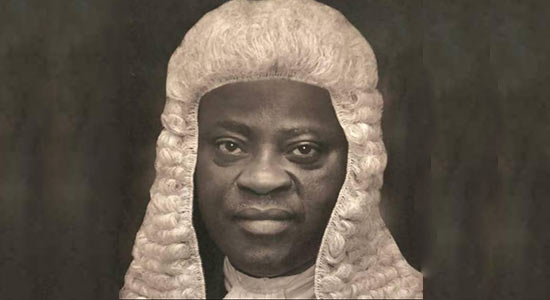
In a bid to enable as well as enhance the workability of the Violence Against Persons (Prohibition) VAPP Act, 2015 in the Federal Capital, the Chief Judge of the Federal Capital Territory (FCT), Justice Husseini Baba Yusuf on Monday signed practice direction and guidelines on the trial of sexual and gender-based violence cases and ancillary procedure and that on the application for a protection order under the VAPP Act.
The signing of the practice directions and guidelines formed part of activities held to mark the commencement of the 2022-2023 legal year in FCT.
The CJ also appended his signature to the practice directions on small claims 2022.
Speaking before signing the instruments, Justice Baba Yusuf said they were carefully thought out practice directions to not only enable but also enhance the workability of the VAPP Act and other related statutes in the Territory.
According to him, in the last one year, there was an upsurge in cases filed in FCT courts as a result of the fast pace it had continued to develop as well as the influx of people into the Territory as a result of insecurity in parts of the country.
“In the last one year, we have witnessed an increase in the number of civil and criminal cases filed in the high court, the magistrate courts and the Customary Court of Appeal.
“This is understandably so, considering the fast pace at which the Federal Capital Territory has continued to develop and movement of people into the Federal Capital as a result of insecurity in some parts of the country,” the CJ said.
According to him, with the exponential increase in the FCT population, the judiciary in the Territory had continued to strive with a view to responding to the need of making justice readily and easily accessible to justice seekers in the Federal Capital.
“As a judiciary saddled with the constitutional mandate to provide judicial and related services within the Federal Capital, we have continued (to) strive to respond to the need to make justice readily and easily accessible to justice-seekers in FCT,” Baba Yusuf said.
He informed that in view of this development, there had been an improvement on structural facilities in order to give existing court environments a befitting facelift.
“We have also endeavoured to create additional judicial divisions in Jikwoyi and Garki Districts and built additional courtrooms to boost the existing structures in the Gwagwalada, Kuje and Bwari Divisions,” the CJ disclosed.
He informed as part of avowed efforts aimed at promoting access to justice and speedy disposal of inexpensive, simple and small liquidated claims, the FCT court collaborated with the Presidential Enabling Business Environment Council (PEBEC) and constituted a steering committee to facilitate the establishment of small claims court in FCT magistracy system.
He further informed that the small claims courts would be manned by 15 designated magistrates, adding that the courts shall take off within the 2022-2023 legal year.
Justice Baba Yusuf said in order to eliminate affidavit racketeering by touts, he created the Commissioner for Oaths Department, which used to be a unit under the enforcement department, in December 2021.
The department, according to the CJ, had witnessed a huge turnaround with the introduction and launching of a system of digitalisation of affidavits, known as Affidavit Registry Management Systems (ARMS), which placed all forms of affidavits in electronic format.
“The introduction of ARMS has made the process of obtaining affidavits in the court more seamless and time efficient; eliminating the incidence of touting that marred the manual issuance of affidavits.
“More significant is that the fidelity and authenticity of affidavits issues by this Court are now guaranteed,” the CJ said.
He added that in an avowed drive to ensure speedy dispensation of justice in FCT, the judiciary had embarked on steady revamp of its statutes and rules.
Baba Yusuf informed that he had signed the new District Court Rules, while a prepared draft of the District/Magistrate Courts Act, which he described as “first of its kind in the FCT”, had been sent to the National Assembly for legislative approval.
Also, The Chief Judge reminded legal practitioners, both the Bar and Bench that as the 2023 general elections draw closer, a lot of expectations are on the judiciary in view of pre and post election litigations.
“As we approach another general election year, it is expected that there will be heightened activities within the precincts of the Courts.
“It is, therefore, imperative for us as law practitioners (both the Bar and the Bench) to brace up for the challenges ahead.
“The Nigerian society looks unto us to continue to provide legal services that seek to stabilize the polity” Justice Baba Yusuf said.
“The Bar, as the bastion of the rule of law, must continue to recognize the leading and sensitive role it plays in nation building.
“As Ministers in the Temple of Justice and custodians of the law, lawyers must join hands with the Bench in ensuring the preservation of the sanctity of our laws, without which our nation cannot survive.
‘The Bar must rise against any attempts from any quarters to subvert the rule of law. The Bar must continue to be the harbinger of the hope of a more egalitarian society” the FCT High Court Chief Judge stated.
He assured on behalf of Judiciary of the FCT, that they remain committed to meeting the expectations of modern-day administration of justice and the rule of law without fear or favour, ill will, affection, self-interest”.
Meanwhile, the Chief Judge gave breakdown of the annual caseload records for the 2021/2022 legal year of the FCT High Court and Magistrate courts.
He said a total of 8,831 cases were brought forward from the previous legal year (2020/2021) in the High Court, while 7,049 new cases were assigned in the course of the legal year in the High Court.
While a total of 4,564 cases had been cumulatively been dispensed with by the High Court, 11,316 cases are pending to be carried over into the 2022/2023 legal year in the High Court.
For the Magistrates’ courts, Justice Baba Yusuf disclosed that 4,474 cases were brought forward to the new legal year in the Magistrate courts.
“10,941 new cases were assigned in the new legal year, while 9,988 have cumulatively been dispensed with the Magistrate court. A total of 5,427 cases are pending to be carried over into the new legal in the Magistrates’ courts, the Chief Judge stated.
Justice Baba Yusuf said the opening of the legal year was significant for the Judiciary as well as the society, as it beams light and public attention on the administration of justice and the rule of law, and in particular the challenges they face.
“Of the three Arms of Government, it is only the Judiciary that is saddled with the task of safeguarding the Constitution that binds people together as a nation,” he said.
“This is what we strive to achieve every year in terms of quick and qualitative justice delivery.
“It is for this reason that we have all gathered here today to take stock of the modest progress we have accomplished so far; and also have a peep into the strides and necessary improvements we hope to attain in the year ahead,” the Chief Judge said.
 Interested buyers are encouraged to place their orders and enquiries via:
0704 444 4777, 0704 444 4999, 0818 199 9888
Website: www.alexandernigeria.com
Interested buyers are encouraged to place their orders and enquiries via:
0704 444 4777, 0704 444 4999, 0818 199 9888
Website: www.alexandernigeria.com
 Reimagine your practice with the power of AI “...this is the only Nigerian book I know of on the topic.” — Ohio Books Ltd
Authored by Ben Ijeoma Adigwe, Esq., ACIArb (UK), LL.M, Dip. in Artificial Intelligence, Director, Delta State Ministry of Justice, Asaba, Nigeria.
Bonus:
Get a FREE eBook titled “How to Use the AI in Legalpedia and Law Pavilion” with every purchase.
Reimagine your practice with the power of AI “...this is the only Nigerian book I know of on the topic.” — Ohio Books Ltd
Authored by Ben Ijeoma Adigwe, Esq., ACIArb (UK), LL.M, Dip. in Artificial Intelligence, Director, Delta State Ministry of Justice, Asaba, Nigeria.
Bonus:
Get a FREE eBook titled “How to Use the AI in Legalpedia and Law Pavilion” with every purchase.
How to Order: 📞 Call, Text, or WhatsApp: 08034917063 | 07055285878 📧 Email: benadigwe1@gmail.com 🌐 Website: www.benadigwe.com
Ebook Version: Access directly online at: https://selar.com/prv626
_______________________________________________________________________ [A MUST HAVE] Evidence Act Demystified With Recent And Contemporary Cases And Materials
 ______________________________________________________________________
“Bridging Theory And Courtroom Practice” — Hagler Sunny Okorie, Nathaniel Ngozi Ikeocha Unveil ‘Functional’ Tort Law Book For Nigerian Legal System
______________________________________________________________________
“Bridging Theory And Courtroom Practice” — Hagler Sunny Okorie, Nathaniel Ngozi Ikeocha Unveil ‘Functional’ Tort Law Book For Nigerian Legal System
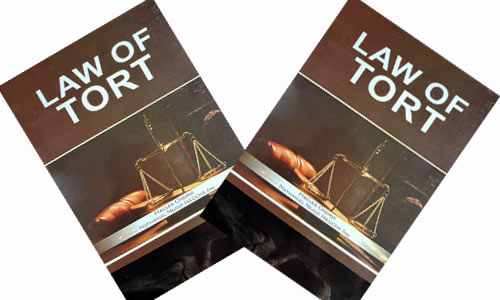 The book, titled The Law of Torts in Nigeria: A Functional Approach, authored by Professor Hagler Sunny Okorie Ph.D and Ikeocha, Nathaniel Ngozi Esq, offers law students, practitioners, and academics a comprehensive guide to understanding and applying tort law in Nigerian courts. Interested buyers can place orders via the following contact numbers: 08028636615, 08037667945, 08032253813, or +234 902 196 2209.