By Chioma Kate Unini, Esq

A viral video recently making the rounds on X (formerly Twitter) captured the moment students at a Nigerian university were asked a seemingly simple question: Would you choose a Master’s degree or $1 million? Reportedly, about 90 percent of them chose the Master’s degree. The internet erupted.
On the surface, the students’ choice appears noble a testament to the Nigerian reverence for education, a cultural inheritance that has made “go to school” the default answer to every question about upward mobility. But peel back the layers, and what this video actually reveals is a far more troubling reality: the dangerous disconnect between Nigeria’s education system and economic productivity.
Nigeria is arguably the most credentialed underemployed nation on the continent. The country produces thousands of Master’s degree holders and PhDs annually. Yet unemployment among graduates continues to climb. As one commenter on X put it bluntly: “Masters in what exactly… we have countless professors and the country is still upside down.” [“A professor with no identifiable research output or tangible contributions to his name.”]
This is not an attack on education, but a critique of education without application, where credentials are pursued as ends in themselves rather than as tools for solving real problems and creating value. The uncomfortable truth is that a Master’s degree, in the absence of a functioning economy that rewards specialized knowledge, can become little more than a decorative certificate.
A friend once told me that despite all my certificates, I have not earned even a single naira from them, and that statement made her reflect deeply. She is now considering moving abroad to take up any kind of work, simply because there are no jobs here that match the promise of these qualifications. This comes against the backdrop of concerns over Nigeria’s energy sector, where despite the presence of numerous professors and experts, there remains no stable electricity supply or lasting solution. While blame is often directed at government failure, questions persist as to why these professors have not leveraged their research to improve and power the very institutions where they serve as academics.
@thenigerialawyer$1 Million Or A Master’s Degree? Why 90% Of Nigerian Students Got It Wrong — And What It Says About Our Education System♬ original sound – TheNigeriaLawyer
The Employer vs. Employee Mentality
Here lies the crux of the matter. The overwhelming majority of Nigerian graduates including those at the postgraduate level are trained to seek employment, not to create it. The entire architecture of the education system funnels young people toward a job market that simply does not have enough seats.
Consider the mathematics: Nigeria’s National Bureau of Statistics has repeatedly shown that the economy does not generate nearly enough jobs to absorb its graduate output. Yet the reflex of most students, when faced with the hypothetical of a million dollars, is to choose more schooling more preparation for a job that may never come.
One commenter raised what may be the most incisive point in the entire debate: with one million dollars, a person could establish a private security company, a logistics firm, or a technology startup enterprises that would not only generate personal wealth but create employment for others. The Master’s degree, on the other hand, adds one more name to an already saturated pool of qualified job seekers.
The students who chose the degree likely did so because Nigerian culture has conditioned them to view education as the only legitimate path to success. But the $1 million in that hypothetical is not just cash. It represents capital the raw material of entrepreneurship, investment, and economic participation.
With $1 million (approximately 1.4 billion naira at current exchange rates, as one user helpfully noted), a person could fund a Master’s degree and a PhD and still have enough capital to launch a business. The reverse is not true. A Master’s degree does not, on its own, generate $1 million. As one respondent summarized: “With $1 million you can get a PhD. But with a Master’s you cannot get $1 million.”
This is not anti-intellectualism. It is arithmetic.
What the video truly exposes is the failure of Nigerian universities to teach financial literacy, entrepreneurial thinking, and critical reasoning about economic realities. If 90 percent of students in a university setting cannot recognize the superior strategic value of capital over credentials in a struggling economy, the institution has failed them not in granting degrees, but in cultivating judgment.
Nigeria does not lack educated people. It is, in fact, overflowing with them. What it lacks are educated people who can convert knowledge into products, services, industries, and jobs. The country has professors and Master’s holders in virtually every discipline, yet the economy remains largely import-dependent, infrastructure remains inadequate, and youth unemployment remains a national emergency.
The question, then, is not whether education matters. Of course it does. The question is: education for what? If the answer is merely “to get a certificate and find a job,” then we have not educated anyone. We have merely processed them through a system and handed them paper.
Nigerian universities must begin to teach students that there is dignity and indeed greater national value in being an employer rather than an employee. Entrepreneurship should not be a single elective course buried in a curriculum dominated by theory. It should be a foundational pillar of every programme, from law to engineering to the humanities.
Students should graduate not just with knowledge of their discipline, but with the ability to identify market needs, develop solutions, raise capital, manage enterprises, and create value. Until this shift occurs, Nigeria will continue to produce brilliant graduates who queue endlessly for jobs that do not exist, while the country’s real problems from food security to energy to healthcare go unsolved.
The 90 percent who chose the Master’s degree were not foolish. They were products of a system that gave them no framework to think differently. The tragedy is not their answer. The tragedy is that no one in their educational journey taught them to ask better questions.
To conclude, it is important to clarify that the issue is not with education or even with professors as a class, but with what my learned friend, Onochiengwu Obuna, Esq., aptly described in his work, “Classification of Professors in Nigeria: A Scientific Approach.”
He observed that within the academic system, there exists a troubling reality where some individuals rise to professorial ranks through questionable practices ranging from compromised grading systems to other forms of academic misconduct. Such a system inevitably produces what he categorises as “paper professors” individuals who hold titles but lack the depth, innovation, and practical impact expected of their positions.
According to him, professors in Nigeria can broadly be classified into four categories: One Chance Professors, Quota Professors, Systemic Professors, and Excellent Professors. While the latter group represents truly outstanding scholars with global relevance, the existence of the others raises serious concerns about the integrity and effectiveness of the system.
This distinction is crucial to the broader argument. The problem, therefore, is not the absence of educated individuals, but the prevalence of credentials without corresponding competence, innovation, or real-world application. Until the system consistently produces and rewards “excellent professors” whose research translates into tangible societal impact, the gap between education and national development will persist.
 Interested buyers are encouraged to place their orders and enquiries via:
0704 444 4777, 0704 444 4999, 0818 199 9888
Website: www.alexandernigeria.com
Interested buyers are encouraged to place their orders and enquiries via:
0704 444 4777, 0704 444 4999, 0818 199 9888
Website: www.alexandernigeria.com
 Reimagine your practice with the power of AI “...this is the only Nigerian book I know of on the topic.” — Ohio Books Ltd
Authored by Ben Ijeoma Adigwe, Esq., ACIArb (UK), LL.M, Dip. in Artificial Intelligence, Director, Delta State Ministry of Justice, Asaba, Nigeria.
Bonus:
Get a FREE eBook titled “How to Use the AI in Legalpedia and Law Pavilion” with every purchase.
Reimagine your practice with the power of AI “...this is the only Nigerian book I know of on the topic.” — Ohio Books Ltd
Authored by Ben Ijeoma Adigwe, Esq., ACIArb (UK), LL.M, Dip. in Artificial Intelligence, Director, Delta State Ministry of Justice, Asaba, Nigeria.
Bonus:
Get a FREE eBook titled “How to Use the AI in Legalpedia and Law Pavilion” with every purchase.
How to Order: 📞 Call, Text, or WhatsApp: 08034917063 | 07055285878 📧 Email: benadigwe1@gmail.com 🌐 Website: www.benadigwe.com
Ebook Version: Access directly online at: https://selar.com/prv626
_______________________________________________________________________ [A MUST HAVE] Evidence Act Demystified With Recent And Contemporary Cases And Materials
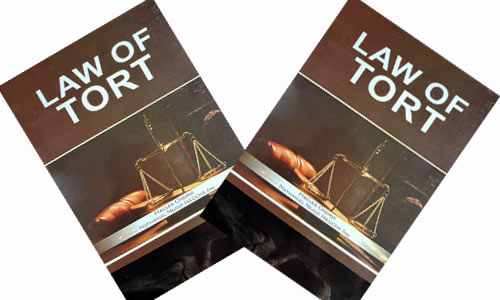 The book, titled The Law of Torts in Nigeria: A Functional Approach, authored by Professor Hagler Sunny Okorie Ph.D and Ikeocha, Nathaniel Ngozi Esq, offers law students, practitioners, and academics a comprehensive guide to understanding and applying tort law in Nigerian courts. Interested buyers can place orders via the following contact numbers: 08028636615, 08037667945, 08032253813, or +234 902 196 2209.