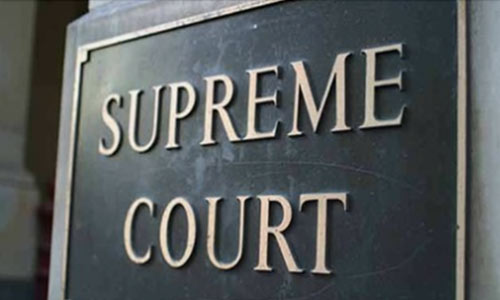
The Supreme Court of Nigeria on Friday, the 24th day of May, 2019, delivered a landmark judgment in which it held that the APC in Zamfara State did not have candidates for all the elections that held in the State based on the fact that the Party did not conduct valid primaries. In its verdict, Paul Galinje, JSC, who read the lead judgment of the apex Court, declared that: “A party that had no candidate cannot be said to have won an election”. He consequently held that “Candidates other than the first Appellant (APC) with the highest votes stand elected”.


As reasonably expected of Nigerians, the apex Court’s judgment has attracted several reactions, opinions, and commendations and to a very large extent, little or no criticisms. While uncertainties greeted Nigerians on the next step that could have been taken by INEC on the issue, the electoral Body pleasantly took a decision on Saturday, the 25th day of May, 2019, by complying with the Supreme Court’s judgment and thus, returned the PDP’s candidates in the Governorship and National Assembly elections as the winners of the elections that were held in February and March this year. Firstly, INEC must be commended for abiding by the order of the Court without much delay. This is what is expected in any sane clime, because obedience to court order is the desideratum of true democracy and a safe nation. Justice Arthur T. Vanderbilt, in his “The Challenge of Law Reform”; Princeton University Press (pp. 4-5), once opined that: “It is the courts and not the legislature that citizens primarily feel keen, cutting edge of the law. If they have respect for the work of the courts, their respect for the law will survive the shortcomings of every other branch of government; but if they lose respect for the work of the courts, their respect for the law and order will vanish with it to the great detriment of society”.
However, more commendable is the water-right verdict of the apex court which left no room for ambiguity or any legal rhetorics or political manoeuvrings. The constitutional provisions particularly on the election of a Governor of a State is very sacrosanct. Section 177 of the Constitution of the Federal Republic of Nigeria, 1999 (as amended), provides that: “A person shall be qualified for election to the office of Governor of a State if-
(a) he is citizen of Nigeria by birth;
(b) he has attained the age of thirty-five years;
(c) he is a member of a political party and is sponsored by that political party;
(d) he has been educated up to at least School Certificate level or its equivalent”. (Emphasis, ours). It is obvious that all the APC candidates in Zamfara State (though they belong to a political party – the APC, yet they) were not sponsored by their Party to contest the February and March 2019 elections, having not emerged from a valid Party primaries which is a condition precedent to taking part in the main election under the Electoral Act. The implication is that all the political parties that participated in Zamfara State elections were eligible to have fielded in candidates for the elections except the APC.
Again, section 179(2) of the said Constitution, further provides that: “A candidate for an election to the office of Governor of a State shall be deemed to have been duly elected where, there being two or more candidates-
(a) he has the highest number of votes cast at the election; and
(b) he has not less than one-thirds of all the local government areas in the State. (Emphasis, ours). By the above quoted constitutional provisions, the only candidate that met the above requirements in the PDP gubernatorial candidate, Dr. Muhammed Mutawalle. Thus, the apex Court having declared the 534,541 votes credited to the APC Candidate, Mukhtar Shehu, the said votes can no longer be reckoned with in the computation of the the total valid votes that were casted during the governorship election in Zamfara State. In other words, the new figure to be used in determining or computing spread for the Governorship Poll across the 14 local government areas in Zamfara shall be the votes scored by the PDP and other political parties that participated in the election, excluding the APC.This was the only way INEC could have determined the total votes cast and worked out the spread in the circumstance. And that was exactly what INEC did before it declared the PDP Candidate as the Governor-elect of Zamfara State.
The Zamfara State experience is almost the same thing with that of the Rivers State, only that in the case of Rivers State, APC was barred by the Supreme Court from taking part in the elections. But, in both cases, the lessons to be learnt are the same: Party primaries must be conducted in line with the laid down rules and guidelines, including compliance with the time limits set by INEC. It is hoped that the gross acts of desperations by way of imposition of a preferred candidate(s) by governors, party leaders/bigwigs will be checkmated by this landmark judgment of the apex Court which is punitive in nature. I also hope that APC will be more careful in handling its Party primaries especially as Kogi and Bayelsa States prepare for their governorship elections in November, 2019. May God bless the Supreme Court of Nigeria!
(Solomon Onunoja Akobe is a Constitutional Lawyer formerly with N.O.O. Oke (SAN) & Co., Ibadan, Southwest, Nigeria)
“Order Your Copy Now” — Basil Momodu, Esq. Unveils Second Edition Of His Book, "Civil Procedure In Nigeria"
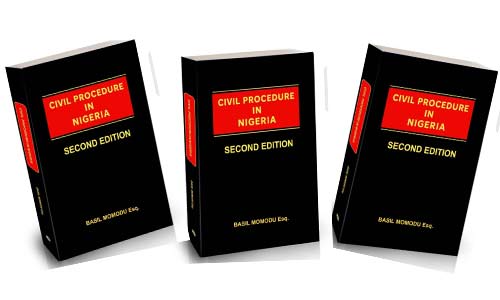 According to the learned author, Basil Momodu Esq. "Law review is a continuum. We will continue to track changes in the law to enrich future editions." Recommended Booksellers: Lagos: 08033855230, Abuja: 08035991379, and others.
_______________________________________________________________________
“Enhance Legal Practice With Authoritative Reports” — Alexander Payne Offers Comprehensive Law Reports, Spanning Over A Century Of Nigerian Jurisprudence
According to the learned author, Basil Momodu Esq. "Law review is a continuum. We will continue to track changes in the law to enrich future editions." Recommended Booksellers: Lagos: 08033855230, Abuja: 08035991379, and others.
_______________________________________________________________________
“Enhance Legal Practice With Authoritative Reports” — Alexander Payne Offers Comprehensive Law Reports, Spanning Over A Century Of Nigerian Jurisprudence
 Interested buyers are encouraged to place their orders and enquiries via:
0704 444 4777, 0704 444 4999, 0818 199 9888
Website: www.alexandernigeria.com
Interested buyers are encouraged to place their orders and enquiries via:
0704 444 4777, 0704 444 4999, 0818 199 9888
Website: www.alexandernigeria.com
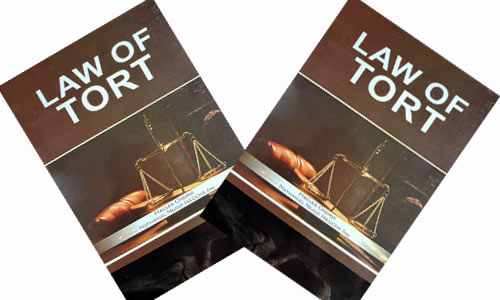 The book, titled The Law of Torts in Nigeria: A Functional Approach, authored by Professor Hagler Sunny Okorie Ph.D and Ikeocha, Nathaniel Ngozi Esq, offers law students, practitioners, and academics a comprehensive guide to understanding and applying tort law in Nigerian courts. Interested buyers can place orders via the following contact numbers: 08028636615, 08037667945, 08032253813, or +234 902 196 2209.
________________________________________________________________________
[A MUST HAVE] Evidence Act Demystified With Recent And Contemporary Cases And Materials
The book, titled The Law of Torts in Nigeria: A Functional Approach, authored by Professor Hagler Sunny Okorie Ph.D and Ikeocha, Nathaniel Ngozi Esq, offers law students, practitioners, and academics a comprehensive guide to understanding and applying tort law in Nigerian courts. Interested buyers can place orders via the following contact numbers: 08028636615, 08037667945, 08032253813, or +234 902 196 2209.
________________________________________________________________________
[A MUST HAVE] Evidence Act Demystified With Recent And Contemporary Cases And Materials

 As an added bonus, every purchase comes with a FREE ebook titled: “AI in Legalpedia and Law Pavilion: A Research Guide.”
Ohio Books Ltd praises the publication, stating:
"....this is the only Nigerian book I know of on the topic."
How to Order:
📞 Call, Text, or WhatsApp: 08034917063 | 07055285878
📧 Email: benadigwe1@gmail.com
🌎 Website: www.benadigwe.com
Ebook Version: Access it directly online at https://selar.com/prv626
As an added bonus, every purchase comes with a FREE ebook titled: “AI in Legalpedia and Law Pavilion: A Research Guide.”
Ohio Books Ltd praises the publication, stating:
"....this is the only Nigerian book I know of on the topic."
How to Order:
📞 Call, Text, or WhatsApp: 08034917063 | 07055285878
📧 Email: benadigwe1@gmail.com
🌎 Website: www.benadigwe.com
Ebook Version: Access it directly online at https://selar.com/prv626