The Minister of Finance and Coordinating Minister of the Economy, Olawale Edun, has assured that the N58.472 trillion 2026 Appropriation Bill, in terms of size and assumptions, is within safe limits.


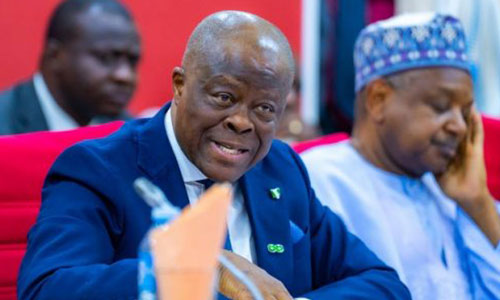
Edun spoke on Thursday when he led the economic team to defend the 2026 budget before the Senate Committee on Appropriations, chaired by Senator Solomon Olamilekan Adeola.
Responding to questions on whether the size of the budget and its assumptions were realistic, Edun said the parameters were well considered and aligned with standard budgeting practices.
On the oil production benchmark of 1.84 million barrels per day, Edun said: “It is a stretch target so that the authorities do not settle for lower output. But as long as we do not spend what we do not have, we are within safe limits.”
He explained that forward crude contracts are standard practice globally and are structured to ensure future production obligations are met with sufficient margins, warning against leaving commodities idle.
“Some countries that left their commodities underground have seen their value decline over time,” Edun said.
Responding to concerns on debt servicing, Edun said Nigeria’s major challenge was not necessarily its debt-to-GDP ratio, but the high cost of borrowing in international markets.
“The problem is the pricing. Developing countries are forced to pay high interest rates in international markets. That is where the difficulty lies,” he said.
Edun added that Nigeria was currently chairing the technical group meeting of the G24, where debt sustainability and rising interest costs were dominating discussions.
He said President Bola Ahmed Tinubu had called for the establishment of an African credit rating agency to ensure fairer assessments and more affordable financing for African economies.
Edun said security spending had been prioritised, stressing that emergency funding had consistently been released for critical military procurements.
“We all agree that security must be prioritised. I can assure you that emergency funding has been given. Critical foreign payments for security equipment have been made at least twice this year that I know of, including as recently as yesterday,” he said.
He explained that some security expenditures may not be immediately visible under conventional budget classifications, but insisted that urgent obligations were being met through the Federation Account within approved fiscal limits.
Edun said fiscal discipline and monetary credibility were critical to sustaining macroeconomic stability.
“When this administration came in 2023, we were paying heavily to stabilise the system. You cannot undermine interest rate mechanisms without consequences. If you do not maintain credibility, the exchange rate will move,” he said.
According to him, the economy is showing signs of recovery, growing at about four per cent, with inflation trending downward, foreign reserves rising and exchange rate stability improving.
He cited renewed investor confidence, including a reported $20 billion investment commitment by Shell, alongside other private sector investments.
Edun said the government plans to raise investment to 30 per cent of GDP to achieve about seven per cent annual growth and reduce poverty.
Dr. Zacch Adedeji, Chairman of the Nigeria Revenue Service (NRS), cautioned against inflating the budget unnecessarily, noting that unrealistic assumptions would continue to undermine implementation.
“Budget funding must come from realistic projections. Efficiency is not about the size of the budget, but about how much can actually be implemented.
“If you think you have 10 units and spend accordingly, that is manageable. But if you assume you have 100 and spend based on that assumption, you may run into serious problems if the funds do not materialise,” he said.
Adedeji explained that under the Petroleum Industry Act (PIA) framework, the Nigerian National Petroleum Company Limited (NNPCL) now operates as a limited liability company, and government revenue from oil production comes mainly from taxes and royalties rather than gross crude sales.
“The only connection between the government and whatever is produced is the taxes and royalties paid. If production costs are high, the net revenue to the government is affected,” he said.
He added that projections showed about 47 per cent of total oil company output would translate into government revenue under current fiscal arrangements, urging lawmakers to focus on cost structures and enforceable fiscal parameters.
Senators faulted the economic team over persistent budget implementation challenges, particularly zero or minimal releases of capital votes to Ministries, Departments and Agencies (MDAs).
The committee raised concerns over the realistic implementation of the 2026 budget and demanded that the capital components of the 2024 and 2025 budgets be concluded by next month.
Chairman of the Senate Committee on Appropriations, Senator Adeola, insisted that the 2026 budget document originated from the executive arm and must therefore reflect credible assumptions.
“This document before us originated from the executive. The projections and challenges came from the executive arm, not the legislature,” Adeola said.
He questioned the wide gap between projected and realised oil revenues in previous fiscal years.
“For example, how do we explain 18 per cent performance in one year and projections of 36.5 per cent the next year when actual performance is still below expectations?” he asked.
Adeola posed a key question on the 2026 budget size: “Do we reduce the N58.472 trillion 2026 budget, or do we proceed and make adjustments?”
He also raised concerns about Nigeria’s debt stock, estimated at N152 trillion, and suggested asset sales as a means of reducing borrowing costs.
“If certain assets were disposed of and used to reduce debt, two things would happen: the overall debt stock would reduce, and future borrowing costs could also decline,” he said.
Dr. Doris Nkiruka Uzoka-Anite, Minister of State for Finance, assured lawmakers that the capital components of the 2024 and 2025 budgets would be fully implemented before the end of next month.
She said funding processes for the 2025 budget were on course, while payments for outstanding 2024 capital projects would start immediately.
“The financial management system is back online. For 2025, MDAs have been asked to upload their cash plans by Monday, after which payments will commence.
“We are ready to start, but the MDAs must complete their documentation requirements,” she said.
The committee later held a closed-door session with the economic team for about two hours to review sensitive fiscal details and possible adjustments to the budget framework.
In a related development, the National Assembly proposed a take-off funding of N1.5 trillion for the Federal Ministry of Art, Culture, Tourism and the Creative Economy (FMACTCE) to enable it drive Nigeria’s economic diversification agenda and reduce dependence on oil revenue.
The proposal came up during the ministry’s 2025 budget defence session before the Joint Committee on Culture, Art and Creative Economy.
Chairman of the joint committee, Senator Mohammed Ogoshi Onawo, said the National Assembly was considering engaging President Tinubu through the leadership of the legislature on the need to provide a substantial seed fund to enable the ministry operate independently and generate sustainable revenue.
“If the Federal Government decides to take you off the national budget, how much take-off grant would you need to become independent? You cannot start with nothing. Whatever we agree here, we will discuss with the Senate leadership and Mr President,” he said.
Minister of Tourism, Culture and Creative Economy, Hannatu Musa Musawa, said the sector could contribute $100 billion to Nigeria’s GDP and create over 2.5 million jobs by 2030, but stressed that significant investment was required to achieve the target.
She also revealed that President Tinubu had approved $200 million for the creative industry through two special purpose vehicles, while the sector contributed about $4 billion to the economy last year.
Senators, however, criticised the ministry’s current revenue profile, describing it as weak and unambitious.
They cited the locked National Theatre as a major source of lost revenue, warning that billions of naira are lost daily due to its inactivity.
#FCTElection #ADC
Your voice matters. Stay and secure your polling unit.
 Reimagine your practice with the power of AI “...this is the only Nigerian book I know of on the topic.” — Ohio Books Ltd
Authored by Ben Ijeoma Adigwe, Esq., ACIArb (UK), LL.M, Dip. in Artificial Intelligence, Director, Delta State Ministry of Justice, Asaba, Nigeria.
Bonus:
Get a FREE eBook titled “How to Use the AI in Legalpedia and Law Pavilion” with every purchase.
Reimagine your practice with the power of AI “...this is the only Nigerian book I know of on the topic.” — Ohio Books Ltd
Authored by Ben Ijeoma Adigwe, Esq., ACIArb (UK), LL.M, Dip. in Artificial Intelligence, Director, Delta State Ministry of Justice, Asaba, Nigeria.
Bonus:
Get a FREE eBook titled “How to Use the AI in Legalpedia and Law Pavilion” with every purchase.
How to Order: 📞 Call, Text, or WhatsApp: 08034917063 | 07055285878 📧 Email: benadigwe1@gmail.com 🌐 Website: www.benadigwe.com
Ebook Version: Access directly online at: https://selar.com/prv626
______________________________________________________________________ "You Don't Need To Be Rich, You Just Need To Start" — Victoria Ezeigwe, Esq Launches Investment Handbook For Nigerians Starting With ₦5,000
Get your copy today and take the first step toward financial growth:
_______________________________________________________________________ [A MUST HAVE] Evidence Act Demystified With Recent And Contemporary Cases And Materials
 _______________________________________________________________________